23 shop systems compared head-to-head in 2026

Shopify, Shopware, WooCommerce, Magento and 19 more systems, compared on cost, SEO setup, AI readiness and quality.

Comparison of the best online shop systems

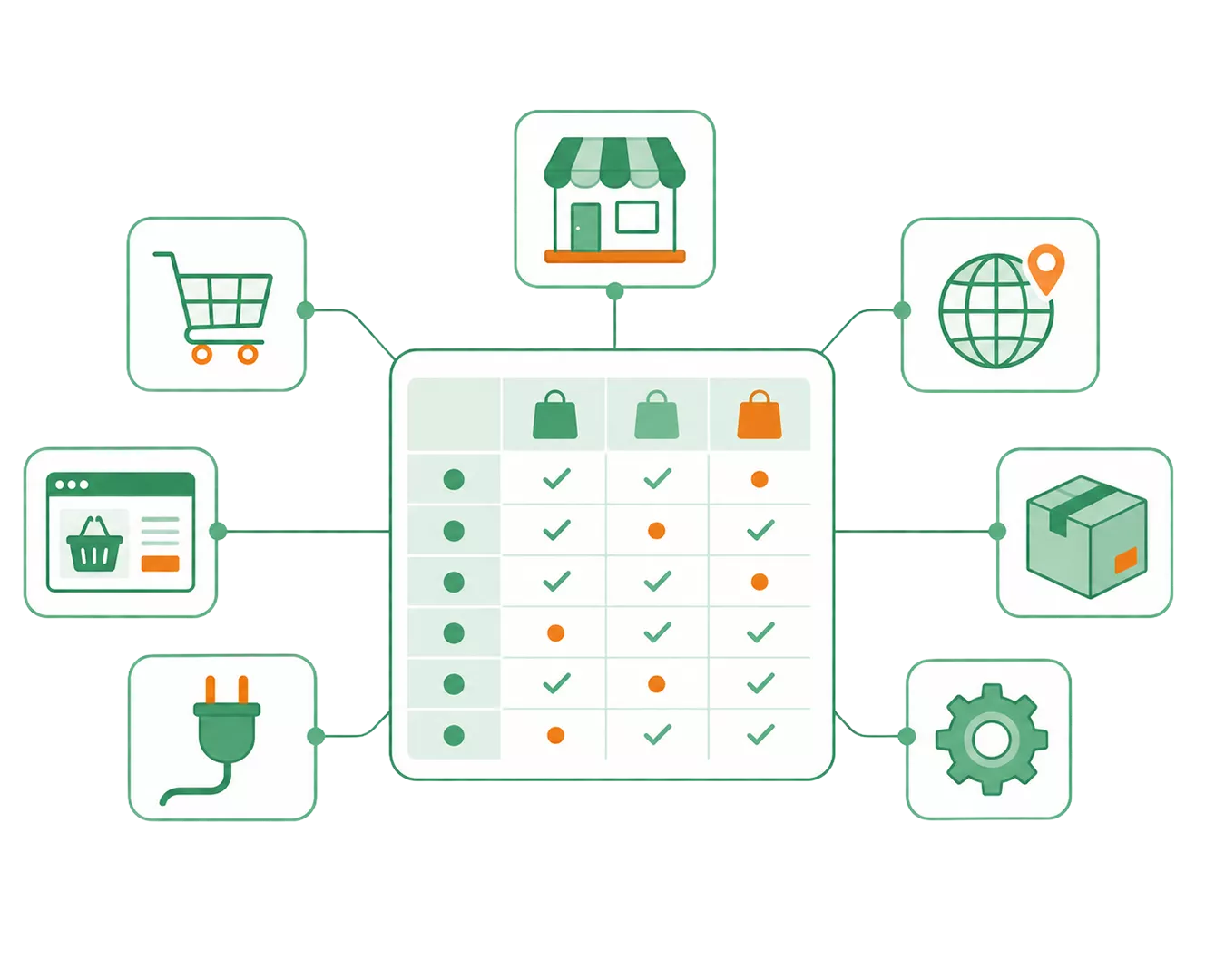
The choice of shop system decides cost, visibility and how fast you can grow, often for years. Yet most comparisons rest on marketing promises. We take a different route: a large part of the values in this comparison comes from our own data studies based on millions of real shops, not gut feeling.

How Store2x compares

  • SEO setup & AI readiness come from our studies based on HTTP Archive (as of 08/2026): how well each system is set up technically by default, and how visible its shops are to ChatGPT & co.
  • Cost & quality axes are based on researched prices and a structured assessment across six dimensions, each with a rationale.
  • Shopify runs as the benchmark, because most merchants migrate there, so you immediately see where your current system stands.

The five types of shop systems

SaaS / hosted

Platform, hosting and updates from one source (e.g. Shopify, BigCommerce). Little maintenance, predictable cost, less low-level freedom.

Website builder

Website builders with shop features (e.g. Wix, Squarespace, Webflow). Great for small shops and fast starts, limited at scale.

Self-hosted

You run the software yourself (e.g. WooCommerce, Shopware, JTL). Maximum freedom, but hosting, updates and security are on you.

Enterprise

Large, complex systems for enterprise requirements (e.g. Magento/Adobe, SAP, VTEX). Powerful, but expensive and maintenance-heavy.

Headless

Pure commerce engines without a fixed frontend (e.g. commercetools, Spryker). For custom architectures with your own dev team.

Which is the best shop system in 2026?

Pick the systems you care about and sort by what matters to you, from cost and SEO setup to quality.

Select up to 3 systems to compare (checkbox in the header).

0/3 selected
Criterion
Best overall
Shopify
Shopify
Best design
Squarespace
Squarespace
Best website builder
Wix
Wix
Jimdo
Jimdo
Webflow
Webflow
Most flexible
WooCommerce
WooCommerce
BigCommerce
BigCommerce
Etsy
Etsy
Volusion
Volusion
Best self-hosted
Shopware
Shopware
PrestaShop
PrestaShop
OpenCart
OpenCart
VTEX
VTEX
Plentymarkets
Plentymarkets
Gambio
Gambio
Contao
Contao
JTL
JTL
OXID
OXID
OroCommerce
OroCommerce
Magento / Adobe Commerce
Magento/Adobe
Best enterprise
commercetools
commercetools
Spryker
Spryker
SAP Commerce
SAP Commerce
Overview
Category SaaS / hosted Website builder Website builder Website builder Website builder Self-hosted SaaS / hosted Marketplace SaaS / hosted Self-hosted Self-hosted Self-hosted Enterprise SaaS / hosted Self-hosted Self-hosted Self-hosted Self-hosted Enterprise Enterprise Headless Headless Enterprise
Hosting Hosted (SaaS) Hosted (SaaS) Hosted (SaaS) Hosted (SaaS) Hosted (SaaS) Self-hosted Hosted (SaaS) Hosted (SaaS) Hosted (SaaS) Self-hosted Self-hosted Self-hosted Hosted (SaaS) Hosted (SaaS) Self-hosted Self-hosted Self-hosted Self-hosted Self-hosted Self-hosted Hosted (SaaS) Self-hosted Hosted (SaaS)
from €/month €36 €36 €30 €17 €42 €0 * €35 €0 €35 €0 * €0 * €0 * €2000 €200 €45 * €0 * €0 * €0 * €0 * €0 * €3000 €2500 * €4000
Data from our studies
SEO-Setup 91.3 % 99.7 % 99.5 % n/a 58.2 % 83.5 % 38.3 % n/a 23.9 % 73.5 % 49.9 % 51.8 % 73.4 % 99 % 82.1 % n/a 65.8 % n/a n/a 47.4 % n/a n/a 59.8 %
KI-Readiness 87.4 % 49.6 % 99 % n/a 63.6 % 84.2 % 14.1 % n/a 3.2 % 54.9 % 72.8 % 70.1 % 85.2 % 85.5 % 94.7 % n/a 46.2 % n/a n/a 62.3 % n/a n/a 56.4 %
Core Web Vitals 81.8 % 78.1 % 81.4 % 96.6 % 73.4 % 45.6 % 69.2 % n/a 46 % 87 % 65.7 % 81.3 % 5.6 % 47.1 % 91 % 82.8 % 89.5 % 81.4 % n/a 51.9 % n/a n/a 42.6 %
Accessibility 42.3 % 76.3 % 80.2 % n/a 59.4 % 31.4 % 31.4 % n/a n/a 33.4 % 17 % 15.6 % 6.7 % n/a n/a 43.5 % 45.7 % 30.6 % n/a 20.9 % n/a n/a 24 %
Market growth +20.9 % +1.3 % +16.6 % -19.2 % +13.9 % -7.4 % -15.7 % n/a -38.8 % -28.6 % -23.2 % -7.4 % -18.4 % -24.2 % -24 % -7.9 % -30.5 % -39.1 % n/a -27.6 % n/a n/a -19.7 %
Quality (1–5, 5 = best)
Cost efficiency 4/5 4/5 4/5 5/5 3/5 4/5 3/5 2/5 3/5 3/5 4/5 4/5 2/5 2/5 3/5 3/5 3/5 2/5 2/5 1/5 1/5 1/5 1/5
Scalability 5/5 2/5 2/5 1/5 2/5 3/5 4/5 2/5 2/5 4/5 3/5 3/5 5/5 4/5 2/5 2/5 3/5 4/5 4/5 5/5 5/5 5/5 5/5
Ease of use 5/5 5/5 5/5 5/5 4/5 3/5 3/5 5/5 3/5 3/5 3/5 3/5 2/5 2/5 3/5 2/5 2/5 2/5 2/5 2/5 1/5 1/5 1/5
Low maintenance 5/5 5/5 5/5 5/5 5/5 2/5 4/5 5/5 5/5 2/5 2/5 2/5 3/5 3/5 2/5 2/5 2/5 2/5 2/5 1/5 2/5 1/5 1/5
Content management 4/5 4/5 3/5 2/5 5/5 5/5 3/5 1/5 2/5 4/5 3/5 2/5 3/5 3/5 3/5 4/5 3/5 3/5 3/5 4/5 3/5 3/5 3/5
Time to market 5/5 5/5 5/5 5/5 4/5 3/5 3/5 5/5 4/5 2/5 3/5 3/5 2/5 2/5 3/5 3/5 2/5 2/5 2/5 1/5 1/5 1/5 1/5

SEO setup, AI readiness, Core Web Vitals, accessibility & market growth come from our own store2x studies (HTTP Archive, 2026). Quality axes: structured assessment with rationale (per-cell tooltip). Prices = entry level excluding transaction fees, * plus hosting.

Sources: Performance study (Core Web Vitals) · SEO setup study · AI readiness study · Accessibility study · Market share study · HTTP Archive (data basis)

Our winners 2026

There is no single best shop system for everyone, it depends on your needs. That is why we pick a winner per category.

Best overall
Shopify

Shopify wins because it is the only system that combines technical excellence, freedom from maintenance and reach. It scales from the first sale to enterprise without a replatform, fully takes on hosting, security and updates, and ships the strongest technical SEO and AI base by default, proven across more than 700,000 shops.

See details →
Best self-hosted
Shopware

Among self-hosted systems, Shopware offers the best balance of flexibility and substance. Full data control, deeply customisable shopping experiences and particular strength in B2B mid-market make it the first choice when a team can run the system long-term.

See details →
Best website builder
Wix

Wix is the strongest website builder because it combines a fast, simple start with a surprisingly complete SEO and AI setup. Small shops are live within hours and ship technical basics that many larger systems do not provide by default.

See details →
Most flexible
WooCommerce

WooCommerce wins on flexibility because the huge WordPress ecosystem has an extension for practically any requirement. Anyone wanting maximum customisability and content strength, and willing to carry hosting and maintenance themselves, gets furthest here.

See details →
Best design
Squarespace

Squarespace delivers the most design-led templates in the field and a very clean technical SEO setup out of the box. For brand-focused, design-conscious shops it is the most beautiful base, provided you deliberately lift the AI crawler block.

See details →
Best enterprise
commercetools

commercetools wins in the enterprise segment as the leading composable commerce system. It fully separates frontend and commerce logic, scales almost without limit and adapts to custom architectures, ideal for large merchants with their own dev team.

See details →

Every system in detail

Click your shop system to get the overview: a short description, pros and cons, suitable alternatives and further reading.

Pick your shop system for the detailed overview:

Shopify

Shopify

SaaS / hosted Best overall

Hosted all-in-one platform that fully takes care of hosting, security and updates. It scales from the first sale to enterprise (Shopify Plus) without a replatform and ships a strong technical SEO and AI base by default.

Pros

  • Scalability: Scales from first sale to Shopify Plus without switching systems
  • Ease of use: Clean dashboard, no technical know-how required
  • Low maintenance: Automatic updates, no server maintenance
  • Time to market: Live in days instead of weeks

Cons

  • Kosten: Transaction fee without Shopify Payments, and app costs add up over time.
  • Cost efficiency: Predictable; apps add up but no hosting/maintenance

Suitable alternatives

Further reading:

What really matters when choosing

Cost efficiency

What does the system really cost, including hosting, maintenance and extensions? Hosted platforms are more predictable, self-hosted systems carry hidden follow-up costs.

Scalability

Does the system still hold up under strong growth, more traffic and more orders, without rebuilding the infrastructure?

Ease of use

How quickly can your team and editors work with it, without constantly needing developers?

Low maintenance

How much ongoing effort goes into updates, security and operations? This is exactly where self-hosted systems tie up time.

Content management

How well can you maintain content, landing pages and SEO copy, without workarounds?

Time to market

How fast is a sellable shop live, from start to first sale?

How to choose the right shop system

The best choice depends less on feature count than on the question of how much technology you want to carry yourself. Roughly: the more you want to focus on product, marketing and growth, the more a hosted platform pays off, one that takes on hosting, updates and the technical SEO base. If you need maximum individuality and full data control and have a team for it, a self-hosted or headless system is more flexible.

Three questions bring the most clarity: how fast do you want to grow? (scaling without a replatform), how much technical team do you have? (maintenance effort) and how important is organic visibility? (SEO and AI readiness by default). Those are exactly the axes our table above maps.

What makes a good shop system for SEO

A large part of the SEO starting position is a question of the system, not the budget. A good shop system ships clean technical SEO by default: structured data (JSON-LD) for rich results and AI answers, correct canonicals against duplicate content, a declared sitemap and fast loading (Core Web Vitals). This is exactly where systems diverge, as our studies show.

A new addition is AI readiness: for a shop to appear in answers from ChatGPT or Perplexity, the system must allow AI crawlers and deliver machine-readable data. Some platforms block AI crawlers by default, others provide nothing readable. Anyone betting on visibility today should keep both in mind, not just classic SEO.

SaaS or self-hosted: which fits you?

The fundamental decision is the operating model. With SaaS platforms (e.g. Shopify, BigCommerce), hosting, security, updates and scaling are part of the product. You pay a predictable fee and can focus on selling and growth, but you give up some control at the code level. Self-hosted systems (e.g. Shopware, WooCommerce, JTL) are entirely yours: maximum freedom and full data control, but servers, performance, security and maintenance are on you or your agency.

As a rule of thumb: for most growing shops without their own dev team, a hosted platform is the more pragmatic route because it takes on the ongoing technical topics. A self-hosted or headless system pays off when you need to map very specific processes and have the resources to run the system long-term.

What a shop system really costs

The licence or plan price is only the tip of the iceberg. The real cost is made up of hosting, maintenance and updates, extensions or apps, transaction fees, plus development and agency effort. Especially with “free” open-source systems, the actual cost arises in operation, because hosting, security and ongoing upkeep have to be paid for. That is why our cost axis in the table deliberately reflects total cost, not just the entry price.

When switching shop systems pays off

A replatform is a project you should not take on lightly, but there are clear signals: when performance and loading time stay poor despite optimisation, when maintenance and updates eat up more and more time, when required features are only possible with expensive workarounds, or when organic and AI visibility structurally suffers. Often, switching to a hosted platform is then cheaper than permanently fighting the old system. The key is to plan the switch SEO-safely, so rankings and data are preserved.
Why most merchants switch to Shopify

Across all categories the same pattern shows: hosted platforms take hosting, maintenance and much of the technical SEO base off merchants' shoulders. Anyone hitting performance, maintenance or visibility limits today gains reliable foundations by switching to Shopify, without wrestling with servers and updates. How that works without data or ranking loss, we show for each system.