OXID vs Shopify: Direct Comparison 2026
OXID vs Shopify in direct comparison. Costs, B2B, hosting and maintenance. Find out which shop system fits your store.

Richard Roth
SEO & GEO Strategist
July 27, 2026
8 min read
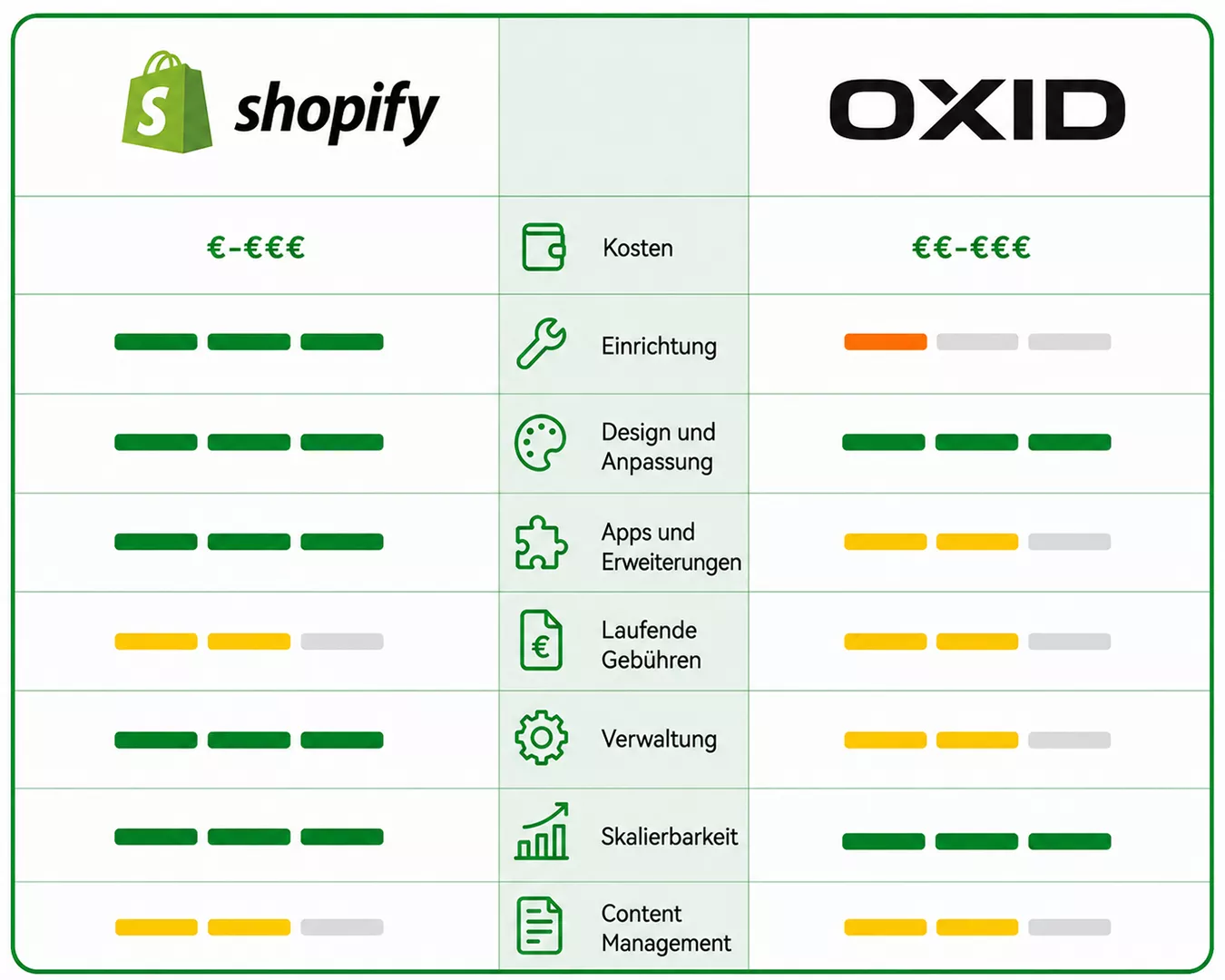
You’re facing a decision: OXID or Shopify? OXID eSales is a self-hosted shop system with a strong B2B focus in the German-speaking market, Shopify a cloud-based all-in-one solution. We compare both from practical experience and show you what really matters in the decision. For an overview of more systems, check out our shop system comparison.
- • OXID is a self-hosted shop system, strong in DACH B2B. The Community Edition is free, Professional and Enterprise Edition are licensed.
- • Shopify is a cloud-based SaaS platform. Hosting, updates, and security are included, and you can start right away.
- • OXID's big strength is native B2B with customer groups and tiered prices.
- • The good news: B2B can also be mapped on Shopify, natively via Shopify B2B (on Shopify Plus) or via apps, without the operational overhead of OXID.
Shopify and OXID: cloud versus self-hosted DACH B2B
Before we get into the details, you should understand that both systems follow fundamentally different approaches.
OXID eSales is self-hosted and, in the German-speaking market, mainly used in the B2B mid-market. It offers deep customizability, native B2B, and full control, but requires your own hosting, license costs for the higher editions, and a developer or agency team for operation and upgrades.
Shopify is a fully hosted SaaS solution. You sign up, pick a theme, and sell. You don’t have to worry about servers, updates, or security. The trade-off is clear: OXID offers maximum control and B2B depth, Shopify maximum peace of mind and speed.

On the dev side, OXID’s B2B in the PE and EE editions is solid, but the customer groups and tiered pricing most mid-market shops actually run map neatly onto Shopify B2B on Plus. Where I’ve seen OXID genuinely earn its license is deeply idiosyncratic pricing logic that was custom-coded over years. Before recommending a move I inventory those modules honestly: if the B2B rules are standard tiers and protected areas, the OXID upgrade and hosting overhead is buying you very little.
Cost comparison: what do you really pay?
The OXID Community Edition is free, but the total costs are elsewhere.
OXID costs
The Community Edition is free, but for serious B2B you usually need the Professional or Enterprise Edition, which are licensed (roughly from several hundred euros per month). On top come your own hosting (about €60 to €120 per month), expensive version upgrades, and ongoing agency care.
So the free edition is the entry point, not the whole picture. In total, OXID creates high, partly fluctuating overall costs.
Shopify costs
Shopify works with a clear pricing model. The Basic plan costs about €36 per month with annual billing, higher plans are about €105 and €384. For native B2B, Shopify Plus is an option. Included are hosting, SSL, support, and the entire operation.
The costs are predictable and include everything you’d have to handle yourself with OXID.
Cost comparison in practice
| Cost type | OXID | Shopify |
|---|---|---|
| License | CE free, PE/EE licensed | from ~€36/month |
| Hosting | €60 to €120 | included |
| Updates & maintenance | agency or in-house | included |
| Version upgrades | costly, sometimes expensive | automatic |
| B2B | native (PE/EE) | Shopify B2B (Plus) / apps |
With OXID, always include hosting, maintenance, upgrades, and agency effort alongside the license. Only then do you have a fair comparison to Shopify’s predictable costs, which include the entire operation.
How important is B2B?
This is often the core of the decision, because B2B is OXID’s actual strength.
In the higher editions, OXID offers native B2B: customer groups, individual prices, tiered pricing, and protected areas. Many mid-market companies have built their sales processes around this, which is a real argument.
The decisive message: you don’t have to give up this B2B when you switch to Shopify. Via Shopify B2B (on Shopify Plus) or proven wholesale apps, we map customer groups, tiered prices, and individual terms, without the operational overhead of a self-hosted platform.
Hosting, updates, and operation
This is one of the biggest differences between the two platforms.
Shopify is fully hosted. Updates are applied automatically, security is handled by Shopify, and the infrastructure scales with your traffic. You add new features through the App Store with over 16,000 apps.
OXID requires your own hosting and active upkeep. You’re responsible for servers, performance, security, and backups yourself. In particular, the version upgrades are often costly projects with developer time and budget in OXID. With Shopify, this effort disappears entirely.
SEO and performance
Both platforms offer solid SEO fundamentals. OXID uses readable SEO URLs, and meta titles and descriptions are customizable.
On performance, OXID depends heavily on your hosting and configuration. Good scores require know-how and ongoing upkeep. Shopify delivers fast loading times worldwide via its global CDN infrastructure, without you having to worry about caching or server optimization. Fast loading times directly affect rankings and conversion.
When is OXID the better choice?
OXID makes sense if you:
- Need very custom, deep B2B with complex customer groups and terms
- Require full control over code and infrastructure
- Have your own developer team or an agency for operation and upgrades
- See the deep adaptability to very specific processes as central
OXID plays to its strengths when highly custom B2B in the DACH mid-market is at the center and you have the technical resources for it.
When is Shopify the better choice?
Shopify makes sense if you:
- Want a maintenance-free platform without server and update worries
- No longer want to carry expensive version upgrades and license costs
- Prefer predictable monthly costs over fluctuating total costs
- Need B2B but want to map it without operational overhead via Shopify B2B
- Want to go live faster and focus on selling
Shopify is usually the better choice when you need B2B features but want to avoid the overhead of OXID.
Switching from OXID to Shopify
Maybe you already use OXID and are wondering whether a switch makes sense, especially when license, hosting, and upgrade costs increase. You’re not alone: our market share analysis recorded a decline of 39.1% in live OXID shops between 2024 and 2026, one of the steepest of all tracked systems, while Shopify grew by 20.9%.
The migration from OXID to Shopify is very doable. Products, variants, customer groups, tiered prices, and order history are transferred, your B2B is mapped to Shopify B2B or suitable apps, and all SEO URLs are redirected via a seamless redirect map. This keeps your rankings and your customer-specific prices intact.
With the right concept, you use the migration as an opportunity: away from license and operating costs, toward a maintenance-free platform with B2B. We at Store2x specialize in exactly these migrations to Shopify. If you’re considering whether a switch makes sense for you, you can request a free potential analysis.
Conclusion
OXID or Shopify? The answer depends on your B2B requirements and your resources. If you run highly custom B2B with your own dev team, OXID has its place. If you want a maintenance-free, predictable platform and can also map your B2B via Shopify B2B, Shopify is the better choice for most, with significantly less operational overhead.
 Frequently Asked Questions
 Can I map my OXID B2B on Shopify?
Is OXID really free?
Will my rankings be preserved when switching to Shopify?
What happens to my OXID modules?
How long does the migration from OXID to Shopify take?
You might also like
Gambio or Shopify? A Direct Comparison 2026
Gambio vs Shopify in a direct comparison: costs, maintenance, performance, features and SEO. Find out which system fits your store.
Volusion vs Shopify: Direct Comparison 2026
Volusion vs Shopify in direct comparison. Costs, checkout, app ecosystem and future-proofing. Find out which platform fits your store.
OpenCart vs Shopify: Direct Comparison 2026
OpenCart vs Shopify in direct comparison. Costs, hosting, extensions and maintenance. Find out which shop system fits your store.