
Key takeaway
Hosted platforms deliver reliably good Core Web Vitals, while the typical migration sources WooCommerce and Magento lag clearly behind.
Below you will find the detailed results, a table covering all 19 systems, the methodology and the data as a CSV download.
How fast is a shop really, depending on which system it runs on? For this report we combined the shop-system detection of the HTTP Archive with field data from real Chrome users (Chrome UX Report) and calculated, for 19 common shop systems, how many of their shops pass Google's Core Web Vitals, as of July 2026. Core Web Vitals are a Google ranking factor and a direct conversion lever, so the results are real money.
The key results
- It is not simply "SaaS good, self-hosted bad": well-maintained systems like Shopware (87%), JTL (89.5%) and Gambio (91%), plus the lightweight builder Jimdo (96.6%), actually beat Shopify on Core Web Vitals.
- The typical migration sources are at the bottom: WooCommerce (45.6%) and Magento (51.9%) pass the Core Web Vitals least often, mainly due to weak loading (WooCommerce good LCP only 48.7%).
- Shopify delivers 81.8% good Core Web Vitals, across more than 352,000 analysed shops (by far the largest sample) and out of the box, without any performance work.
- VTEX is the big outlier: only 5.6% of shops pass the Core Web Vitals (good loading at just 9.9%).
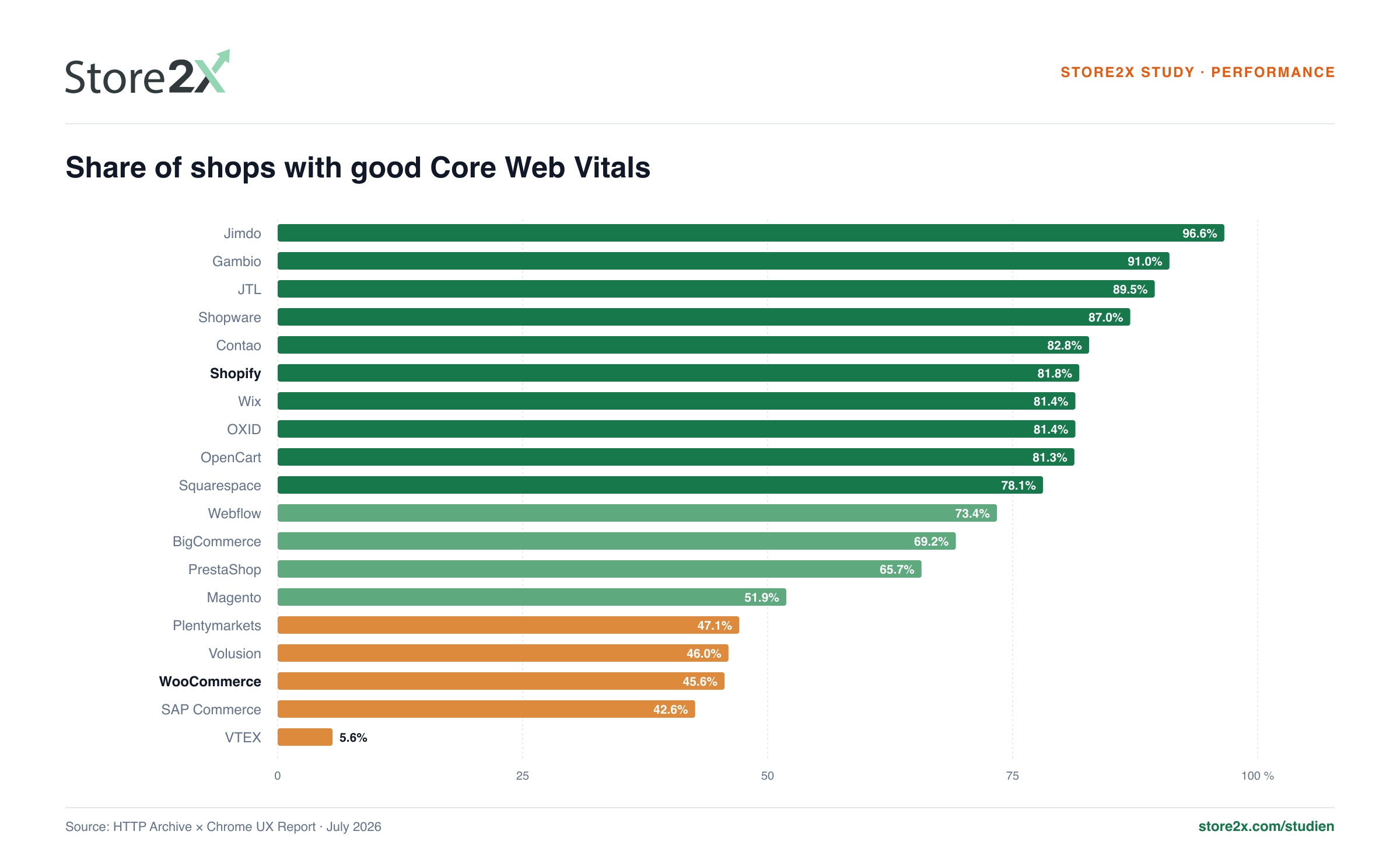
Performance by shop system
| Shop system | Good CWV | Good loading (LCP) | INP | CLS | Shops (n) |
|---|---|---|---|---|---|
| Jimdo | 96.6% | 98.3% | 99.1% | 98.7% | 16,074 |
| Gambio | 91.0% | 93.0% | 98.8% | 98.8% | 1,293 |
| JTL | 89.5% | 92.7% | 98.4% | 97.4% | 2,676 |
| Shopware | 87.0% | 91.3% | 98.7% | 95.9% | 6,786 |
| Contao | 82.8% | 90.3% | 95.5% | 94.9% | 7,231 |
| Shopify | 81.8% | 89.0% | 92.4% | 95.1% | 352,499 |
| Wix | 81.4% | 85.7% | 94.1% | 98.3% | 87,827 |
| OXID | 81.4% | 90.7% | 94.6% | 93.8% | 808 |
| OpenCart | 81.3% | 85.8% | 97.0% | 95.1% | 15,580 |
| Squarespace | 78.1% | 83.4% | 98.3% | 93.0% | 66,147 |
| Webflow | 73.4% | 78.0% | 94.5% | 95.5% | 6,512 |
| BigCommerce | 69.2% | 87.8% | 97.9% | 77.9% | 9,682 |
| PrestaShop | 65.7% | 75.3% | 93.3% | 89.9% | 40,470 |
| Magento | 51.9% | 62.9% | 90.8% | 78.2% | 28,542 |
| Plentymarkets | 47.1% | 84.3% | 99.2% | 52.6% | 662 |
| Volusion | 46.0% | 57.6% | 90.0% | 90.7% | 568 |
| WooCommerce | 45.6% | 48.7% | 94.8% | 92.4% | 416,199 |
| SAP Commerce | 42.6% | 68.6% | 81.6% | 62.9% | 1,670 |
| VTEX | 5.6% | 9.9% | 52.0% | 34.7% | 3,078 |
Cite this study
Our studies are free to use, including by media and in commercial articles.
We only ask that you credit Store2x by name and link to the original study, so readers can check the methodology.
Store2x (2026): Shop System Performance Report 2026: Core Web Vitals of 19 Shop Systems Compared. Data basis: HTTP Archive × Chrome UX Report, July 2026. https://store2x.com/en/studies/core-web-vitals-shop-system-comparison/
Licence: CC BY 4.0
What this means for your shop
The difference comes from loading. INP and CLS are good on almost all systems, and the ranking is decided by load time (LCP). If you want to improve performance, work on loading, not on interactivity.
A fast Shopware or JTL reaches its numbers through good hosting and development work. Shopify delivers comparable numbers hosted and maintenance-free.
For choosing a platform this means: performance is not a given for any category. What matters is whether the system, its hosting and the implementation keep loading under control. That is exactly why a few well-kept self-hosted systems sit ahead of some hosted platforms.
For the systems most merchants move away from, though, the picture is clear: WooCommerce and Magento are among the slowest. Anyone hitting performance limits there gains reliably good Core Web Vitals with a hosted platform like Shopify, without having to tune servers, caching and themes. Because Core Web Vitals feed into both rankings and conversion, that pays off twice on revenue.
Related tool
Compare your shop system directly with Shopify →
3-year costs, strengths and your biggest levers in the free calculator.
 Frequently asked questions
 Which shop system has the best Core Web Vitals performance?
Why do WooCommerce and Magento perform so poorly?
How was this measured?
Sources & methodology
This is our own analysis: we combined the shop-system detection of the HTTP Archive (which shop system a domain uses) with field data from the Chrome UX Report (CrUX), as of July 2026, mobile users. A shop counts as "good" when its 75th percentile is LCP <= 2.5 s, INP <= 200 ms and CLS <= 0.1, and it has data for all three metrics. For website builders (Wix, Squarespace, Webflow) we use their ecommerce variant so only real shops are included; different editions (e.g. OXID, plentymarkets) are combined. Systems with a very small sample (Spryker, commercetools, OroCommerce) were deliberately excluded. All values are a snapshot and change with new CrUX data.
- Chrome UX Report (CrUX) – Google field data from real users
- HTTP Archive – technology detection & data
- Google: Core Web Vitals (definition & thresholds)
Conducted by

Richard Roth
SEO & GEO Strategist

Till Täubrich
Shopify Development & Migration
Research and analysis by the team at store2x, specialists in Shopify migration and SEO.