Key takeaway
Some platforms lock out AI crawlers almost across the board by default, others give them nothing readable. Only systems that combine access and machine-readability are truly AI-ready.
Below you will find the detailed results, a table covering all 34 systems, the methodology and the data as a CSV download.
For a shop to appear in AI answers from ChatGPT, Perplexity or Google, two things have to be right: the AI crawlers must be allowed in at all (robots.txt), and they must find machine-readable content (structured data). For this report we measured both for 34 shop systems, how many of their shops allow AI bots such as GPTBot, ClaudeBot and PerplexityBot, and how many ship structured data (JSON-LD). The basis is real shops from HTTP Archive, as of August 2026. The result is surprisingly clear: some platforms block AI crawlers almost across the board by default, others give them nothing readable, and only a few are genuinely ready on both axes.
The key results
- AI readiness has two conditions: the AI crawler must be allowed in, and it must find structured data. Only a few systems are strong on both axes, led by Wix (score 99.0) and Shopify (87.4).
- The most surprising finding: Squarespace blocks AI crawlers on 99.7% of its shops via a default robots.txt. That makes over 237,000 shops effectively invisible to ChatGPT and Perplexity, even though they ship the best structured data in the field at 99.0%.
- BigCommerce (94.0% blocked) and Volusion (99.5%) also lock out AI crawlers by default. Anyone selling there barely appears in AI answers, without noticing.
- Shopify, by contrast, allows AI crawlers almost everywhere: only 2.2% of shops block them, WooCommerce 7.1%, Wix just 0.6%.
- The other weakness is missing machine-readability: ePages (94.6% AI access but only 0.5% structured data) and Shopware (94.7% / 15.0%) do let the AI in, but offer it almost nothing readable.
- For visibility in AI search, the combination is what counts. After a switch to Shopify, shops are both accessible and machine-readable by default.
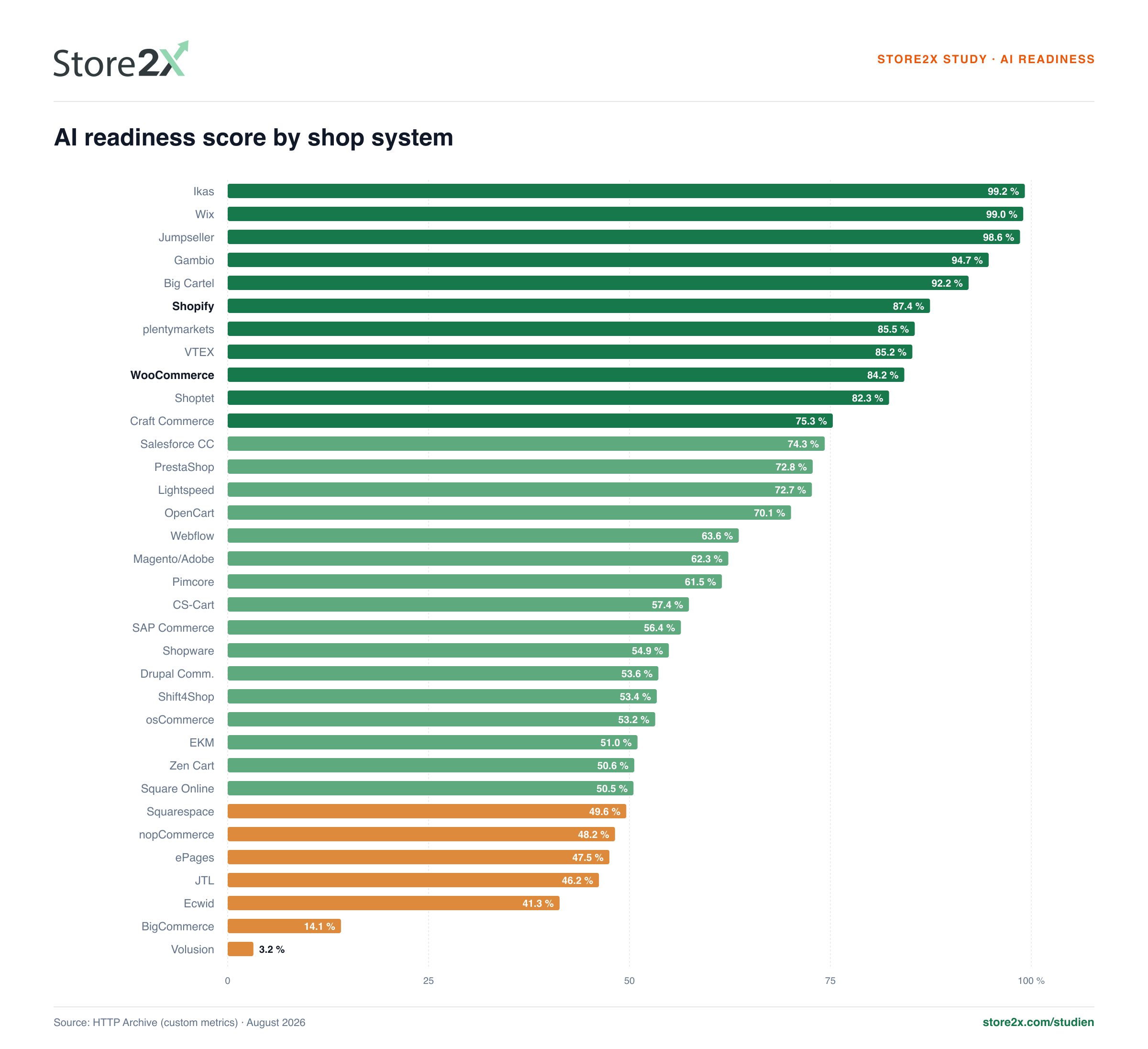
AI readiness by shop system
| Shop system | AI readiness score | AI crawlers allowed | Structured data (JSON-LD) | Shops (n) |
|---|---|---|---|---|
| Ikas | 99.2 % | 98.3 % | 100.0 % | 4,547 |
| Wix | 99.0 % | 99.4 % | 98.6 % | 281,109 |
| Jumpseller | 98.6 % | 98.9 % | 98.3 % | 3,366 |
| Gambio | 94.7 % | 97.1 % | 92.3 % | 3,181 |
| Big Cartel | 92.2 % | 84.5 % | 100.0 % | 2,471 |
| Shopify | 87.4 % | 97.8 % | 77.1 % | 706,482 |
| plentymarkets | 85.5 % | 71.4 % | 99.6 % | 1,034 |
| VTEX | 85.2 % | 92.6 % | 77.9 % | 3,528 |
| WooCommerce | 84.2 % | 92.9 % | 75.6 % | 986,946 |
| Shoptet | 82.3 % | 98.2 % | 66.4 % | 14,697 |
| Craft Commerce | 75.3 % | 84.1 % | 66.5 % | 847 |
| Salesforce Commerce Cloud | 74.3 % | 91.2 % | 57.4 % | 3,981 |
| PrestaShop | 72.8 % | 88.7 % | 57.0 % | 74,248 |
| Lightspeed | 72.7 % | 98.2 % | 47.2 % | 5,425 |
| OpenCart | 70.1 % | 91.4 % | 48.7 % | 31,945 |
| Webflow | 63.6 % | 95.1 % | 32.2 % | 15,377 |
| Magento / Adobe Commerce | 62.3 % | 76.0 % | 48.6 % | 43,964 |
| Pimcore | 61.5 % | 94.1 % | 28.9 % | 3,345 |
| CS-Cart | 57.4 % | 85.7 % | 29.1 % | 4,022 |
| SAP Commerce | 56.4 % | 72.1 % | 40.8 % | 2,249 |
| Shopware | 54.9 % | 94.7 % | 15.0 % | 12,385 |
| Drupal Commerce | 53.6 % | 92.6 % | 14.6 % | 973 |
| Shift4Shop | 53.4 % | 98.8 % | 8.1 % | 1,616 |
| osCommerce | 53.2 % | 82.4 % | 23.9 % | 2,536 |
| EKM | 51.0 % | 99.9 % | 2.1 % | 1,107 |
| Zen Cart | 50.6 % | 85.4 % | 15.7 % | 952 |
| Square Online | 50.5 % | 100.0 % | 0.9 % | 23,907 |
| Squarespace | 49.6 % | 0.3 % | 99.0 % | 237,340 |
| nopCommerce | 48.2 % | 88.8 % | 7.7 % | 5,270 |
| ePages | 47.5 % | 94.6 % | 0.5 % | 4,551 |
| JTL | 46.2 % | 73.7 % | 18.7 % | 5,227 |
| Ecwid | 41.3 % | 43.3 % | 39.4 % | 7,969 |
| BigCommerce | 14.1 % | 6.0 % | 22.1 % | 16,906 |
| Volusion | 3.2 % | 0.5 % | 5.9 % | 1,308 |
Cite this study
Our studies are free to use, including by media and in commercial articles.
We only ask that you credit Store2x by name and link to the original study, so readers can check the methodology.
Store2x (2026): AI Readiness of Shop Systems 2026: Which Shops Are Visible to ChatGPT and Perplexity. Data basis: HTTP Archive (custom metrics), August 2026. https://store2x.com/en/studies/ai-readiness-shop-systems/
Licence: CC BY 4.0
What this means for your shop
For visibility in AI systems this means: having good content is not enough. If the robots.txt locks out GPTBot, ClaudeBot or PerplexityBot, the AI never sees the shop in the first place, and that is exactly what happens on Squarespace, BigCommerce and Volusion by default, at scale.
Conversely, open access is of little use if there is nothing machine-readable. Systems like ePages and Shopware let the crawlers in but ship barely any structured data from which an AI could reliably derive products, prices and content.
Only systems that get both right by default are genuinely ready. Anyone betting on AI visibility is on the safe side with an open, machine-readable platform such as Shopify, rather than leaving one of the axes to a default configuration that is easy to overlook.
Related tool
Compare your shop system directly with Shopify →
3-year costs, strengths and your biggest levers in the free calculator.
 Frequently asked questions
 Which shop systems are best prepared for AI search?
Why is Squarespace poor for AI visibility despite good data?
How was this measured?
Sources & methodology
The basis is our own analysis of HTTP Archive data (as of August 2026, mobile crawls, the homepage of each shop). For AI access we analysed the robots.txt of each shop domain for whether known AI crawlers (including GPTBot, OAI-SearchBot, ChatGPT-User, ClaudeBot, Claude-User, PerplexityBot, Google-Extended, CCBot, Applebot-Extended, Meta-ExternalAgent) are disallowed by name; "AI crawlers allowed" is the share of shops without such a block. For machine-readability we checked whether structured data is present as JSON-LD. The AI readiness score is the average of both shares per system. The system attribution comes from HTTP Archive technology detection; we only include systems with at least 300 captured shops. The AI bot list is deliberately conservative, so the actual block rate may be higher rather than lower. All values are a snapshot.
- HTTP Archive – technology detection & custom metrics
- OpenAI: GPTBot and robots.txt
- Google: Google-Extended (controlling AI crawlers)
Conducted by

Richard Roth
SEO & GEO Strategist

Till Täubrich
Shopify Development & Migration
Research and analysis by the team at store2x, specialists in Shopify migration and SEO.