Key takeaway
Accessibility is patchy across all shop systems: website builders provide the best baseline, but the theme and implementation remain decisive, not the system alone.
Below you will find the detailed results, a table covering all 15 systems, the methodology and the data as a CSV download.
Since the European Accessibility Act (EAA) took effect, digital accessibility is no longer optional for many online shops but a legal requirement. But how accessible are shops today, depending on which system they run on? For this report we linked the shop system detection of the HTTP Archive with the automated Lighthouse accessibility checks and analysed, for 15 common shop systems, how well their shops score, as of June 2026. The result is sobering: no system delivers broadly accessible shops out of the box.
The key results
- Website builders lead: Wix and Squarespace reach a median score of 94 out of 100, Webflow 91. They deliver the best accessibility by default.
- Shopify sits solidly in the middle (median 88), level with JTL, ahead of WooCommerce (86), Shopware (85), Magento (81) and bottom-placed VTEX (77).
- Not a single system has a majority of fully passing shops: even for Wix, 80 percent reach a score of 90 or more, for Shopify it is 42 percent, for Magento only 21 and for VTEX 7 percent.
- By far the most common problem is insufficient colour contrast: depending on the system, 51 to 89 percent of shops fail the contrast check (WooCommerce 82.5 percent, PrestaShop 86.4 percent, OpenCart 88.7 percent).
- Next come unrecognisable link texts (48 to 86 percent) and missing image alt text (5 to 43 percent), both classic, easily fixable errors.
- Important context: Lighthouse only tests automatically and therefore covers only part of the WCAG criteria. A good score is a good foundation, but not proof of legal compliance.
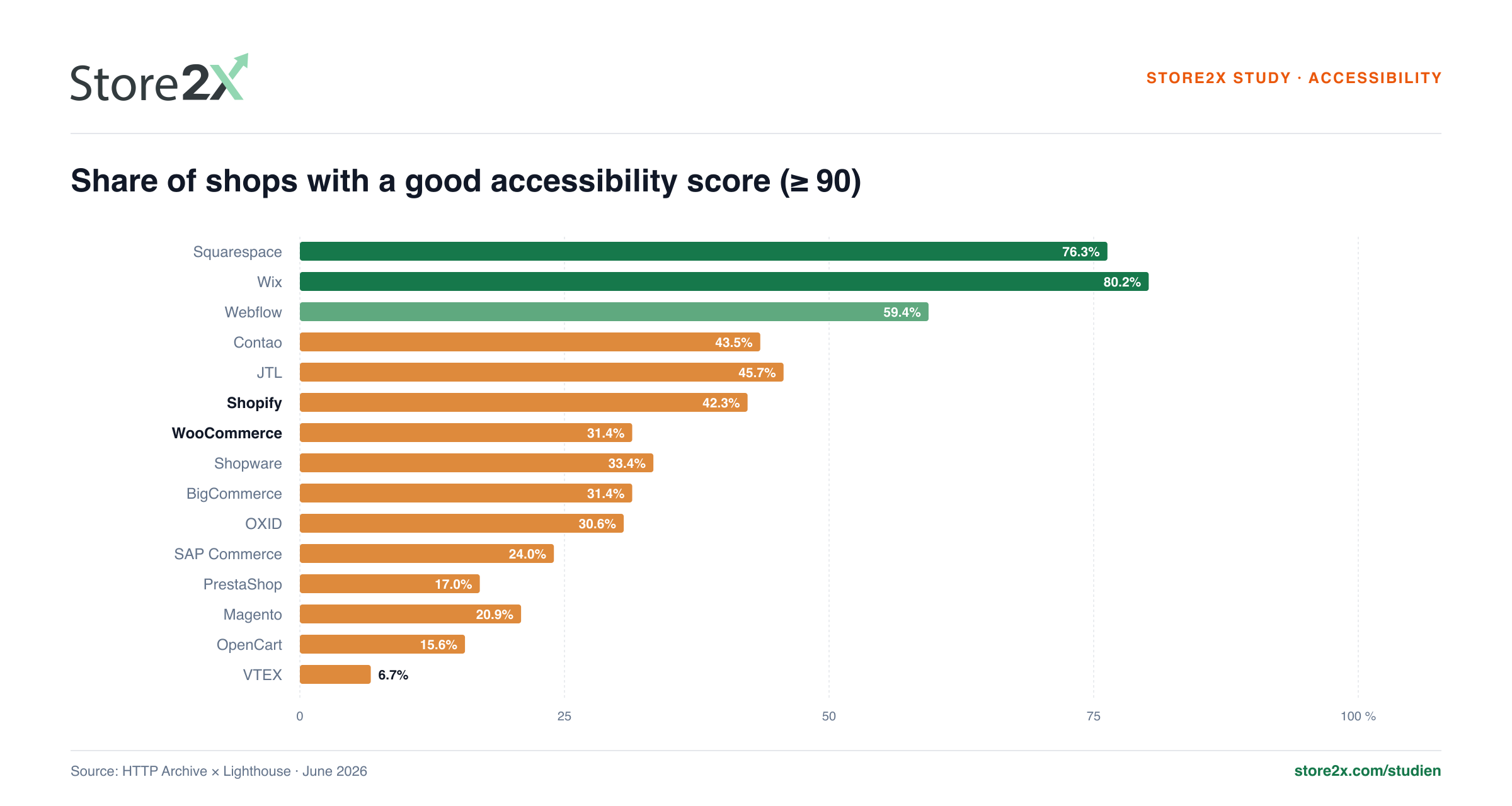
Accessibility by shop system
| Shop system | Median score | Score ≥ 90 | Contrast fails | Link-text fails | Shops (n) |
|---|---|---|---|---|---|
| Squarespace | 94 | 76.3% | 51.4% | 50.0% | 507 |
| Wix | 94 | 80.2% | 21.9% | 48.8% | 611 |
| Webflow | 91 | 59.4% | 70.3% | 70.9% | 340 |
| Contao | 88 | 43.5% | 71.2% | 64.0% | 191 |
| JTL | 88 | 45.7% | 72.4% | 58.4% | 486 |
| Shopify | 88 | 42.3% | 67.4% | 63.1% | 41,450 |
| WooCommerce | 86 | 31.4% | 82.5% | 77.1% | 21,108 |
| Shopware | 85 | 33.4% | 72.1% | 59.5% | 861 |
| BigCommerce | 85 | 31.4% | 71.0% | 71.1% | 1,589 |
| OXID | 84 | 30.6% | 66.2% | 62.5% | 216 |
| SAP Commerce | 82 | 24.0% | 61.0% | 62.2% | 649 |
| PrestaShop | 82 | 17.0% | 86.4% | 81.1% | 6,497 |
| Magento | 81 | 20.9% | 74.7% | 72.6% | 8,035 |
| OpenCart | 81 | 15.6% | 88.7% | 80.3% | 2,074 |
| VTEX | 77 | 6.7% | 73.2% | 85.5% | 1,463 |
Cite this study
Our studies are free to use, including by media and in commercial articles.
We only ask that you credit Store2x by name and link to the original study, so readers can check the methodology.
Store2x (2026): Accessibility in E-Commerce 2026: How Accessible Shop Systems Really Are. Data basis: HTTP Archive × Lighthouse, June 2026. https://store2x.com/en/studies/accessibility-shop-systems/
Licence: CC BY 4.0
What this means for your shop
The most important finding is not the ranking but the level: accessibility is patchy across all systems. There is a reason website builders like Wix and Squarespace lead. They constrain themes and components more tightly and leave less room for contrast and structure errors. Classic commerce systems with freely designable themes shift exactly this responsibility onto merchants and agencies.
In practice this means: the shop system is only the baseline, what matters is the theme, the templates and the actual implementation. That is precisely why a migration or relaunch is the ideal moment to build in accessibility from the start, rather than retrofitting it expensively later. The most common errors (contrast, link texts, alt text) are predictable and fixable with manageable effort.
Related tool
Compare your shop system directly with Shopify →
3-year costs, strengths and your biggest levers in the free calculator.
 Frequently asked questions
 Which shop system is the most accessible?
What is the most common accessibility error in online shops?
Does a good Lighthouse score make my shop legally compliant?
Sources & methodology
The basis is our own analysis: we linked the technology detection of the HTTP Archive with the Lighthouse results of the same dataset, as of June 2026, mobile crawl, home pages. We analysed shops that rank within the global top 1 million by CrUX rank, i.e. the higher-traffic shops per system; the real picture in the long tail is likely worse. The median score is the Lighthouse accessibility score (0 to 100). The failure rates indicate the share of shops that do not pass the respective WCAG-related check (among shops where the check applies). Systems with fewer than 150 analysable shops are excluded. Important: Lighthouse tests automatically and therefore captures only part of the WCAG success criteria. A good score does not prove a legally compliant, fully accessible offering; it is an indicator, not a certificate of conformance.
- European Accessibility Act (EAA)
- Lighthouse Accessibility – Scoring (Google)
- WCAG 2.1 – Web Content Accessibility Guidelines (W3C)
- HTTP Archive – technology detection & data
Conducted by

Richard Roth
SEO & GEO Strategist

Till Täubrich
Shopify Development & Migration
Research and analysis by the team at store2x, specialists in Shopify migration and SEO.