
Key takeaway
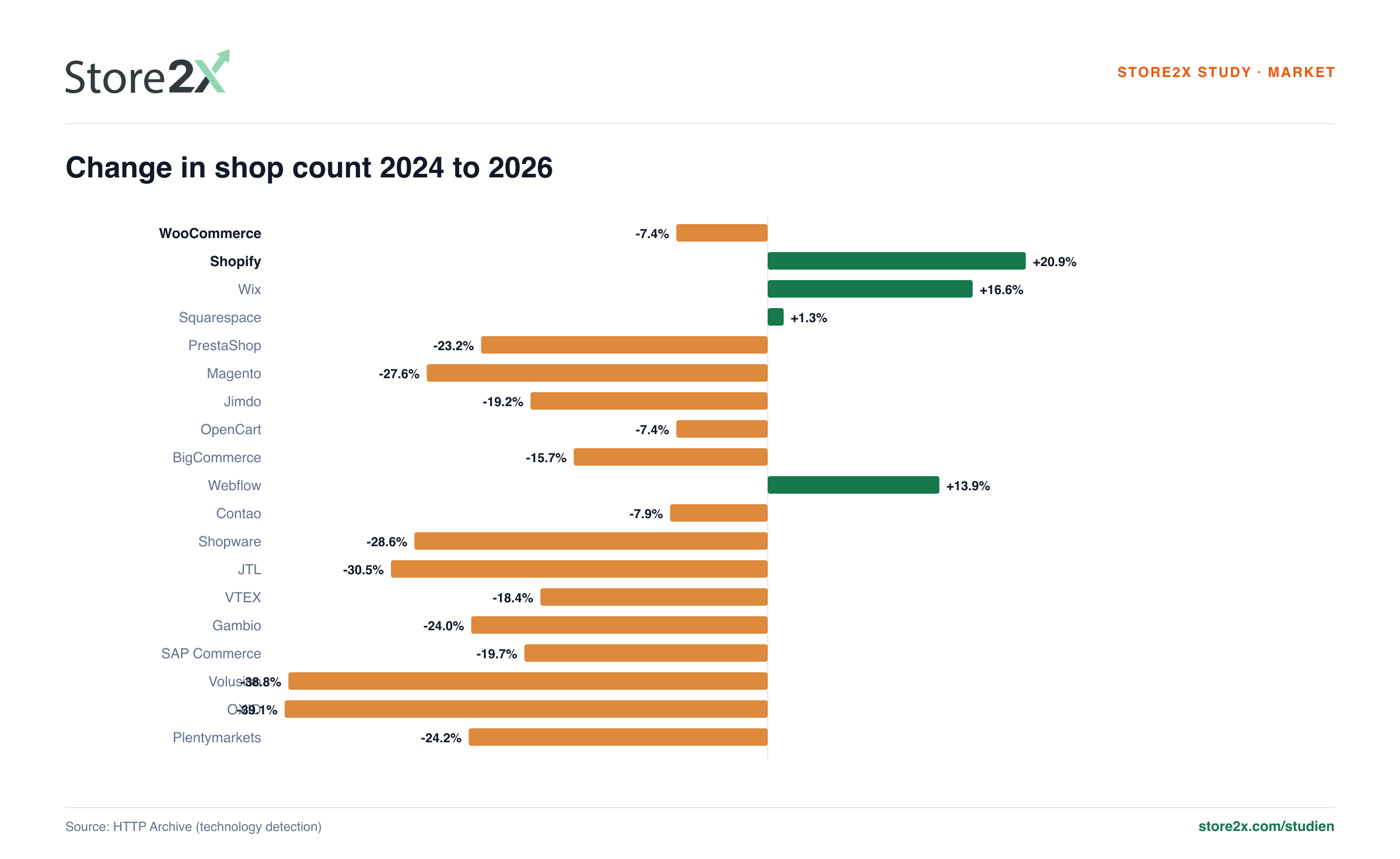
The market is consolidating towards hosted platforms: Shopify and Wix are growing, while WooCommerce, Magento and the classic self-hosted systems lose shops.
Below you will find the detailed results, a table covering all 19 systems, the methodology and the data as a CSV download.
Where is the shop system market heading? For this report we analysed the technology detection of the HTTP Archive and counted, for 19 common shop systems, how many active shops each one runs, year by year from June 2024 to June 2026. The result is a snapshot of the balance of power: WooCommerce leads by sheer volume, but the direction of travel is clear. Shopify and lean website builders are gaining, while the classic self-hosted systems lose shops year after year.
The key results
- Shopify is the clear winner: from 573,000 to 693,000 active shops in two years, up 20.9 percent (around 120,000 more shops).
- WooCommerce remains by far the most widespread system with over 1 million shops, but it is declining: down 7.4 percent since 2024.
- The typical migration sources are shrinking sharply: Magento down 27.6 percent, PrestaShop down 23.2 percent, OpenCart down 7.4 percent.
- The smaller self-hosted systems fall hardest: OXID down 39.1 percent, Volusion down 38.8 percent, JTL down 30.5 percent.
- Website builders do not all grow alike: Wix (up 16.6 percent) and Webflow (up 13.9 percent) are gaining, Squarespace is flat, Jimdo is losing (down 19.2 percent).
- The movement is directional: while Shopify gains around 120,000 shops, WooCommerce loses around 82,000, and almost every classic self-hosted system is in the red.
Shops per system and change
| Shop system | Shops 2024 | Shops 2025 | Shops 2026 | Change |
|---|---|---|---|---|
| WooCommerce | 1,116,462 | 1,099,863 | 1,033,932 | -7.4% |
| Shopify | 573,370 | 612,387 | 693,145 | +20.9% |
| Wix | 250,295 | 262,643 | 291,757 | +16.6% |
| Squarespace | 243,490 | 239,580 | 246,564 | +1.3% |
| PrestaShop | 103,104 | 92,484 | 79,152 | -23.2% |
| Magento | 61,633 | 53,179 | 44,594 | -27.6% |
| Jimdo | 53,727 | 46,771 | 43,428 | -19.2% |
| OpenCart | 35,585 | 35,493 | 32,949 | -7.4% |
| BigCommerce | 20,714 | 18,446 | 17,452 | -15.7% |
| Webflow | 14,439 | 16,310 | 16,447 | +13.9% |
| Contao | 17,500 | 16,467 | 16,124 | -7.9% |
| Shopware | 16,001 | 10,432 | 11,430 | -28.6% |
| JTL | 6,603 | 6,260 | 4,590 | -30.5% |
| VTEX | 4,438 | 4,101 | 3,621 | -18.4% |
| Gambio | 4,473 | 3,871 | 3,400 | -24.0% |
| SAP Commerce | 3,025 | 2,660 | 2,428 | -19.7% |
| Volusion | 2,291 | 1,821 | 1,402 | -38.8% |
| OXID | 2,256 | 1,819 | 1,375 | -39.1% |
| Plentymarkets | 1,457 | 1,266 | 1,104 | -24.2% |
Cite this study
Our studies are free to use, including by media and in commercial articles.
We only ask that you credit Store2x by name and link to the original study, so readers can check the methodology.
Store2x (2026): Shop System Market Share 2026: Which Platforms Are Growing and Which Are Shrinking. Data basis: HTTP Archive (technology detection), June 2024 to June 2026. https://store2x.com/en/studies/shop-system-market-share-growth/
Licence: CC BY 4.0
What this means for your shop
For choosing a platform, direction matters more than the current standing: a system that loses shops year after year means fewer agencies, fewer up-to-date extensions and a shrinking community over time. That is exactly what shows up for Magento, PrestaShop, OXID and others.
For merchants on a shrinking self-hosted system, this is a signal to question their foundation before maintenance costs rise and specialists become scarce. The market is visibly consolidating towards hosted platforms, with Shopify in the lead. Anyone planning a move is therefore going with the trend, not against it.
Related tool
Compare your shop system directly with Shopify →
3-year costs, strengths and your biggest levers in the free calculator.
 Frequently asked questions
 Which shop system has the largest market share?
Which shop system is growing fastest?
How was market share measured?
Sources & methodology
The basis is our own analysis of the HTTP Archive technology detection. For the crawls of June 2024, June 2025 and June 2026 we counted, for each, how many home pages (mobile crawl) a shop system was detected on, deduplicated per domain. The numbers therefore reflect detectable, active shops, not market revenue. Different editions (e.g. OXID, plentymarkets) are combined; website builders are counted in their ecommerce variant. Automatic detection is not perfect in every individual case, and some systems (such as Shopware) show detection fluctuations between years. Very small systems (Spryker, commercetools, OroCommerce) were excluded.
- HTTP Archive – technology detection & data
- Web Almanac – Ecommerce (HTTP Archive)
- Chrome UX Report – rank data from real users
Conducted by

Richard Roth
SEO & GEO Strategist

Till Täubrich
Shopify Development & Migration
Research and analysis by the team at store2x, specialists in Shopify migration and SEO.