
SAP Commerce Alternatives 2026: Enterprise Power, Leanly Operated
SAP Commerce alternatives compared: enterprise power without six-figure costs or months of time-to-market. The ERP stays connected via a connector.

Richard Roth
SEO & GEO Strategist
October 10, 2026
10 min read
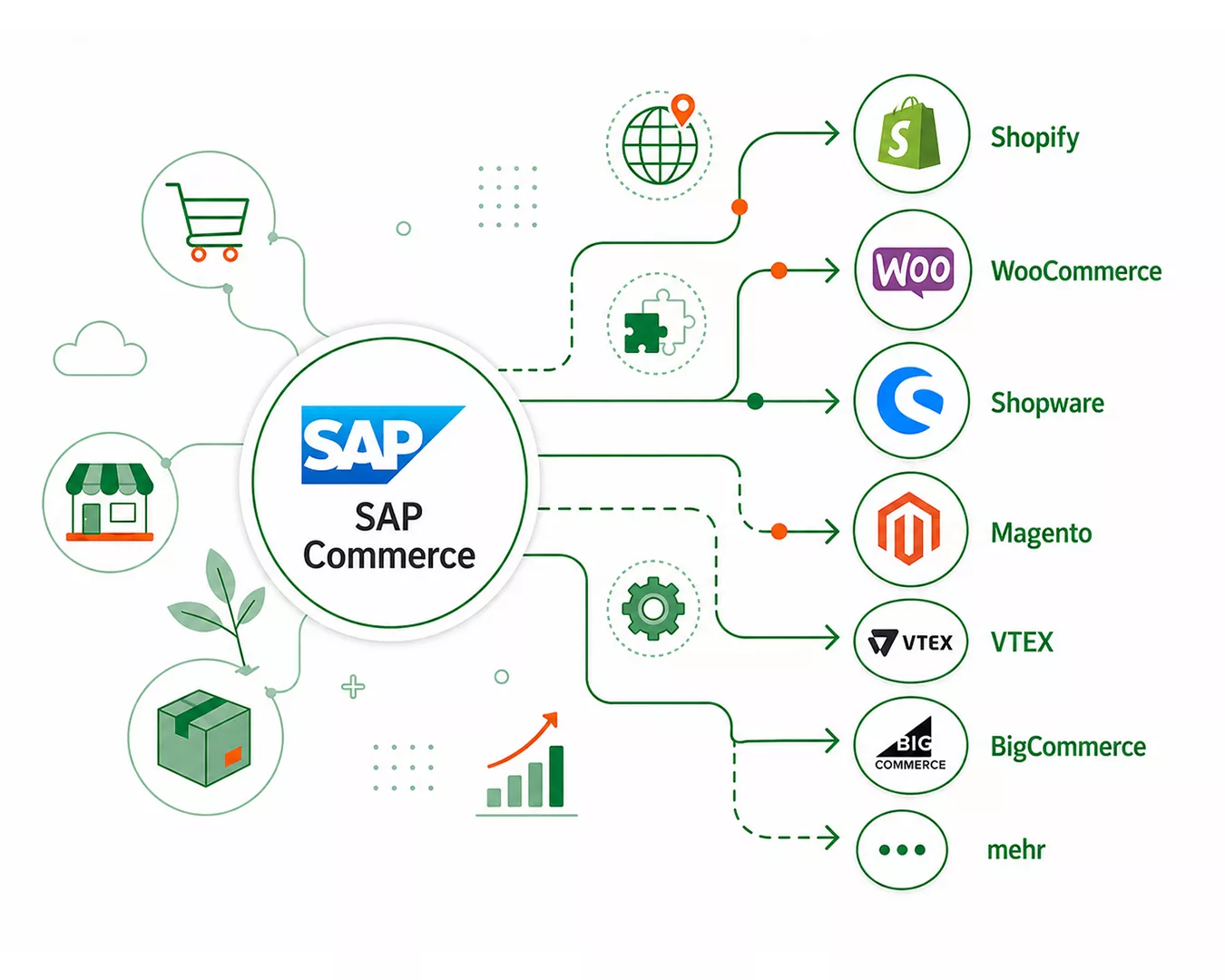
SAP Commerce (Cloud, formerly Hybris) is a heavyweight for enterprise commerce. It can do a great deal, but it costs six figures per year and up, demands a large team of specialists and long, expensive implementations. For most mid-market companies, that force is oversized and slow.
Let’s look at the best SAP Commerce alternatives: what they can do, where their limits are and which system really pays off for whom.
Why do merchants look for a SAP Commerce alternative?
The most common reason is the mismatch between cost, complexity and actual need. SAP Commerce is built for corporate scenarios where deep integration into the SAP world justifies any effort. As soon as your business runs at its core like a very good, scalable shop, most companies carry cost and inertia they never fully use.
The typical triggers for switching:
- Very high total cost. License and operation quickly reach six figures per year, without a comparable added value.
- Extreme complexity. Every change goes through development, a large team of specialists is mandatory.
- Long time to market. Implementations and releases stretch over many months and tie up budget.
- Everyday inertia. Campaigns, products and adjustments take time, where a lean platform delivers in hours.
The complexity shows in the frontend too: in our Core Web Vitals shop system study, only 42.6% of SAP Commerce shops pass the mobile benchmark, against 81.8% of Shopify shops.
- • Shopify (Plus): Delivers comparable performance for most projects at a fraction of the cost, without operations and without a permanent team of specialists.
- • SAP ERP stays connectable: Your SAP ERP can be cleanly connected to Shopify via a connector. Switching the shop system does not mean the end of your SAP landscape.
- • Adobe Commerce (Magento): The classic enterprise alternative for very large, highly custom B2B with your own dev team.
- • commercetools and Spryker: Sensible if you truly need composable commerce and actually use that freedom.
- • SAP Commerce stays strong if your shop is deeply embedded in a corporate SAP landscape. Then the platform can remain the right choice despite the cost.

The one thing people forget when they eye a leaner platform is the SAP connector. Moving off SAP Commerce almost never means moving off SAP ERP, and the shop still needs inventory, prices and orders flowing both ways. I always scope the connector as its own workstream, because a clean Shopify build with a flaky ERP sync is worse than the enterprise suite you left behind.
What must a good SAP Commerce alternative be able to do?
A serious alternative has to play in the same league, just leaner. We rate every system against six axes so the comparison stays fair and comparable:
- Total cost: License, hosting, operation and team together, not just the list price.
- Scalability: High volumes, B2B, internationalization and peaks without rebuilds.
- Usability: How much runs without developers in day-to-day work?
- Maintenance effort: Updates, security and operation, self-carried or included.
- Content and SEO: Clean fundamentals, performance and visibility out of the box.
- Time to market: Weeks instead of months to go live and for every change.
The best SAP Commerce alternatives at a glance
| Shop system | Type | From price/month | Hosting | Best for |
|---|---|---|---|---|
| Shopify (Plus) | SaaS (hosted) | from 36 € | included | Enterprise performance without an operating and cost load |
| Adobe Commerce (Magento) | Self-hosted / PaaS | high license/year | your own | Very large, custom enterprise B2B |
| commercetools | Composable / SaaS | high license | managed | Real composable commerce without running your own infrastructure |
| Spryker | Composable / self-hosted | high license | your own | Highly custom marketplaces and multi-business models |
| Shopware | Self-hosted | CE free | your own | Self-hosted DACH B2B in the mid-market, leaner than SAP |
Shopify is on top because it delivers the performance most SAP Commerce projects actually need, without operation and without a team of specialists. Adobe Commerce and Spryker fit when maximum customization with your own team is the priority. commercetools takes the operation off your plate, and Shopware is the pragmatic path for self-hosted B2B in the mid-market.
The alternatives in detail
Shopify: enterprise performance without enterprise effort
Shopify, or Shopify Plus, scales into the enterprise and delivers exactly the performance most SAP Commerce projects actually need, just without the operation.
- Cut cost drastically. Shopify includes hosting, updates and security from 36 euros a month, so six-figure license and operating costs plus the permanent team of specialists fall away, without relevant performance loss.
- Shorten time to market. Changes and campaigns go live without long developer sprints and months-long releases.
- Keep SAP ERP connected. You connect your SAP ERP to Shopify via a connector, for inventory, prices, orders and customer data. The shop frontend layer becomes lean, the ERP stays.
For most companies sitting on SAP Commerce today or evaluating it, that’s the more pragmatic path to comparable performance.
Do the honest test: list the features you really need SAP Commerce for. If little comes to mind that a scalable standard platform with an ERP connector wouldn’t also cover, the enterprise force is probably oversized for your project.
Adobe Commerce (Magento): the classic enterprise pick
Adobe Commerce is the classic enterprise alternative for very large, highly custom B2B with your own team. Shopify isn’t automatically the better choice here if you need full code control over a deep standard feature set.
- Strengths: Maximum depth in B2B, huge feature range, full control over the code.
- When it doesn’t fit: If you want to avoid hosting, maintenance and a dev team. Operation stays demanding.
- Best for: Large merchants with their own dev team and truly custom processes.
commercetools: real composable without operation
commercetools is an API-first, managed composable platform. Sensible if you really need composable commerce but don’t want to run it yourself.
- Strengths: High flexibility, freely combinable services, managed infrastructure.
- When it doesn’t fit: If you don’t use the composable freedom at all, you pay license and complexity without any return.
- Best for: Teams with real composable needs that want to hand off infrastructure operation.
Spryker: maximum customization for marketplaces
Spryker is a composable enterprise platform for highly custom setups, large marketplaces and multi-business models.
- Strengths: Boundless flexibility, ideal for many sellers or several business models under one roof.
- When it doesn’t fit: Without a large dev team and real custom needs, the effort isn’t justified.
- Best for: Very large, custom projects with their own developer team.
Shopware: lean B2B in the mid-market
Shopware offers self-hosted DACH B2B with full code control, much leaner to operate than SAP Commerce.
- Strengths: Strong B2B in the mid-market, open platform, DACH focus.
- When it doesn’t fit: If you want maintenance-free operation, hosting and major upgrades stay your job.
- Best for: Mid-market companies that stay self-hosted but want to escape SAP’s complexity.
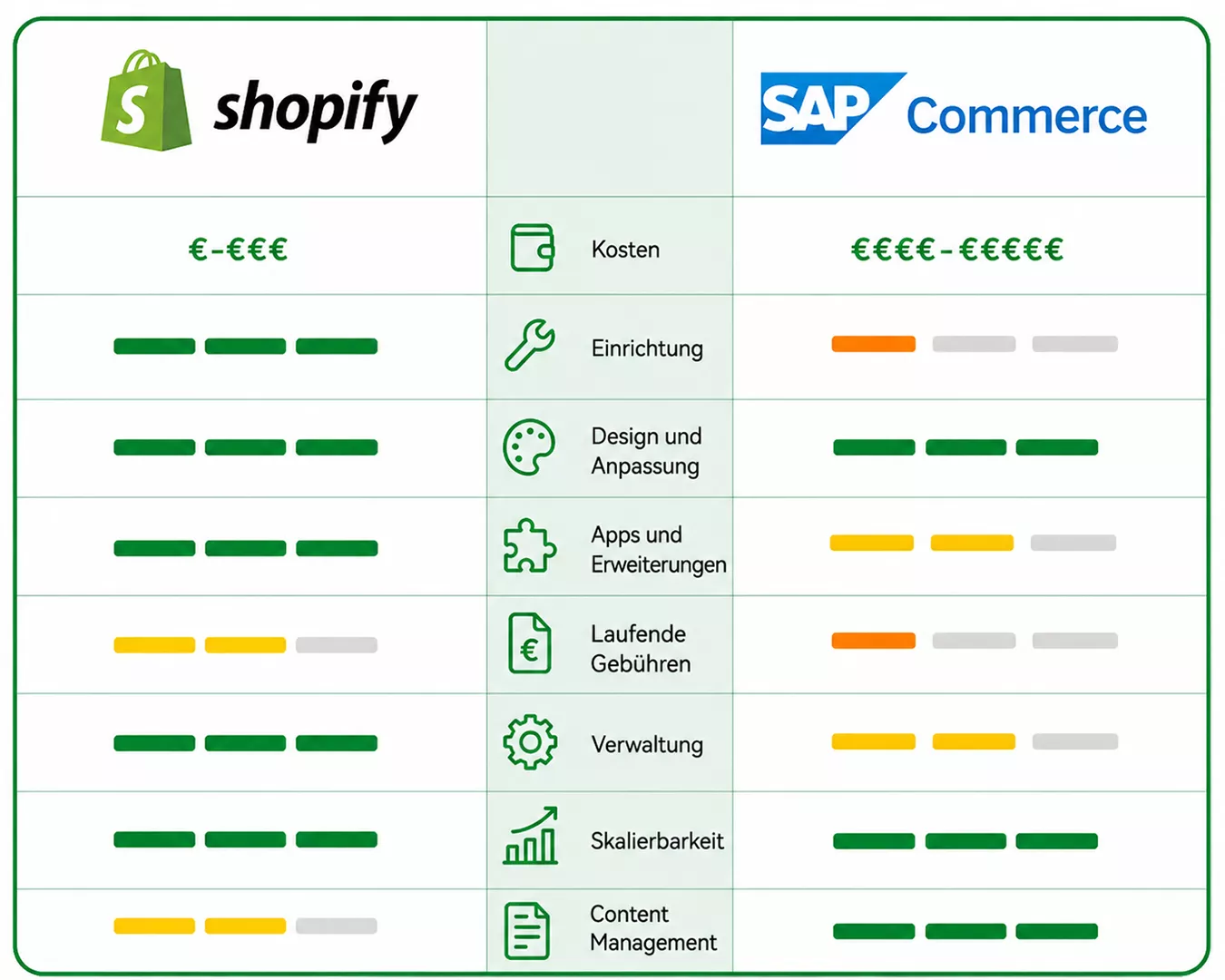
SAP Commerce vs. Shopify: the direct comparison
| Criterion | SAP Commerce | Shopify (Plus) |
|---|---|---|
| Model | Enterprise, self-hosted / cloud | SaaS, fully hosted |
| Entry cost | six figures/year and up | from 36 €/month, Plus for enterprise |
| Hosting and updates | your own / partner | included, automatic |
| Maintenance effort | very high, team of specialists | minimal |
| Time to market | months | weeks |
| SAP ERP integration | native, deeply integrated | cleanly connectable via connector |
| Best for | deep corporate SAP integration | scaling brands without an operating load |
You’ll find the detailed head-to-head in SAP Commerce vs. Shopify.
Which alternative fits whom?
| Your profile / requirement | Recommendation |
|---|---|
| Enterprise performance without operation and specialists | Shopify (Plus) |
| Very large, custom enterprise B2B with your own team | Adobe Commerce |
| Real composable commerce, but without running it yourself | commercetools |
| Highly custom marketplace or multi-business model | Spryker |
| Self-hosted B2B in the mid-market, leaner than SAP | Shopware |
| Deep integration into a corporate SAP landscape | Stay on SAP Commerce |
For most projects the road leads to Shopify, because you get the performance without carrying the cost and inertia of an enterprise suite.
What does switching from SAP Commerce cost?
It depends heavily on your individual architecture and interfaces, since a SAP setup is rarely standard. So there’s no fixed flat price.
The ecommerce platform calculator helps with the cost estimate. As an agency specialized in Shopify migration we also handle demanding moves so that data, interfaces and rankings carry over cleanly, including connecting your SAP ERP via a connector. How it works for SAP Commerce is on our SAP Commerce to Shopify migration page.
Conclusion: which SAP Commerce alternative fits you?
For most projects, Shopify is the best alternative to SAP Commerce. You get enterprise performance including a clean SAP ERP connection, without having to carry six-figure costs, months of implementation and a permanent team of specialists. If you need real, highly custom composable commerce, commercetools or Spryker stay sensible, and for very large B2B, Adobe Commerce is the enterprise pick. If your shop is deeply embedded in a corporate SAP landscape, however, SAP Commerce can remain the right choice despite the cost.
Not sure whether the enterprise force is really necessary for your project? We look at your setup and migrate at a fixed price, including interfaces and rankings. Get your free analysis.
 Frequently Asked Questions
What is the best SAP Commerce alternative?
Can I connect my SAP ERP to Shopify?
When is SAP Commerce worth it over a leaner platform?
What does switching from SAP Commerce to Shopify cost?
Will I lose my Google rankings when switching?
You might also like
SAP Commerce or Shopify? A Direct Comparison 2026
SAP Commerce vs Shopify in a direct comparison: costs, B2B, SAP integration, complexity and SEO. Find out which system fits your store.
VTEX or Shopify? A Direct Comparison 2026
VTEX vs Shopify in a direct comparison: costs, B2B, marketplace, internationalization and SEO. Find out which system fits your store.
VTEX Alternatives 2026: Enterprise Power with Predictable Costs
VTEX alternatives compared: enterprise power without revenue-based GMV fees or partner dependency. Which system suits which shop.