
OroCommerce Alternatives 2026: The Best B2B Shop Systems Compared
OroCommerce alternatives compared: native B2B with price lists and payment terms without self-hosting or constant dev work. With a clear recommendation.

Richard Roth
SEO & GEO Strategist
October 16, 2026
9 min read
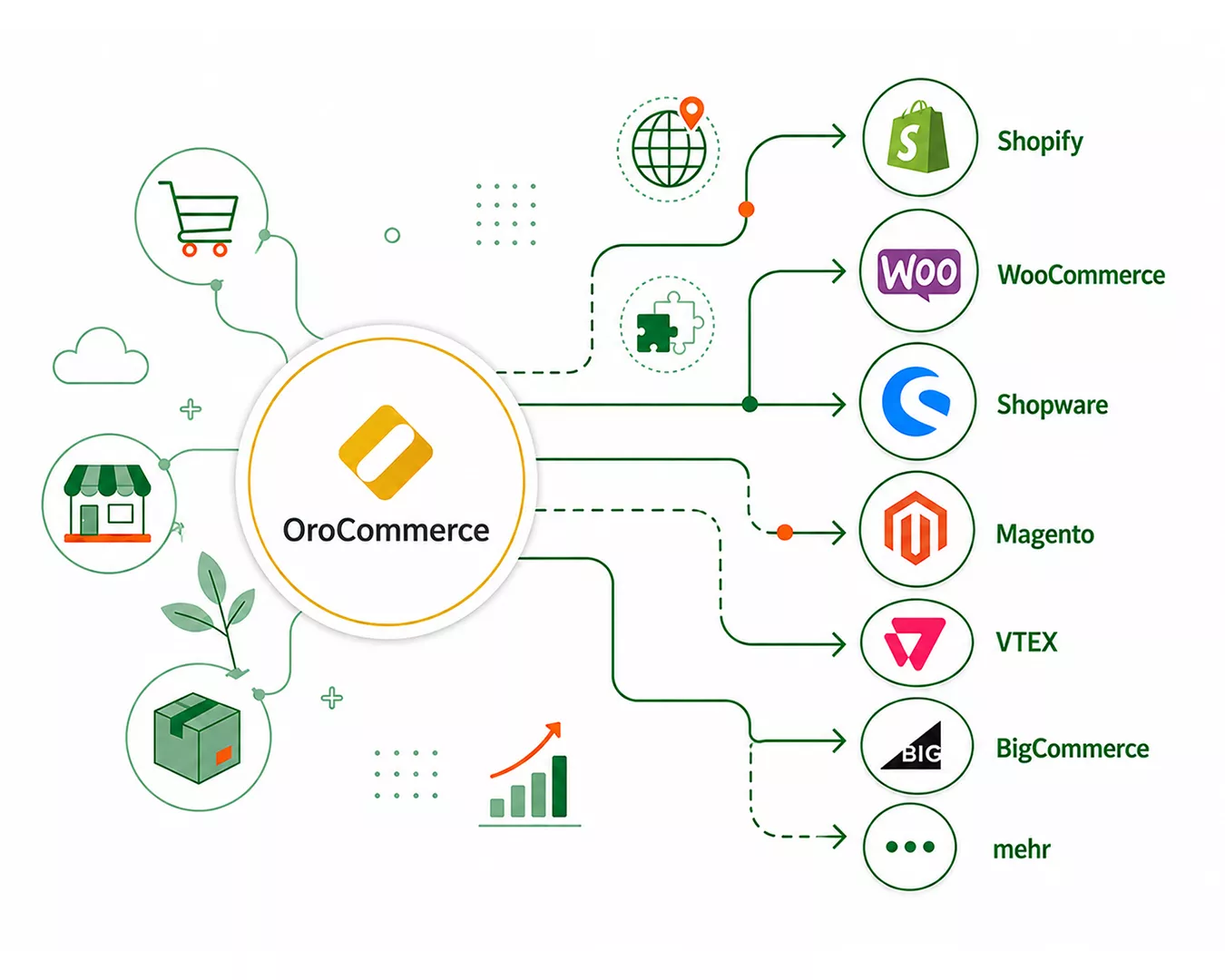
OroCommerce is a powerful open-source platform for demanding B2B. It can model complex corporate structures, quotes and customer-specific price lists, but it demands self-hosting, ongoing development and, for the Enterprise Edition, a hefty license. For many B2B shops, the question eventually comes up whether that operating effort is really necessary.
Let’s look at the best OroCommerce alternatives: what they can do, where their limits are and which system really pays off for whom.
- • Shopify (Plus): Covers B2B with corporate accounts, price lists and payment terms natively, without your own hosting or dev team and at predictable cost.
- • OroCommerce only really pays off if you run very specific, deeply integrated B2B processes with your own team. Otherwise the operation is oversized.
- • Adobe Commerce (Magento): The classic enterprise choice for very large, highly custom B2B with maximum depth.
- • Shopware: Worth a look if you want to stay self-hosted in DACH B2B but run leaner.
- • OroCommerce's strength stays the very complex, native B2B including its integrated CRM. The question is whether your project really needs that depth.
Why do merchants look for an OroCommerce alternative?
The most common reason is operating effort. OroCommerce is self-hosted, which means you carry hosting, security, updates and ongoing development yourself. Every change goes through developers, and larger B2B projects often stretch over months.
On top come the costs. The Community Edition is free, but the Enterprise Edition works with custom licenses in the high range per year. Add hosting and a team for operation and upgrades, and you quickly reach total costs that exceed the actual benefit.
So the three typical triggers are: high maintenance and hosting effort, long time to market on B2B projects, and EE license costs plus a permanent need for developers. If your B2B at its core is corporate accounts, price lists and payment terms, you get that faster and cheaper elsewhere.

Having built B2B setups on both sides, my test with OroCommerce is simple: write down the processes you genuinely couldn’t run without it. The integrated CRM, deep RFQ chains and truly composable logic are real reasons to stay. But if the list comes down to corporate accounts, customer price lists and payment terms, you’re maintaining a whole self-hosted platform for capabilities Shopify Plus now covers natively. That’s a lot of operational weight to carry for features you can rent.
What should a good OroCommerce alternative be able to do?
A serious alternative has to cover the same B2B fundamentals, but with less operating load. We rate the systems on six axes so the comparison stays fair and comparable:
- Total cost: License, hosting and ongoing development added up, not just the entry price.
- Scalability: Does the system grow with your B2B volume and channels?
- Ease of use: Can you maintain products, prices and campaigns without developers?
- Maintenance effort: Who carries updates, security and hosting?
- Content and SEO: Does the system bring clean SEO fundamentals and a usable CMS?
- Time to market: How fast are you live and how fast do you ship changes?
The best OroCommerce alternatives at a glance
| Platform | Type | From price/month | Hosting | Best for |
|---|---|---|---|---|
| Shopify (Plus) | SaaS (hosted) | from 36 € | included | Native B2B without hosting and maintenance load |
| Shopware | Self-hosted | CE free | your own | Self-hosted DACH B2B, leaner than OroCommerce |
| Adobe Commerce (Magento) | Self-hosted / PaaS | high license/year | your own | Very large, highly custom enterprise B2B |
| BigCommerce | SaaS (hosted) | from ~35 € | included | A hosted platform with solid B2B features |
| Spryker | Composable / self-hosted | high license | your own | Composable commerce and marketplaces with your own team |
Shopify (Plus) covers corporate accounts, price lists and payment terms natively and takes hosting and maintenance off your plate entirely. Shopware stays self-hosted but is leaner to operate than OroCommerce. Adobe Commerce is the pick for very large, custom B2B if you have the team for it. BigCommerce is hosted and brings solid B2B features. Spryker plays to its strength with real composable commerce and marketplaces.
The alternatives in detail
Shopify (Plus): strong B2B without your own operations
Shopify scales up to Shopify Plus and delivers exactly the B2B performance most OroCommerce projects actually need, just without the operation.
- Native B2B. Corporate accounts, customer-specific price lists and payment terms are built directly into Shopify Plus, without custom development.
- Less maintenance. No self-hosting, no EE upgrades: Shopify includes hosting, updates and security from 36 euros a month and handles scaling automatically.
- Live faster. B2B projects on OroCommerce are long. Shopify shortens time to market considerably, and you ship many changes without developers.
For special logic like RFQ, meaning individual quote requests, or complex approval workflows, you rely on apps or Shopify Functions. That gives you the B2B depth without running an entire platform yourself.
Do the honest test: list the B2B processes you really need OroCommerce for. If little comes to mind that native Shopify B2B plus a few apps wouldn’t also cover, self-hosting is probably oversized for your project.
Shopware, Adobe Commerce and BigCommerce
- Shopware offers self-hosted DACH B2B with full code control, much leaner to operate than OroCommerce. Sensible if you want to stay self-hosted but carry less effort.
- Adobe Commerce (Magento) is the classic enterprise pick for very large, highly custom B2B with your own team. Shopify isn’t automatically the better choice here.
- BigCommerce is a hosted SaaS with solid native B2B features and an open API, a middle ground between a standard platform and flexibility, without the OroCommerce operation.
Spryker: composable commerce with your own team
Spryker is a composable enterprise platform for highly custom architectures, large marketplaces and multiple business models under one roof. If your B2B is not just complex but truly composable, Spryker can replace OroCommerce, but it demands a large dev team and high total costs.
OroCommerce vs. Shopify: the direct comparison
| Criterion | OroCommerce | Shopify (Plus) |
|---|---|---|
| Model | Open source, self-hosted | SaaS, fully hosted |
| Entry cost | CE free, EE license custom | from 36 €/month, Plus for enterprise |
| Hosting and updates | your own / agency | included, automatic |
| Maintenance effort | high (self-hosting, upgrades) | minimal |
| Time to market | longer (B2B projects) | fast |
| B2B native | very strong, incl. CRM and RFQ | corporate accounts, price lists, payment terms native, RFQ via apps |
| Best for | very complex, deeply integrated B2B | scaling B2B without maintenance load |
More detail in OroCommerce vs. Shopify and the shop system comparison.
Which alternative fits whom?
| Your profile / requirement | Recommendation |
|---|---|
| Strong B2B, but without hosting and maintenance load | Shopify (Plus) |
| Self-hosted DACH B2B, leaner than OroCommerce | Shopware |
| Very large, highly custom enterprise B2B with your own team | Adobe Commerce |
| A hosted platform with solid B2B features | BigCommerce |
| Real composable commerce or a large marketplace | Spryker |
| Maximum code control more important than maintenance-free | Stay on OroCommerce or Adobe Commerce |
For most B2B shops the road leads to Shopify (Plus), because you get the B2B performance without carrying the cost and operation of a self-hosted system.
What does switching from OroCommerce cost?
It depends heavily on your individual B2B architecture, since an OroCommerce setup with CRM, price lists and workflows is rarely standard. So there’s no fixed flat price.
The shop system calculator helps with the cost estimate, and as an agency specialized in Shopify migration we also handle demanding B2B moves so that data, corporate accounts, prices and rankings carry over cleanly. How it works for OroCommerce is on our OroCommerce to Shopify migration page.
Conclusion: which OroCommerce alternative fits you?
For most B2B shops, Shopify (Plus) is the best alternative to OroCommerce. You get corporate accounts, price lists and payment terms natively, RFQ and special logic via apps or Functions, and all of that without your own hosting, an EE license or a permanent developer team.
If you really need very specific, deeply integrated B2B processes including an integrated CRM, OroCommerce or Adobe Commerce can stay sensible, and for real composable commerce, Spryker is the pick. Not sure whether self-hosting is really necessary for your B2B? We look at your setup and migrate at a fixed price, including interfaces and rankings. Get your free analysis.
 Frequently Asked Questions
What is the best OroCommerce alternative?
Does Shopify cover B2B as well as OroCommerce?
When is OroCommerce worth it over a hosted platform?
What does switching from OroCommerce to Shopify cost?
Which alternative fits very large B2B?
You might also like
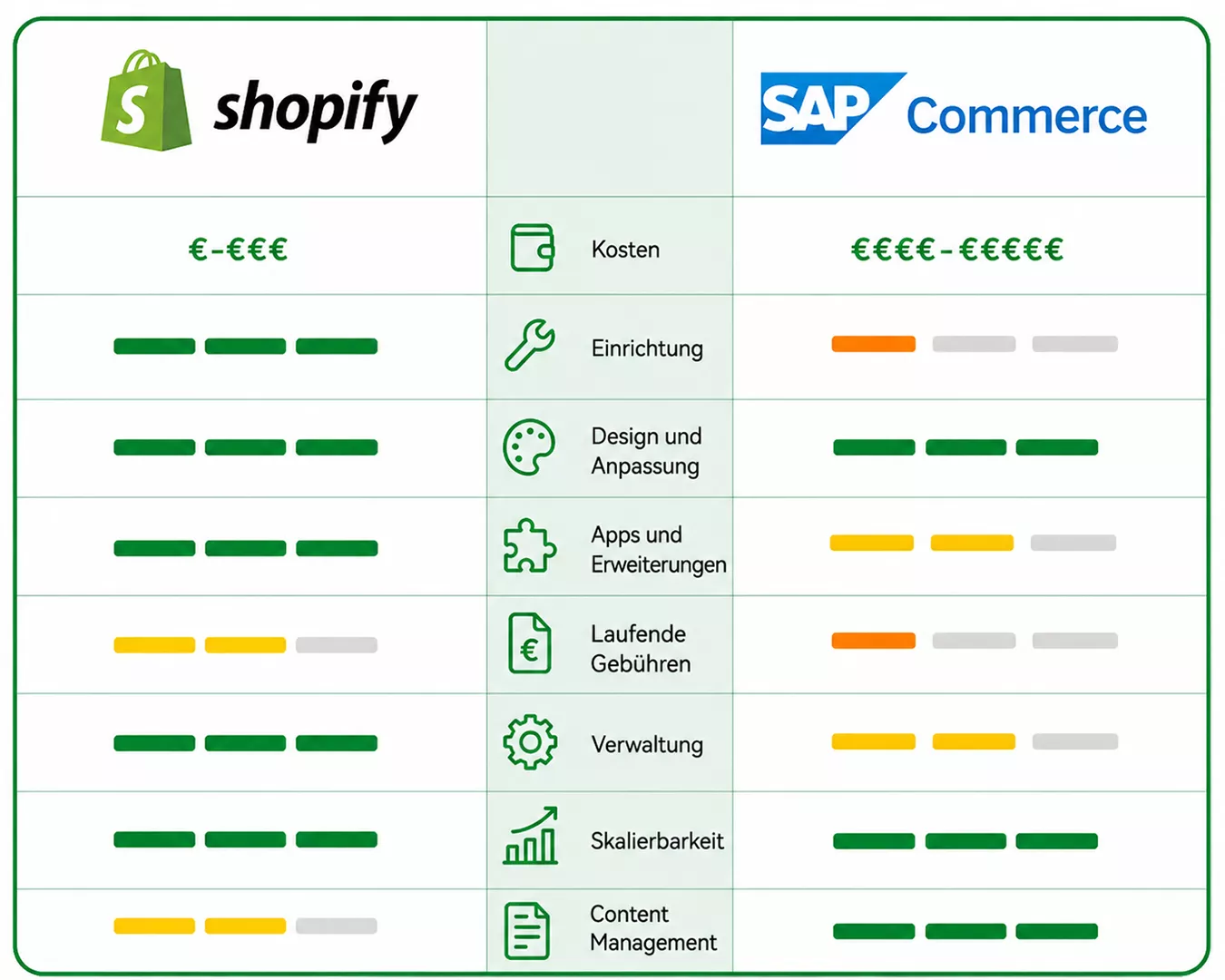
SAP Commerce or Shopify? A Direct Comparison 2026
SAP Commerce vs Shopify in a direct comparison: costs, B2B, SAP integration, complexity and SEO. Find out which system fits your store.
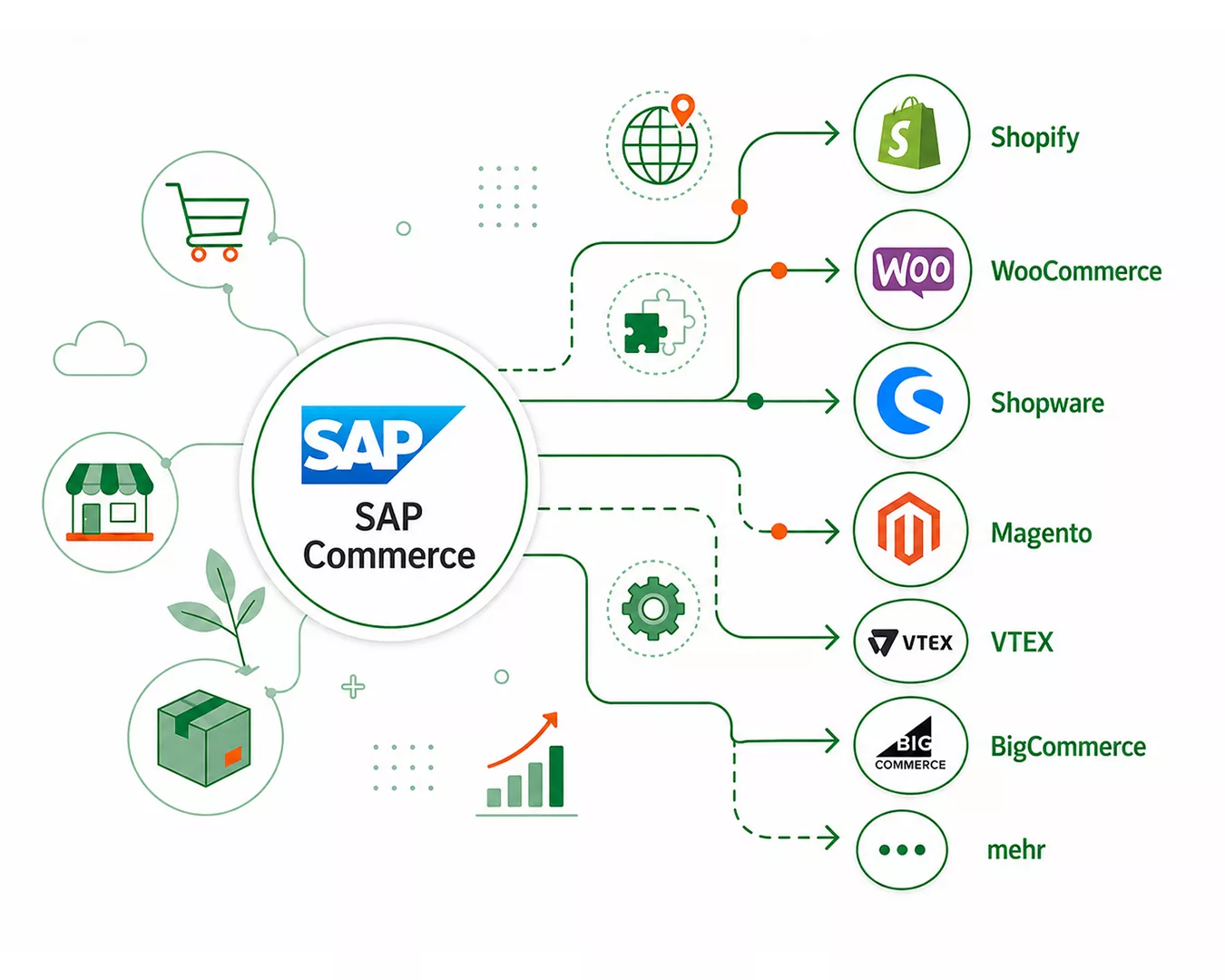
SAP Commerce Alternatives 2026: Enterprise Power, Leanly Operated
SAP Commerce alternatives compared: enterprise power without six-figure costs or months of time-to-market. The ERP stays connected via a connector.
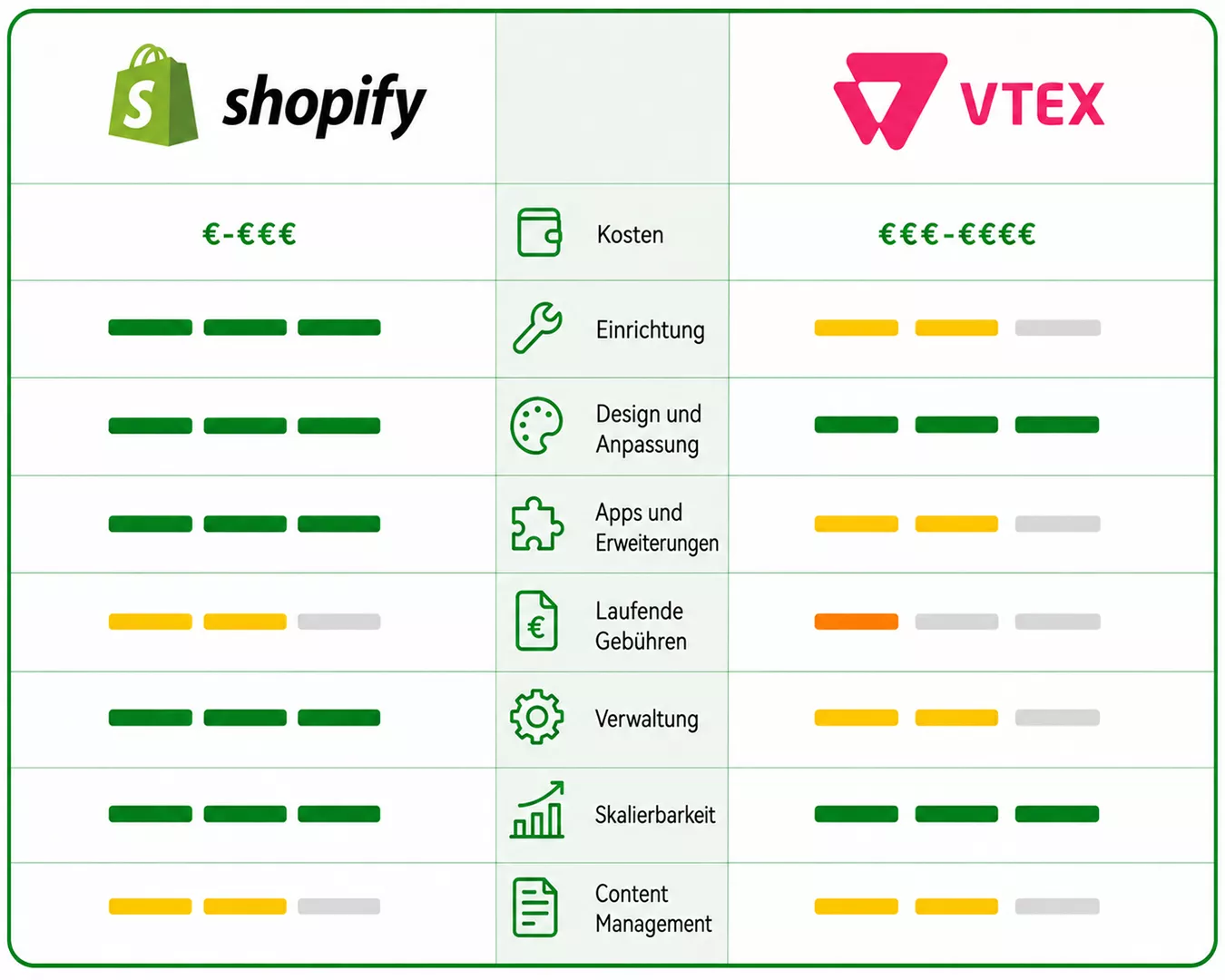
VTEX or Shopify? A Direct Comparison 2026
VTEX vs Shopify in a direct comparison: costs, B2B, marketplace, internationalization and SEO. Find out which system fits your store.