BigCommerce vs Shopify: Direct Comparison 2026
BigCommerce vs Shopify in direct comparison. Costs, plan upgrades, checkout and app ecosystem. Find out which SaaS platform fits your store.

Richard Roth
SEO & GEO Strategist
July 9, 2026
9 min read
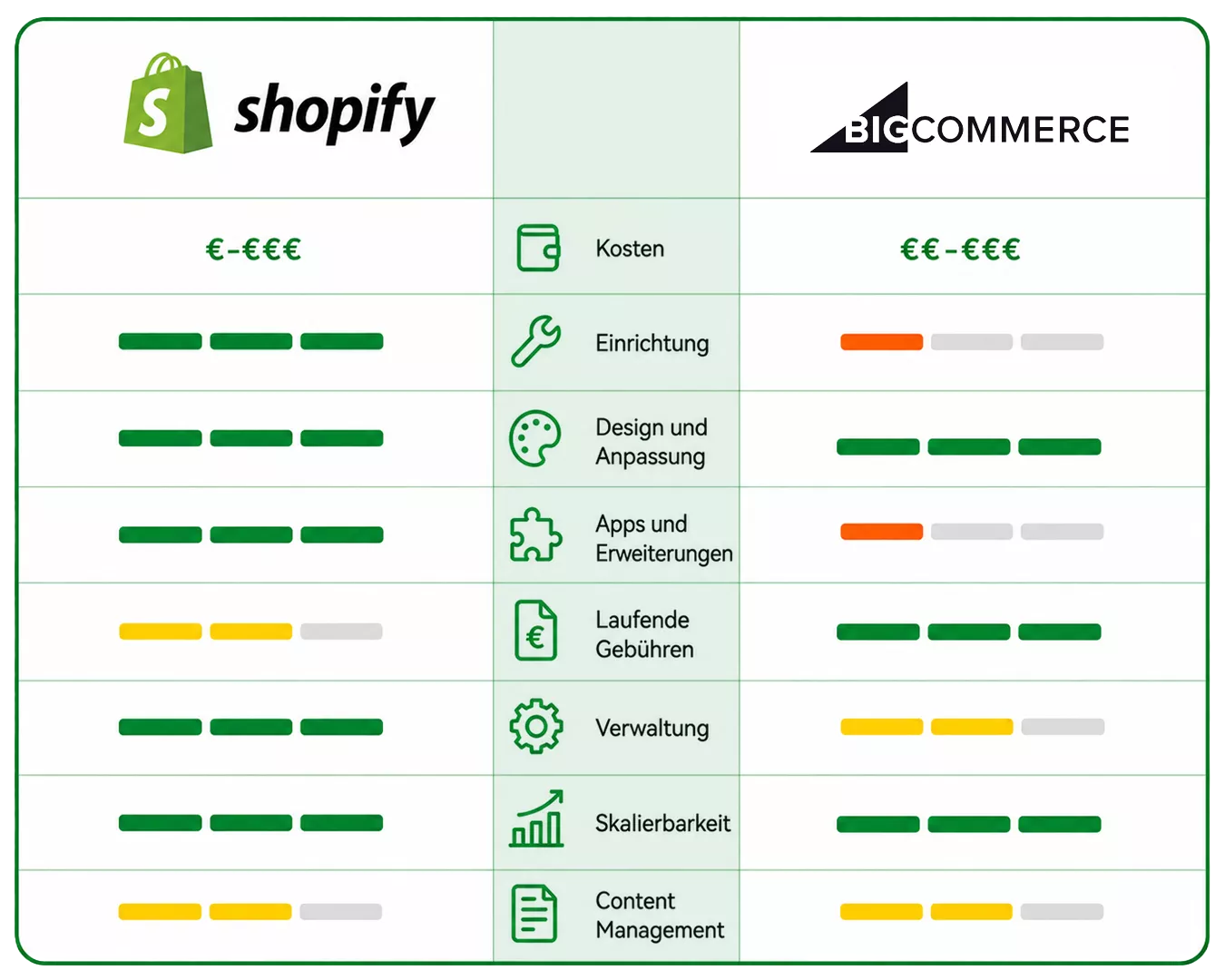
You’re facing a decision: BigCommerce or Shopify? Both are hosted SaaS platforms and look similar at first glance. In daily use the differences show clearly, especially in the pricing model, checkout, and app ecosystem. We compare both from practical experience and show you what really matters in the decision. For an overview of more systems, check out our shop system comparison.
- • BigCommerce is a hosted SaaS platform with many native features and no transaction fees, but it automatically bumps your plan as soon as you cross a sales threshold.
- • Shopify is also hosted, but wins with the largest app ecosystem and the best-converting checkout on the market (Shop Pay).
- • On ecosystem, Shopify clearly leads: more apps, more themes, more agencies and developers.
- • BigCommerce has a real edge in native B2B and the absence of transaction fees. For most growing brands, though, Shopify's reach and conversion outweigh it.
Shopify and BigCommerce: two SaaS platforms compared
Unlike a comparison with a self-hosted system, this isn’t about servers or hosting. Both platforms take the technical operation off your plate entirely: hosted, automatically updated, and secure.
The difference is in the philosophy. BigCommerce relies on many native features and skips transaction fees, but ties its plans to your annual revenue. Shopify keeps the core platform leaner and lets you extend it through the huge app ecosystem, in exchange you get the most mature checkout and the largest reach in e-commerce.
For your decision that means: it’s less about “who can do what” and more about ecosystem, conversion, and how predictable your costs stay as you grow.
The point that gets underweighted in these comparisons is the ecosystem’s SEO reach, not just the app count. Because so many agencies and developers build on Shopify, the tooling for redirects, structured data and technical SEO is simply deeper and better documented. On BigCommerce the fundamentals are fine, but when you hit an edge case you’re on your own far sooner, and that shows up in how cleanly a store recovers after a move.
Cost comparison: what do you really pay?
Both platforms work with clear monthly prices. With BigCommerce the catch is in the revenue thresholds.
BigCommerce costs
BigCommerce starts with the Standard plan at around $39 per month, Plus is about $105, and Pro from around $399. A plus: with its embedded payment providers (e.g. BigCommerce Payments, Stripe, PayPal), BigCommerce charges no transaction fees. With an external provider it adds an Open Payment Provider Fee depending on the plan, up to 2 percent on Core.
The catch: each plan has an annual online sales limit. If you cross it, BigCommerce automatically upgrades you to the next, more expensive plan. So your success drives your fixed costs directly.
Shopify costs
Shopify works with a fixed pricing model. The Basic plan costs about €36 per month with annual billing, the Shopify plan about €105, the Advanced plan about €384. The plans are not tied to your revenue.
With Shopify Payments the platform transaction fees disappear, you only pay the usual card fees. If you use an external payment provider, a small surcharge applies.
Cost comparison in practice
| Cost type | BigCommerce | Shopify (Basic) |
|---|---|---|
| Base plan | ~$39/month | ~€36/month |
| Transaction fee | none | 0% with Shopify Payments |
| Plan upgrade on revenue | automatically forced | no |
| App costs | tend to be higher (smaller offering) | broad, often cheaper offering |
| Hosting & updates | included | included |
With BigCommerce, don’t just calculate today’s plan but also the next sales threshold. If you plan to grow, the forced tier jump is a real cost factor that Shopify simply doesn’t have.
Why does BigCommerce automatically raise my plan?
This is where many BigCommerce merchants push back. BigCommerce defines a maximum annual online sales limit for each plan. If your shop grows beyond it, you’re automatically moved to the next, higher plan, regardless of whether you even need its extra features.
In practice that means: exactly in the growth phase when you actually want to invest, your platform costs jump. With Shopify the price decouples from your revenue. You stay on your plan as long as its features are enough, and you decide when to switch.
For predictable budgets, this difference often matters more than the pure entry price.
App ecosystem and themes: who offers more?
This is Shopify’s biggest structural advantage.
The Shopify App Store includes over 16,000 apps for practically every use case, plus a huge selection of themes and a worldwide network of agencies and developers. If you need a feature, there’s a high chance a mature solution already exists.
BigCommerce ships with many features out of the box that require an app on Shopify. But the app and theme selection is noticeably smaller, and there are clearly fewer specialized agencies. For standard requirements that’s enough, for custom needs you hit limits faster.
Checkout and conversion: the Shop Pay advantage
In the end the checkout decides your revenue, and here Shopify has a strong argument.
Shop Pay is Shopify’s accelerated checkout with saved payment and shipping details. It’s considered one of the best-converting checkouts in e-commerce and is recognized across the entire Shopify network, which makes repeat purchases easier.
The BigCommerce checkout is solid and customizable, but doesn’t reach the same conversion optimization and network effect. At the same traffic, this difference adds up to a noticeable revenue amount over the year.
SEO and performance
Both platforms offer solid SEO fundamentals: customizable meta titles, descriptions, URLs, and a clean technical base.
On performance, both deliver fast loading times via global CDNs. Shopify additionally benefits from the constant evolution of its checkout and storefront technology. In practice, the two are close on Core Web Vitals as long as your theme is cleanly built.
The difference comes less from pure tech and more from the content and marketing options that Shopify’s larger app ecosystem opens up.
When is BigCommerce the better choice?
BigCommerce makes sense if you:
- Need a lot of native B2B and don’t want to move to Shopify Plus
- Depend on zero transaction fees with an external payment provider
- Get by with the native features and use few apps
- Have stable, mid-sized revenue without aggressive growth plans
BigCommerce plays to its strengths when you want many features natively and the sales thresholds aren’t an issue for you.
When is Shopify the better choice?
Shopify makes sense if you:
- Want predictable costs without revenue-driven tier jumps
- Prioritize the best-converting checkout and maximum conversion
- Depend on the largest app and theme ecosystem
- Want to scale internationally and serve multiple channels
- Want a strong network of agencies and developers behind you
Shopify is usually the better choice when growth, conversion, and flexibility are the priority.
Switching from BigCommerce to Shopify
Maybe you already use BigCommerce and are wondering whether a switch makes sense, for example because the next sales threshold is approaching or the ecosystem feels too tight.
The migration from BigCommerce to Shopify is very doable because both platforms are hosted. Products, variants, customers, and order history are transferred, customer groups and price lists are mapped to Shopify B2B or suitable apps, and all URLs are redirected via a seamless redirect map so your rankings stay intact.
With the right concept, you use the migration as an opportunity: out of the sales thresholds, into an ecosystem that grows with you. We at Store2x specialize in exactly these migrations to Shopify. If you’re considering whether a switch makes sense for you, you can request a free potential analysis.
Conclusion
BigCommerce or Shopify? Both are strong SaaS platforms. BigCommerce wins with many native features, native B2B, and no transaction fees, but ties its prices to your revenue. Shopify offers more predictable costs, the best-converting checkout, and by far the largest ecosystem. For most growing brands, Shopify is therefore the more future-proof path.
 Frequently Asked Questions
 Does BigCommerce really have no transaction fees?
Why does my BigCommerce plan get more expensive automatically?
Is the Shopify checkout really better than BigCommerce's?
Will my rankings be preserved when switching to Shopify?
What happens to my customer groups and price lists?
You might also like
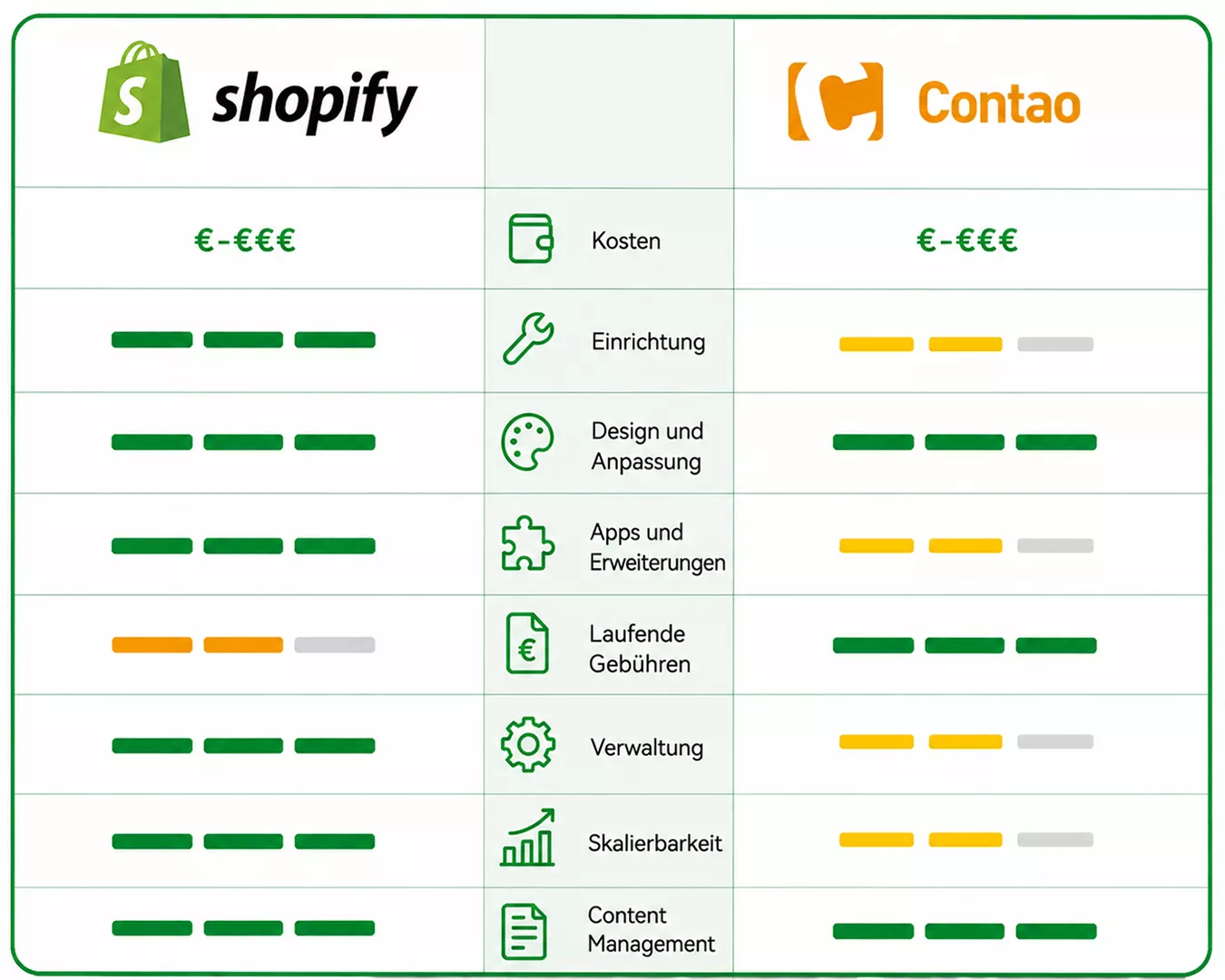
Contao or Shopify? A Direct Comparison 2026
Contao vs Shopify in a direct comparison: commerce features, content, maintenance, costs and SEO. Find out which system fits your store.
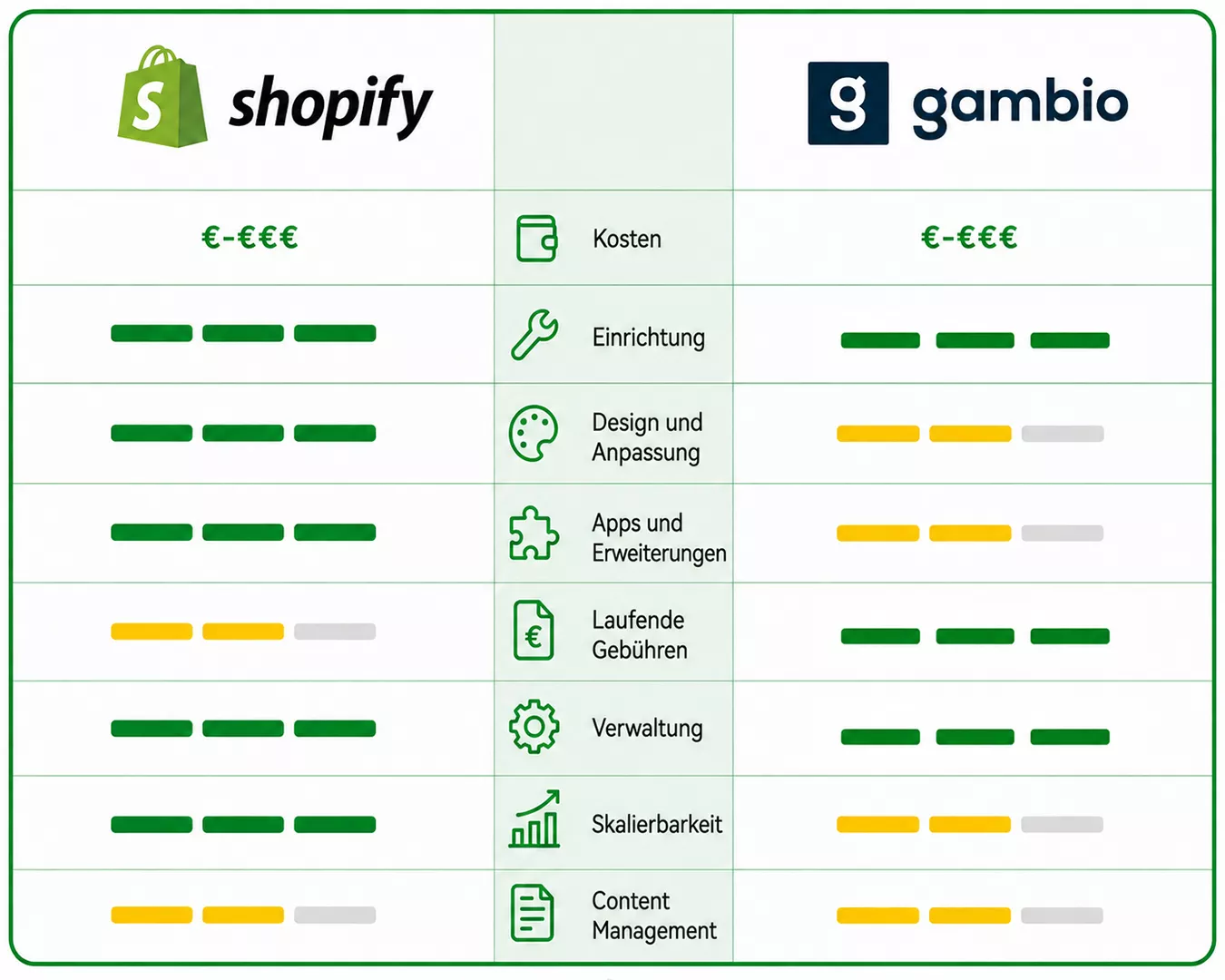
Gambio or Shopify? A Direct Comparison 2026
Gambio vs Shopify in a direct comparison: costs, maintenance, performance, features and SEO. Find out which system fits your store.
OXID vs Shopify: Direct Comparison 2026
OXID vs Shopify in direct comparison. Costs, B2B, hosting and maintenance. Find out which shop system fits your store.