OpenCart vs Shopify: Direct Comparison 2026
OpenCart vs Shopify in direct comparison. Costs, hosting, extensions and maintenance. Find out which shop system fits your store.

Richard Roth
SEO & GEO Strategist
July 15, 2026
7 min read
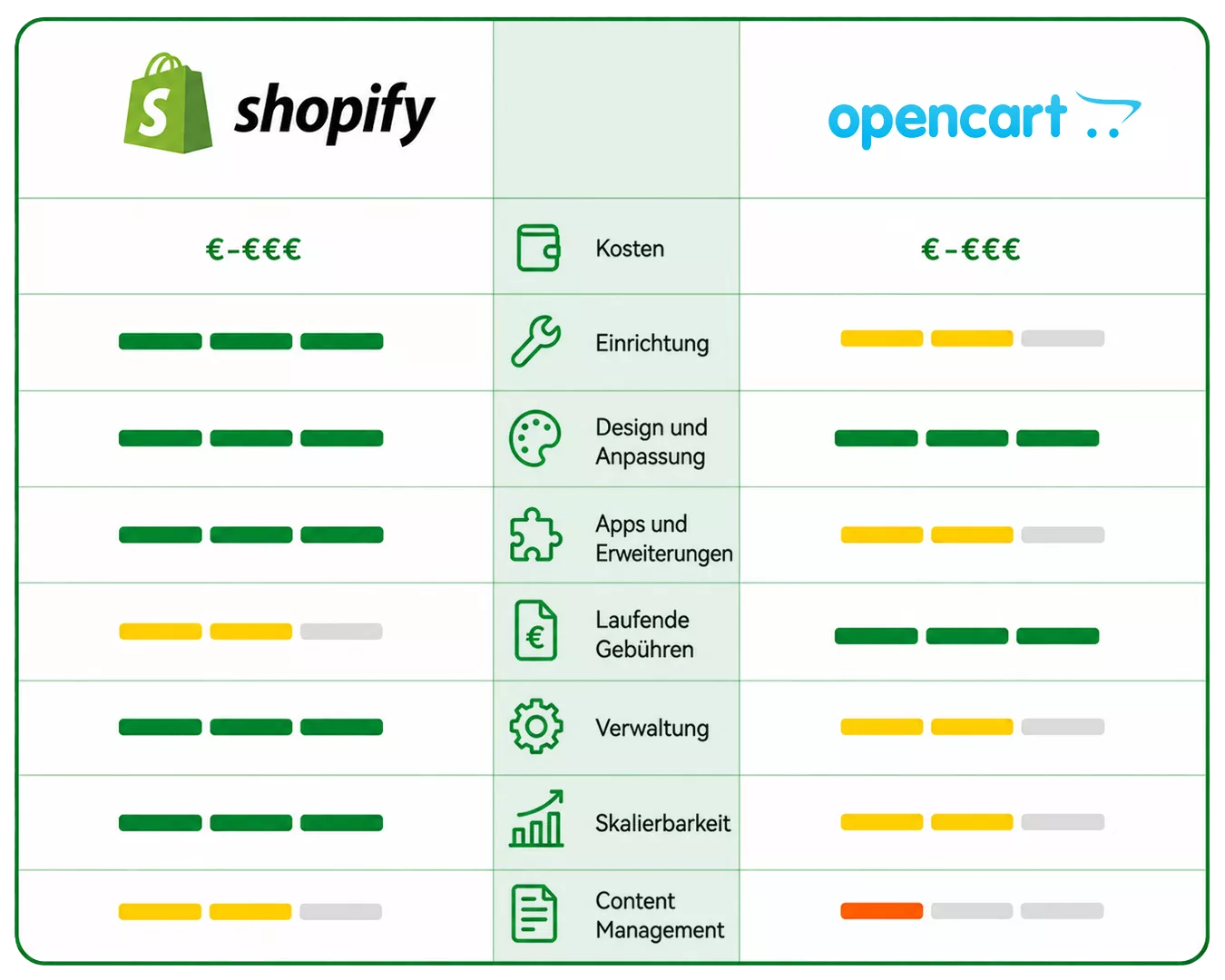
You’re facing a decision: OpenCart or Shopify? OpenCart is a lean, free open-source shop system that you host yourself. Shopify is a cloud-based all-in-one solution. We compare both from practical experience and show you what really matters in the decision. For an overview of more systems, check out our shop system comparison.
- • OpenCart is a self-hosted open-source shop system. The license is free, but you need your own hosting, extensions, and ongoing maintenance.
- • Shopify is a cloud-based SaaS platform. Hosting, updates, and security are included, and you can start right away.
- • OpenCart gives you full code access and a lean base, but requires technical know-how or an agency.
- • On maintenance, version upgrades, and time to market, Shopify clearly leads because the entire operation disappears.
Shopify and OpenCart: cloud versus self-hosted open source
Before we get into the details, you should understand that both systems follow fundamentally different approaches.
OpenCart is open source and self-hosted. You download the free software, install it on your own server, and have full access to the code. That makes OpenCart lean and flexible, but you’re responsible for hosting, updates, security, and extensions yourself.
Shopify is a fully hosted SaaS solution. You sign up, pick a theme, and sell. You don’t have to worry about servers, updates, or security. The trade-off is clear: OpenCart offers maximum control, Shopify maximum peace of mind.
OpenCart’s leanness is genuinely appealing until you hit a major version jump. The merchants who ask me about switching almost always describe the same story: a shop stuck on an older release because the upgrade to 4.x meant reworking half the extensions. If you have a developer who enjoys that maintenance and wants full code control, OpenCart still fits. If you’d rather never think about a breaking upgrade again, that’s exactly the friction Shopify removes.
Cost comparison: what do you really pay?
At first glance OpenCart looks cheaper because the software is free. A second look shows a different picture.
OpenCart costs
The OpenCart software is free. The total costs arise elsewhere: you need your own hosting (about €25 to €60 per month depending on traffic), often paid extensions, and in most cases a developer or agency for setup, customizations, and the often painful version upgrades.
So the free license is the entry point, not the whole picture. Especially the ongoing technical upkeep adds up over the year.
Shopify costs
Shopify works with a clear pricing model. The Basic plan costs about €36 per month with annual billing. It includes hosting, SSL, support, and all core features. Higher plans are about €105 and €384 per month.
With Shopify Payments you pay no platform transaction fee, only the usual card fees. The costs are predictable and include the entire operation.
Cost comparison in practice
| Cost type | OpenCart | Shopify (Basic) |
|---|---|---|
| Shop system license | free | ~€36/month |
| Hosting | €25 to €60 | included |
| Updates & maintenance | agency or in-house | included |
| Extensions | often paid | broad app ecosystem |
| Version upgrades | costly, sometimes breaking | automatic |
The free OpenCart license hides the running costs. Always include hosting, extensions, maintenance, and agency effort. Only then do you have a fair comparison to the predictable monthly costs of Shopify.
Hosting, updates, and extensions
This is one of the biggest differences between the two platforms.
Shopify is fully hosted. Updates are applied automatically, security is handled by Shopify, and the infrastructure scales with your traffic. You add new features through the App Store with over 16,000 apps.
OpenCart requires your own hosting and active upkeep. You apply security patches yourself, test updates, and manage performance. The extension ecosystem is fragmented and quality varies. In particular, the version upgrades (for example from 1.5 through 2.x and 3.x to 4.x) were often costly projects with breaking changes in the past.
Customizability and developer dependency
On flexibility, the different philosophies show.
OpenCart gives you far-reaching control through full code access. You can go deep and adjust everything, but you usually need developer know-how. For many standard customizations there’s no way around an agency.
Shopify offers modern, fast themes that are customizable without programming. Through Liquid and custom apps you go deep if you want. For most requirements the theme editor plus App Store is enough, without needing a developer for every change.
SEO and performance
Both platforms offer solid SEO fundamentals. OpenCart uses SEO keywords for readable URLs, and meta titles and descriptions are customizable.
On performance, OpenCart depends heavily on your hosting and configuration. With a well-optimized server you reach good scores, but that requires know-how and ongoing upkeep. Shopify delivers fast loading times worldwide via its global CDN infrastructure, without you having to worry about caching or server optimization. Fast loading times directly affect rankings and conversion.
When is OpenCart the better choice?
OpenCart makes sense if you:
- Need full control over code and infrastructure
- Have technical resources or an agency for operation and maintenance
- Want a lean, free base without a monthly license
- Plan very custom adjustments at the code level
OpenCart plays to its strengths when you have technical know-how and want maximum control over a lean open-source base.
When is Shopify the better choice?
Shopify makes sense if you:
- Want a maintenance-free platform without server and update worries
- No longer want to run expensive version upgrades
- Prefer predictable monthly costs over fluctuating maintenance costs
- Want to go live fast and focus on selling
- Want a large app ecosystem and agency network behind you
Shopify takes the entire technical burden off your plate and is usually the better choice when growth and focus are the priority.
Switching from OpenCart to Shopify
Maybe you already use OpenCart and are wondering whether a switch makes sense, especially when maintenance effort, extension chaos, and version upgrades increase.
The migration from OpenCart to Shopify is very doable. Products, options, categories, customers, and order history are transferred, your SEO URLs are redirected via a seamless redirect map, and matching Shopify apps are set up for your extensions. This keeps your rankings intact and no feature is lost.
With the right concept, you use the migration as an opportunity: away from server maintenance and extension upkeep, toward a modern, maintenance-free platform. We at Store2x specialize in exactly these migrations to Shopify. If you’re considering whether a switch makes sense for you, you can request a free potential analysis.
Conclusion
OpenCart or Shopify? The answer depends on your resources. If you have technical know-how, want full control, and value a lean open-source base, OpenCart has its place. If you want a maintenance-free, modern, and quickly ready platform without server and update worries, Shopify is usually the better choice.
 Frequently Asked Questions
 Is OpenCart really free?
Which OpenCart version can I migrate from to Shopify?
Will my rankings be preserved when switching to Shopify?
What happens to my OpenCart extensions?
How long does the migration from OpenCart to Shopify take?
You might also like
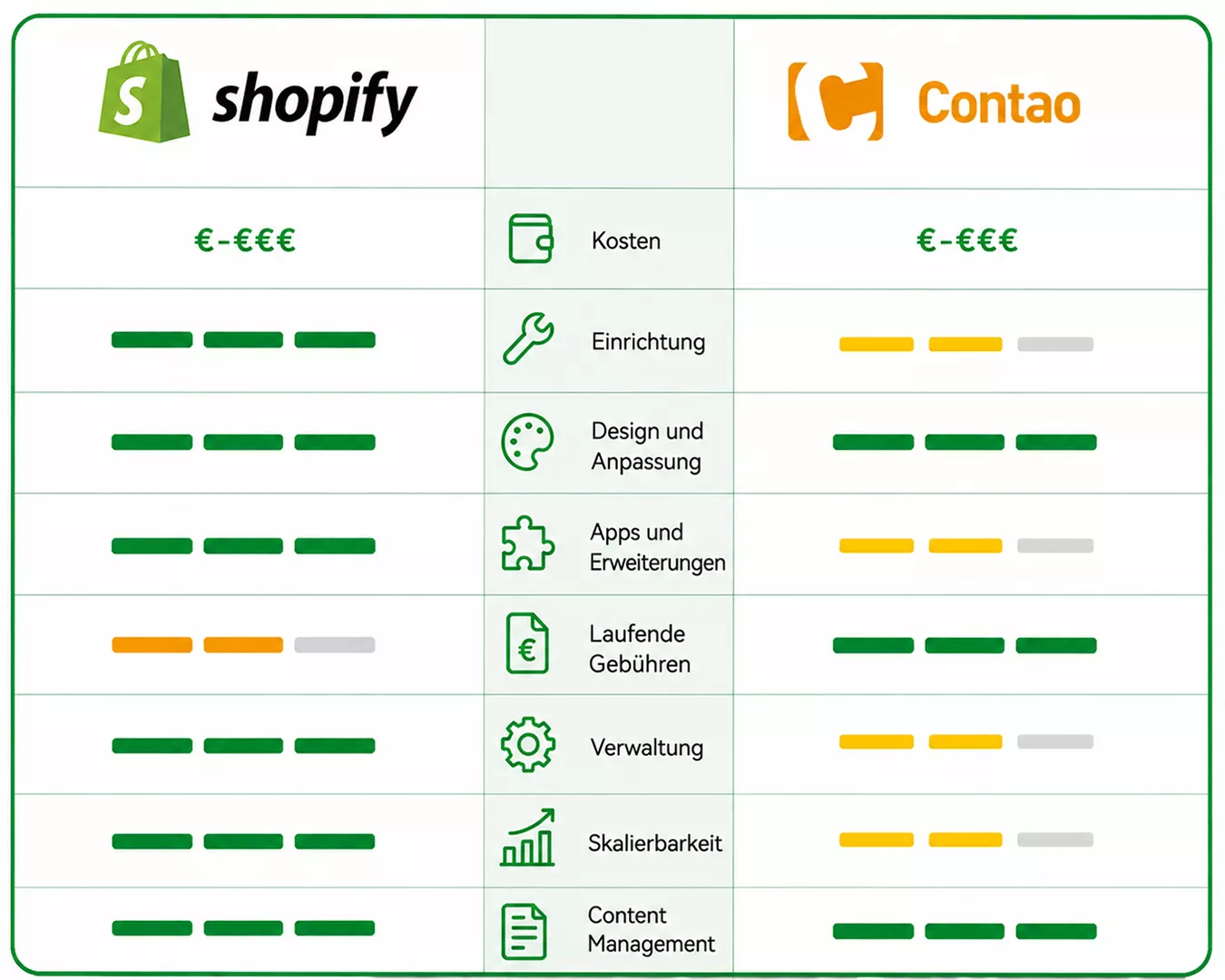
Contao or Shopify? A Direct Comparison 2026
Contao vs Shopify in a direct comparison: commerce features, content, maintenance, costs and SEO. Find out which system fits your store.
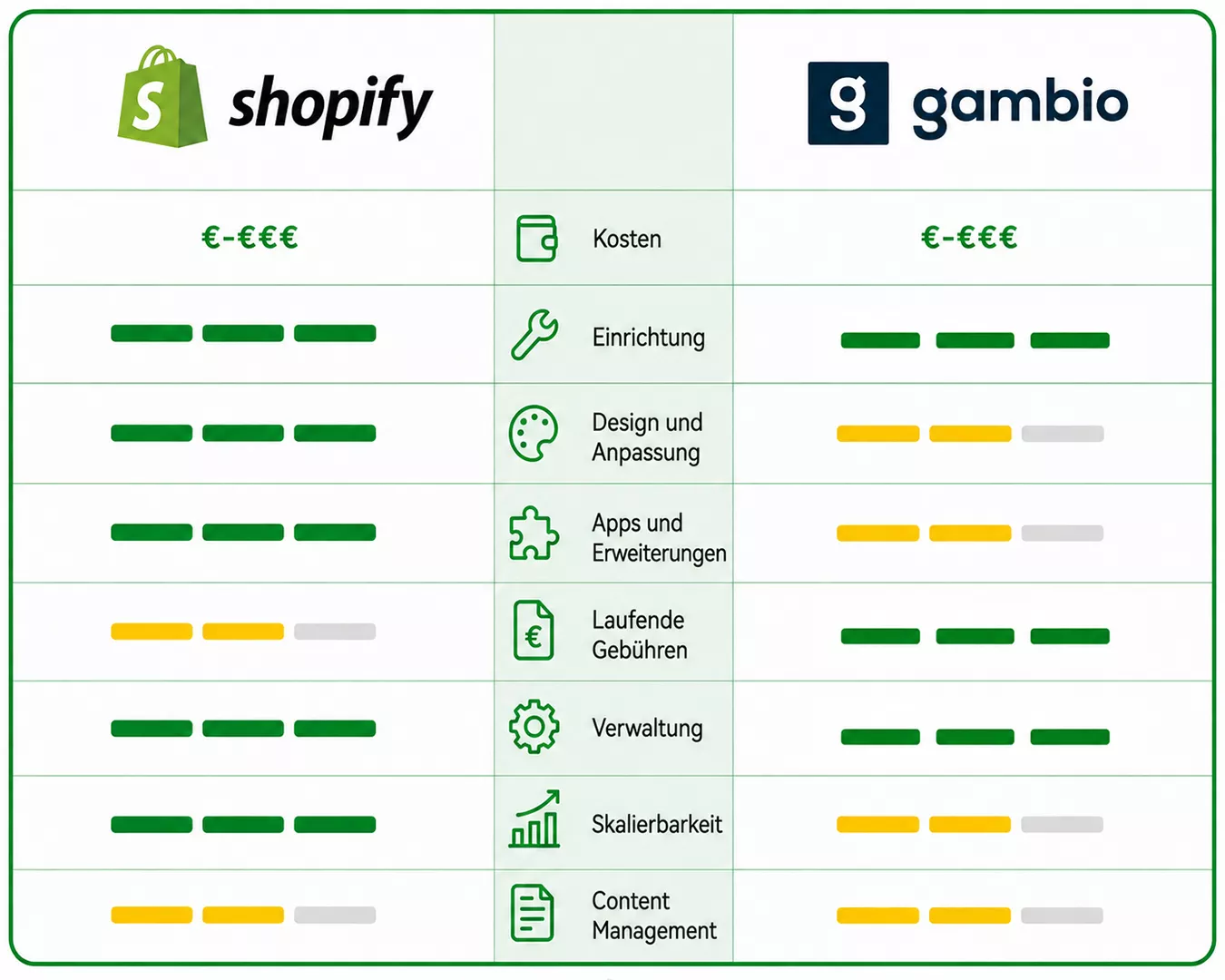
Gambio or Shopify? A Direct Comparison 2026
Gambio vs Shopify in a direct comparison: costs, maintenance, performance, features and SEO. Find out which system fits your store.
OXID vs Shopify: Direct Comparison 2026
OXID vs Shopify in direct comparison. Costs, B2B, hosting and maintenance. Find out which shop system fits your store.