Etsy vs Shopify: Direct Comparison 2026
Etsy vs Shopify in direct comparison. Fees, reach, your own brand and customer data. Find out what fits your sales better.

Richard Roth
SEO & GEO Strategist
July 12, 2026
8 min read
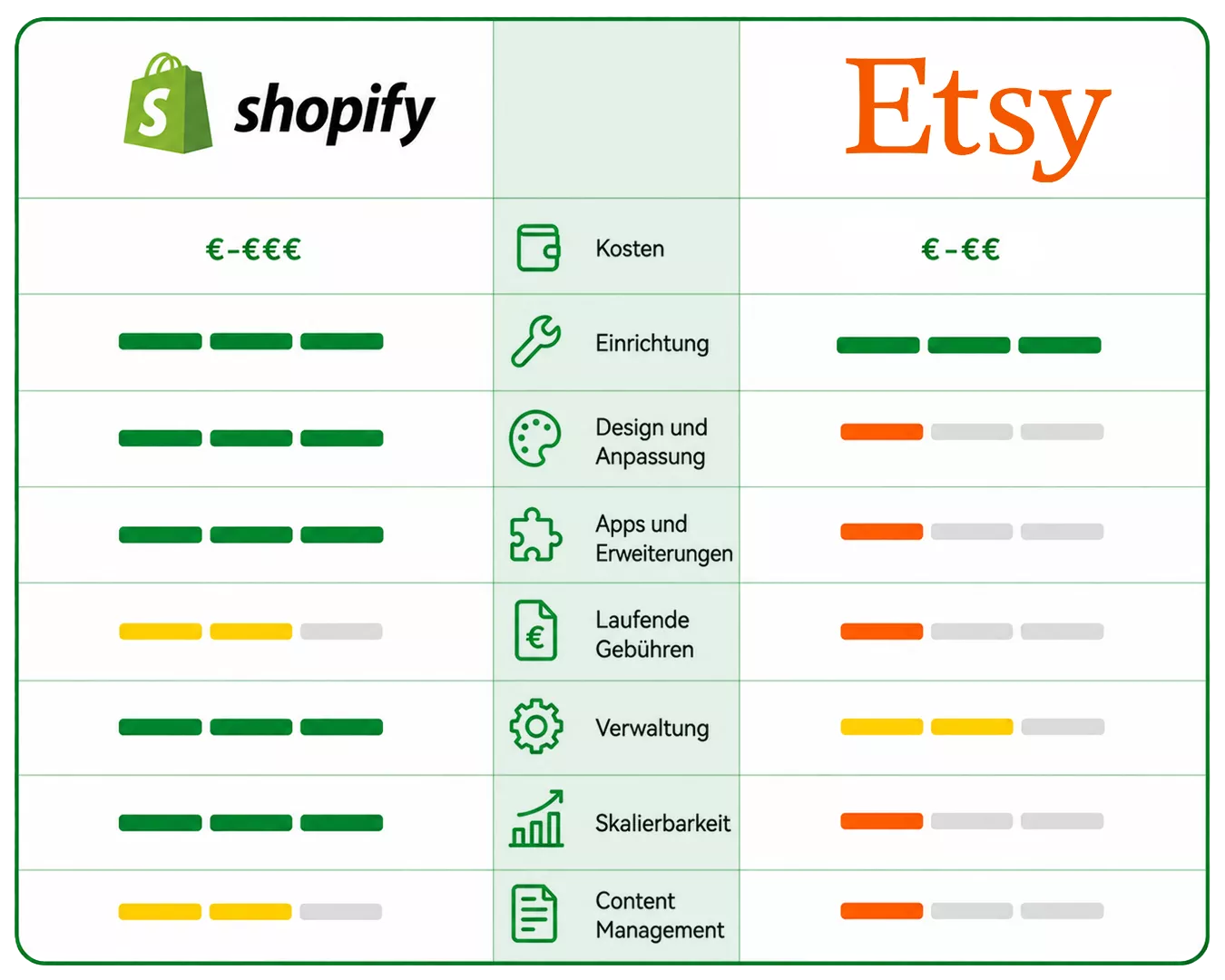
You’re facing a decision: Etsy or Shopify? This isn’t really a classic system comparison but the question of marketplace versus your own store. Etsy gives you reach, but the shop isn’t yours. Shopify gives you your own brand, but you have to attract the buyers yourself. We show you when each makes sense and why the answer for many is “both”. For an overview of more systems, check out our shop system comparison.
- • Etsy is a marketplace. You benefit from the reach but pay high fees per sale, and the customer relationship belongs to Etsy, not you.
- • Shopify is your own store with your own domain, full customer data, and predictable fixed costs instead of a commission on every sale.
- • Etsy's big advantage is its built-in reach: millions of buyers actively search there for products.
- • For many, the best solution is both: Etsy as an additional channel, Shopify as the center of your own brand.
Marketplace versus your own store: the decisive difference
Etsy and Shopify solve two different problems. Etsy is a marketplace: you place your products into a huge, shared catalog where millions of buyers actively search for handmade, creative, and custom items. The reach is built in, you don’t have to build traffic first.
Shopify is your own store. You get your own domain, your own design, and full control over brand, prices, and the customer relationship. In exchange, you’re responsible for getting visitors into your shop, through SEO, social media, email, and ads.
In short: on Etsy you rent a spot, on Shopify you build your own home. Both have their place, and often they complement each other.
The mistake I see most is treating this as an either-or. Etsy and your own store aren’t rivals in the early days: Etsy hands you buyers you’d otherwise have to earn through months of SEO and ads. What I tell sellers is to use that reach to fund the Shopify build, then slowly steer repeat customers to the store where the email list and the margin are yours. The moment your Etsy fees start rivalling a Basic plan, that shift has already paid for itself.
Cost comparison: fees per sale versus fixed costs
The biggest difference is in the fee model.
Etsy costs
Etsy has no monthly base fee (Etsy Plus is optional), but earns from every sale. Together this quickly adds up to an effective take rate of 10 to 15 percent: around 6.5 percent transaction fee, plus payment fees, $0.20 per listing, and, if you sell via Etsy ads, additional offsite ads fees.
That means: the more you sell, the more you pay Etsy. As revenue rises, this model gets expensive.
Shopify costs
Shopify works with predictable fixed costs. The Basic plan costs about €36 per month with annual billing, regardless of how much you sell. With Shopify Payments you pay no platform transaction fee, only the usual card fees.
So your revenue largely stays with you instead of flowing as a percentage to a marketplace.
Cost comparison in practice
| Cost type | Etsy | Shopify (Basic) |
|---|---|---|
| Base fee | none (Etsy Plus optional) | ~€36/month |
| Fee per sale | ~10 to 15% effective | 0% with Shopify Payments |
| Listing fee | $0.20 per item | none |
| Own domain | no | yes |
| Customer data | with Etsy | with you |
Project your Etsy fees across a full year. As revenue rises, the percentage take rate quickly exceeds the predictable fixed costs of a Shopify store. That’s exactly the point where your own store pays off.
Who owns your customers and your brand?
This is the point that weighs heaviest in the long run.
On Etsy the customer relationship belongs to the platform. You may not freely market to buyers by email, have only limited access to their data, and compete with similar offers on every product page. Your brand stays subordinate to the Etsy layout.
With Shopify you own your brand, design, and customer data. You build an email list, turn repeat buyers into loyal customers, and design every step of the customer journey yourself. That’s the real value of your own store: you build an asset that belongs to you.
Reach: Etsy’s biggest advantage
To be fair, Etsy’s strongest argument deserves to be named clearly: the built-in reach.
Etsy has a huge, purchase-ready community that actively searches for products. For a new shop without a marketing budget that’s worth gold, you get visibility you’d have to work for on Shopify. Especially early on or in niches like handmade, vintage, and personalization, Etsy is an excellent starting point.
That’s why the recommendation is rarely “shut down Etsy” but keep Etsy as a channel and build your own store in parallel.
Reviews, SEO, and content
Here Shopify plays to its strength as your own platform.
On Etsy your reviews are tied to the platform and can’t be taken with you. SEO happens within Etsy, not on your own domain, and content marketing or a blog are practically impossible.
With Shopify you build your own SEO on a domain that belongs to you, including a blog and content pages. Through review apps you collect new reviews that are yours. This creates organic traffic that makes you more independent of marketplace algorithms.
When is Etsy the better choice?
Etsy makes sense if you:
- Are just starting out and have no marketing budget yet
- Sell handmade, vintage, or personalized products in a typical Etsy niche
- Mainly want to benefit from the built-in reach
- Want to sell as simply and without tech as possible
Etsy is a strong starting point and a good additional channel, especially in creative niches.
When is Shopify the better choice?
Shopify makes sense if you:
- Want to build your own brand with your own domain and design
- Want to avoid the high marketplace fees as revenue grows
- Want to own your customer data and email list
- Want to become more independent of a single channel and its rules
Shopify is the better choice as soon as selling should become a real, independent business.
From Etsy to your own Shopify store
Maybe you’re already selling successfully on Etsy and notice that fees and dependency are holding you back. Building your own store is then the logical next step, without giving up Etsy.
When switching to or expanding onto Shopify from Etsy, we transfer your products, variants, and images into your own store, build your brand, and set up reviews and email marketing. The catch: Etsy listing URLs can’t be redirected, so you keep Etsy as a channel and make your Shopify store the hub of your brand.
We at Store2x specialize in exactly these migrations to Shopify. If you’re considering whether your own store makes sense for you, you can request a free potential analysis.
Conclusion
Etsy or Shopify? It depends on your stage. Etsy is ideal for starting out and for reach in creative niches. Shopify is the path as soon as you want to build your own brand, own your customer data, and leave the high per-sale fees behind. For most growing shops the smartest answer is: start with Etsy or keep it as a channel, and make your Shopify store the center.
 Frequently Asked Questions
 Do I have to close my Etsy shop if I switch to Shopify?
How high are the Etsy fees really?
Can I take my Etsy reviews with me to Shopify?
Will I lose my Etsy visibility if I start a Shopify store?
When does my own Shopify store pay off compared to Etsy?
You might also like
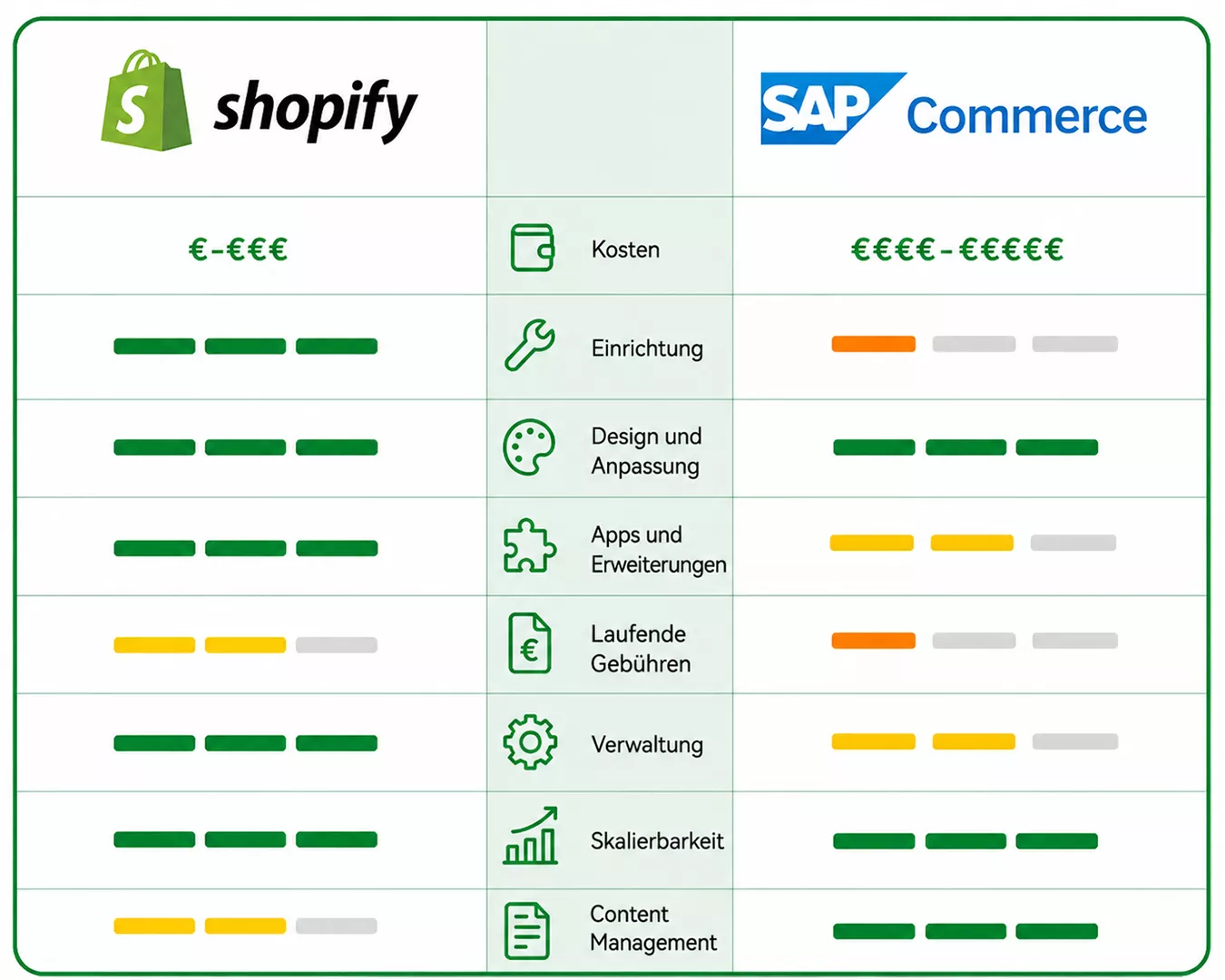
SAP Commerce or Shopify? A Direct Comparison 2026
SAP Commerce vs Shopify in a direct comparison: costs, B2B, SAP integration, complexity and SEO. Find out which system fits your store.
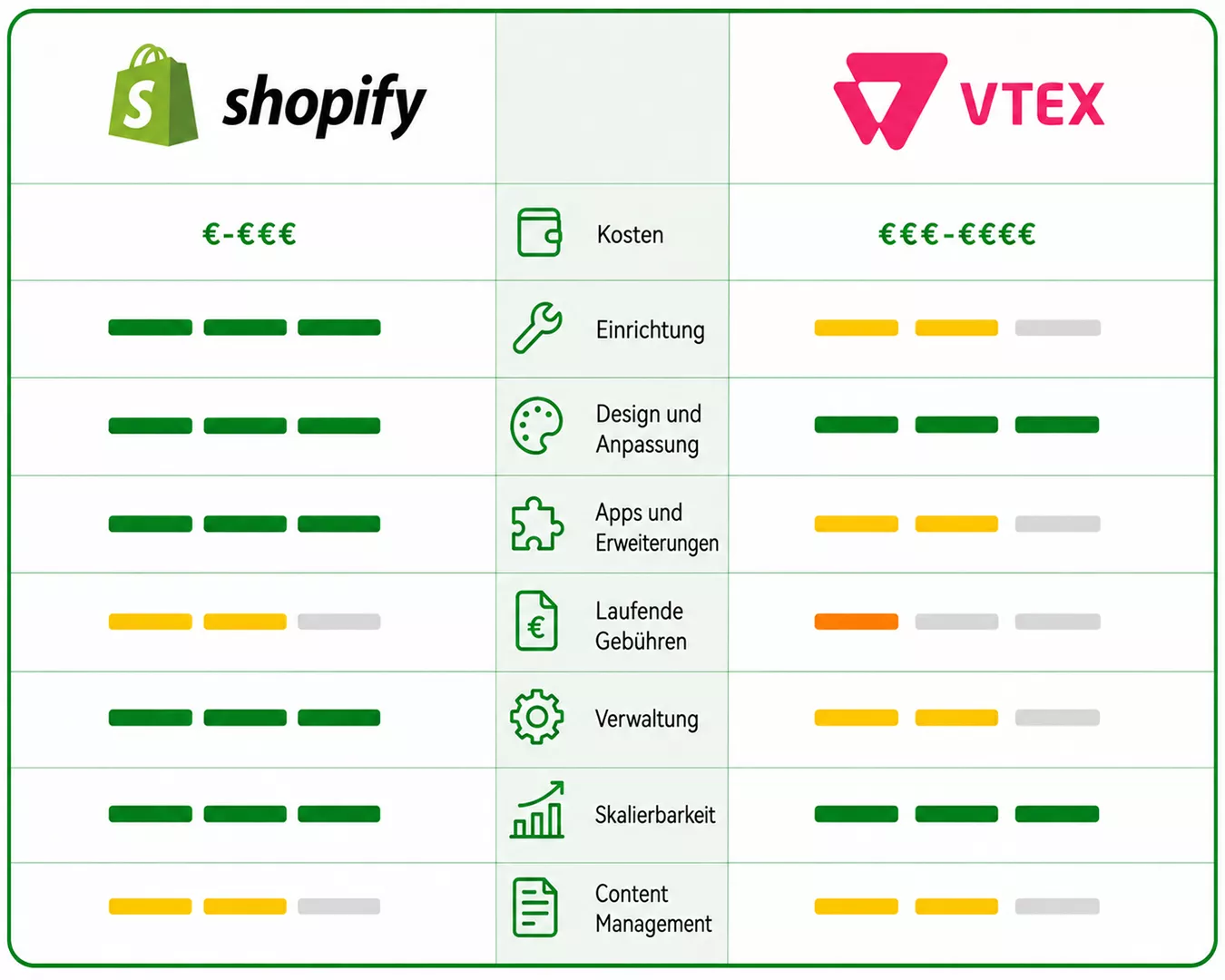
VTEX or Shopify? A Direct Comparison 2026
VTEX vs Shopify in a direct comparison: costs, B2B, marketplace, internationalization and SEO. Find out which system fits your store.
commercetools or Shopify? A Direct Comparison 2026
commercetools vs Shopify in a direct comparison: costs, composable/headless, time to market, B2B and SEO. Find out which system fits your store.