Spryker vs Shopify: Direct Comparison 2026
Spryker vs Shopify in direct comparison. Costs, complexity, composable commerce and time to market. Find out which platform fits you.

Richard Roth
SEO & GEO Strategist
July 30, 2026
7 min read
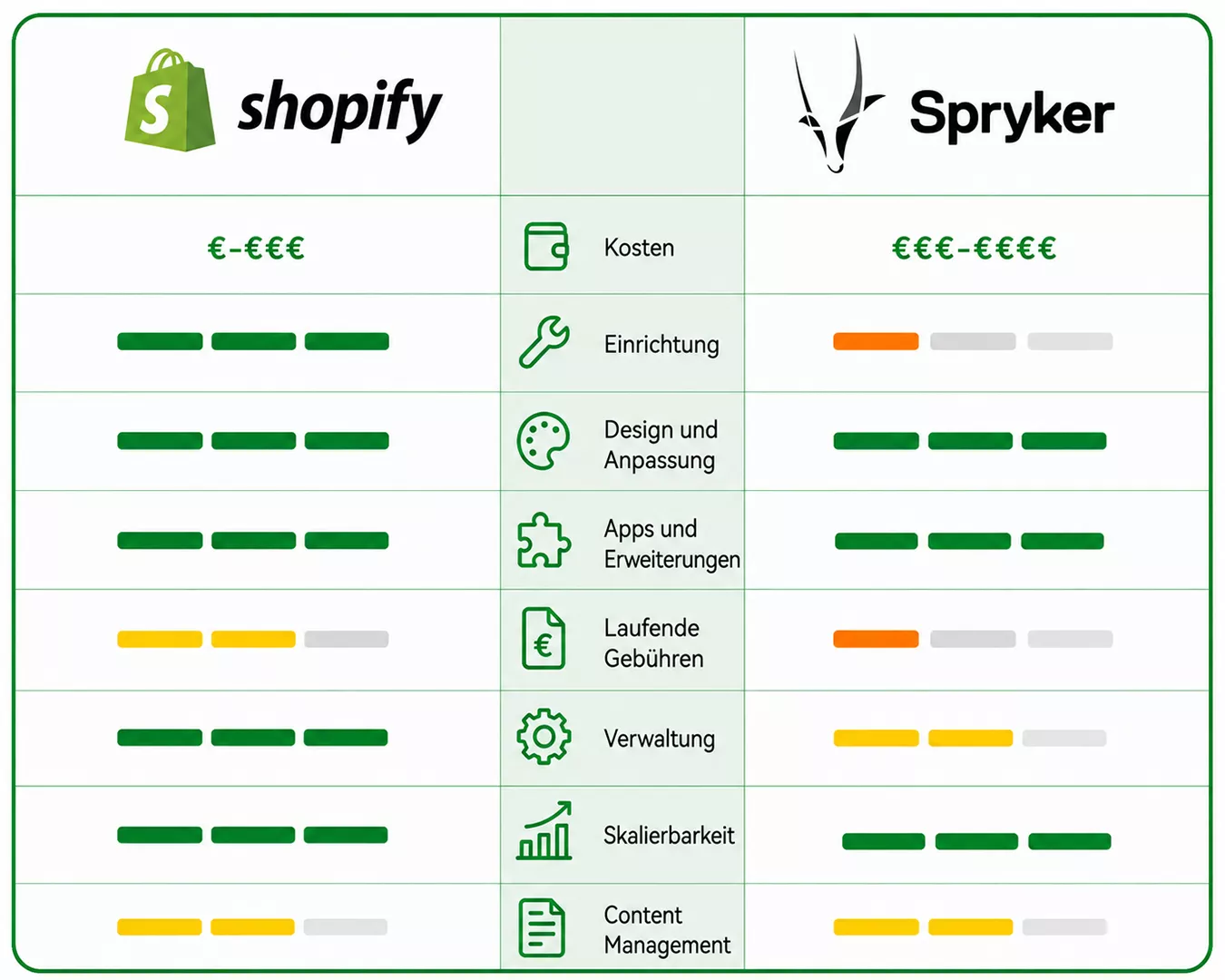
You’re facing a decision: Spryker or Shopify? Spryker is a composable enterprise platform for very complex scenarios, Shopify an all-in-one solution focused on speed and conversion. We compare both from practical experience and show you when each path pays off. For an overview of more systems, check out our shop system comparison.
- • Spryker is a powerful, composable enterprise platform for complex B2B, marketplaces, and composable commerce, with high costs and its own dev team.
- • Shopify, or Shopify Plus, delivers nearly the same capability at a fraction of the cost and time to market, without an in-house dev team.
- • For truly highly complex composable scenarios, Spryker remains strong, and we say so plainly.
- • For the vast majority of shops, though, Spryker's complexity is oversized and Shopify is the leaner, cheaper path.
Shopify and Spryker: composable enterprise versus all-in-one commerce
Both platforms target different leagues and needs.
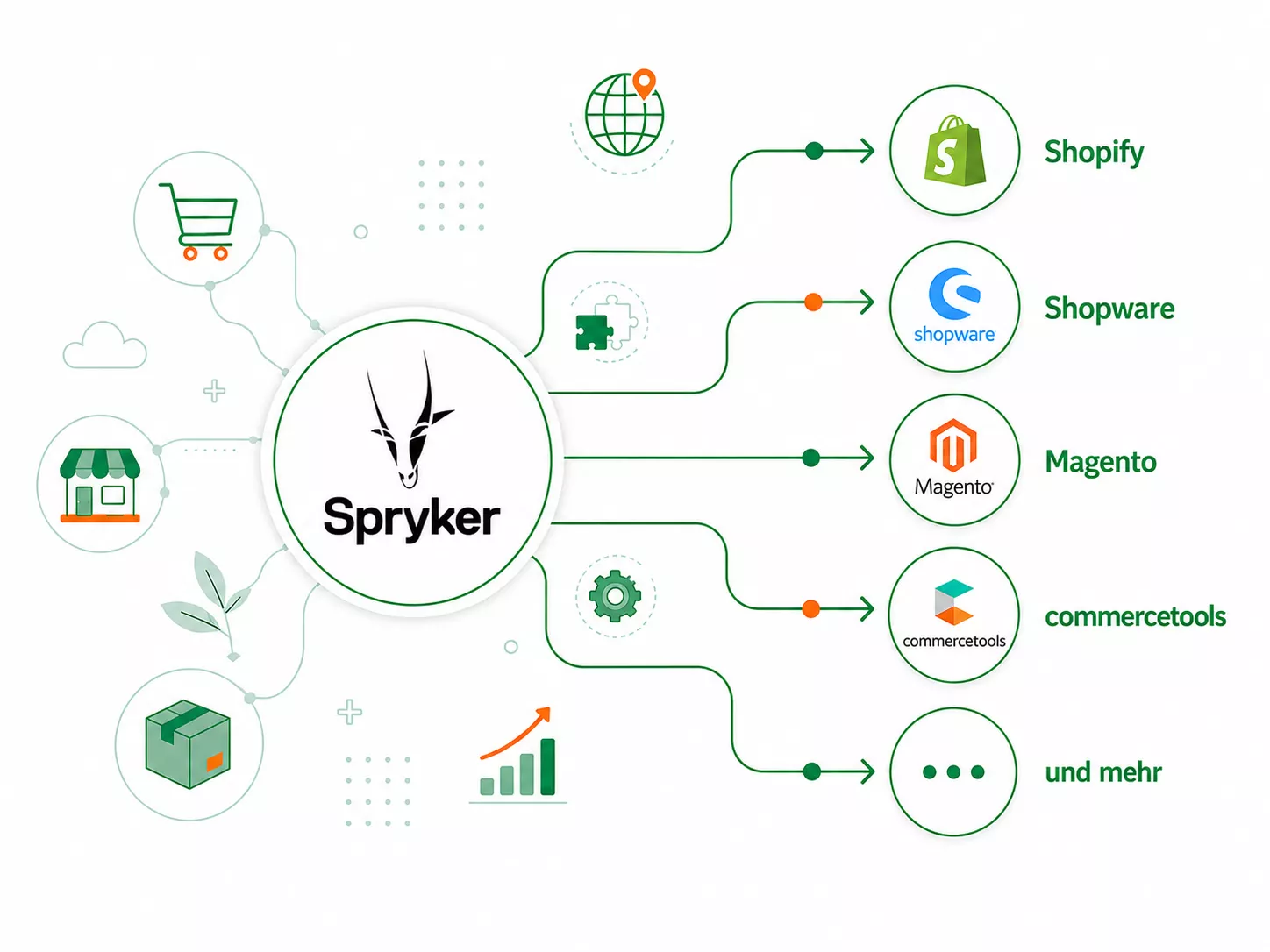
Spryker is an API-first, composable commerce platform. You assemble your system yourself from building blocks and your own frontend, maximally flexible for highly complex B2B, marketplace, and multi-business models. That’s powerful but requires a large developer team, high license and infrastructure costs, and long implementation times.
Shopify, or Shopify Plus, is a hosted all-in-one solution. You get enterprise capability without running infrastructure or developing everything yourself. The trade-off: slightly less boundless flexibility, but drastically lower costs and time to market.

Composable is a real answer to a real problem, but I’ve watched teams assemble a Spryker stack for flexibility they end up using maybe ten percent of. The tell is whether you truly have distinct services and business models that need to move independently, or just one very good shop. If it’s the latter, Shopify Plus with Hydrogen gives you a headless frontend without a standing dev team keeping the whole architecture alive.
Cost comparison: what do you really pay?
This is the biggest difference between the two platforms.
Spryker costs
Spryker works with custom enterprise licenses that quickly move into the high five- to six-figure range per year. On top come cloud infrastructure and, above all, a dedicated developer team that builds, operates, and evolves the platform.
The total costs are correspondingly high. Spryker only pays off if the complexity and revenue volume actually justify this effort.
Shopify costs
Shopify works with a clear pricing model. The Basic plan costs about €36 per month, and for enterprise requirements Shopify Plus is an option (predictable enterprise terms). In all cases, hosting, updates, security, and scaling are included, without an in-house dev team for operations.
For most shops that means a fraction of Spryker’s total costs.
Cost comparison in practice
| Cost type | Spryker | Shopify (Plus) |
|---|---|---|
| License | high, custom (enterprise) | predictable Plus terms |
| Infrastructure | self-operated (cloud) | included |
| Dev team | strictly required | not required |
| Time to market | months | weeks |
| Operation | your own team | with Shopify |
Spryker only pays off if you truly need the complexity. If your business is covered by a standard enterprise platform, with Spryker you pay for flexibility you never use. This is exactly where Shopify Plus is usually the more economical path.
Complexity, dev team, and time to market
This is the practical core of the decision.
Spryker is a pure developer platform. Without an experienced dev team you can’t operate anything with it, and every change goes through development. Implementations often stretch over many months, which burdens budget and time to market.
Shopify is usable right away. You implement campaigns, products, and changes in hours instead of sprints, much of it without developers. For teams that want to act quickly and flexibly in the market, that’s an enormous advantage.
When do you really need Spryker?
To be fair, Spryker’s strength deserves to be named clearly: for truly highly complex, composable scenarios the platform is excellent. If you run a large marketplace with many sellers, unite multiple business models under one roof, or run deeply customized processes with a large dev team, Spryker can be the right choice.
The key point is: very few shops have these requirements. Many companies that adopt Spryker are over-served and pay for flexibility and complexity they never fully use. For them, Shopify Plus covers the same needs far more leanly.
SEO and performance
Both platforms can deliver strong SEO and performance, but with Spryker both depend on your own implementation and infrastructure.
Shopify brings enterprise performance and a global CDN out of the box, without you having to operate infrastructure. The SEO fundamentals are clean and immediately usable. With Spryker you have to build this quality yourself and maintain it permanently, which ties up know-how and resources.
When is Spryker the better choice?
Spryker makes sense if you:
- Run a truly complex composable scenario with a lot of custom development
- Operate a large marketplace or multiple business models under one roof
- Have a large, experienced dev team and corresponding budget
- Put maximum, boundless flexibility above everything else
Spryker plays to its strengths when the complexity is real and you have the resources to master it.
When is Shopify the better choice?
Shopify makes sense if you:
- Want drastically lower total costs and predictable terms
- Don’t want to provide an in-house dev team for operation and development
- Want to go live in weeks instead of months
- Can cover enterprise requirements like B2B, internationalization, and high volumes via Shopify Plus
For the vast majority of shops, Shopify is the leaner, faster, and cheaper path to enterprise commerce.
Switching from Spryker to Shopify
Maybe you’re on Spryker and notice that the complexity and costs are out of proportion to your actual needs. Switching to Shopify Plus is then often a big win in speed and predictability.
The migration from Spryker to Shopify transfers products, customers, B2B accounts, prices, and content. We rebuild your frontend, map B2B via Shopify B2B, replace custom integrations with suitable apps or Shopify Functions, and redirect all URLs via a redirect map so your rankings are preserved.
If you run a truly highly complex composable setup, we assess neutrally whether the switch is even worth it. We at Store2x specialize in migrations to Shopify. For a straight assessment, you can request a free potential analysis.
Conclusion
Spryker or Shopify? For truly highly complex, composable enterprise scenarios with a large dev team, Spryker remains a strong choice. For the vast majority of shops, though, this complexity is oversized, and Shopify, or Shopify Plus, delivers nearly the same capability at a fraction of the cost and time to market.
 Frequently Asked Questions
 Is Shopify powerful enough to replace Spryker?
Why is Spryker so expensive?
How much faster is Shopify to go live?
Will my rankings be preserved when switching to Shopify?
Can we map our complex B2B on Shopify?
You might also like
Spryker Alternatives 2026: Headless Power, Compactly Delivered
Spryker alternatives compared: enterprise and headless commerce without a large dev team or a long implementation. With a clear recommendation.
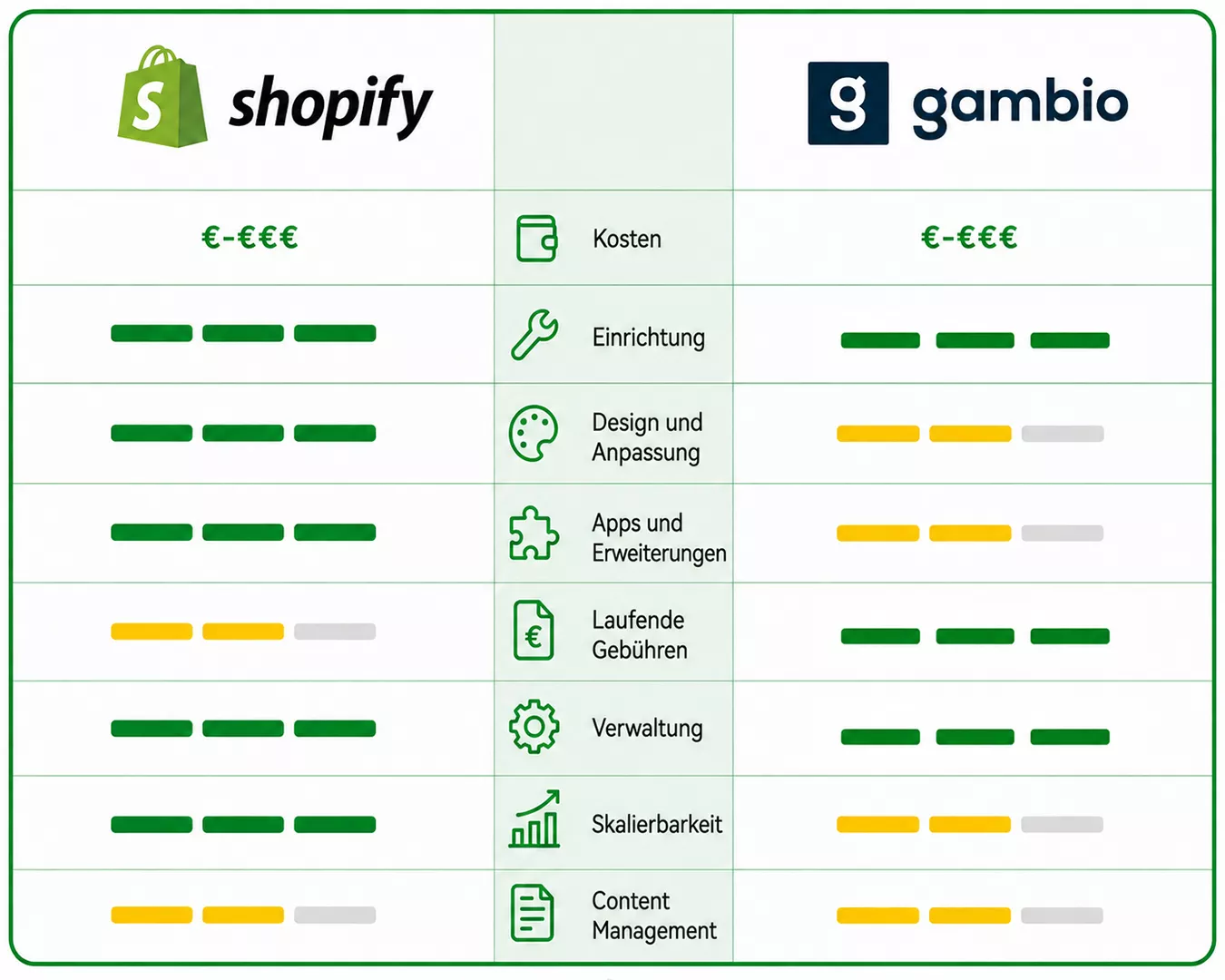
Gambio or Shopify? A Direct Comparison 2026
Gambio vs Shopify in a direct comparison: costs, maintenance, performance, features and SEO. Find out which system fits your store.
OXID vs Shopify: Direct Comparison 2026
OXID vs Shopify in direct comparison. Costs, B2B, hosting and maintenance. Find out which shop system fits your store.