Shopify vs Wix: Direct Comparison for Your Store
Shopify vs Wix in direct comparison. Costs, features, pros and cons. Find out which platform fits your online store.

Richard Roth
SEO & GEO Strategist
June 12, 2026
11 min read
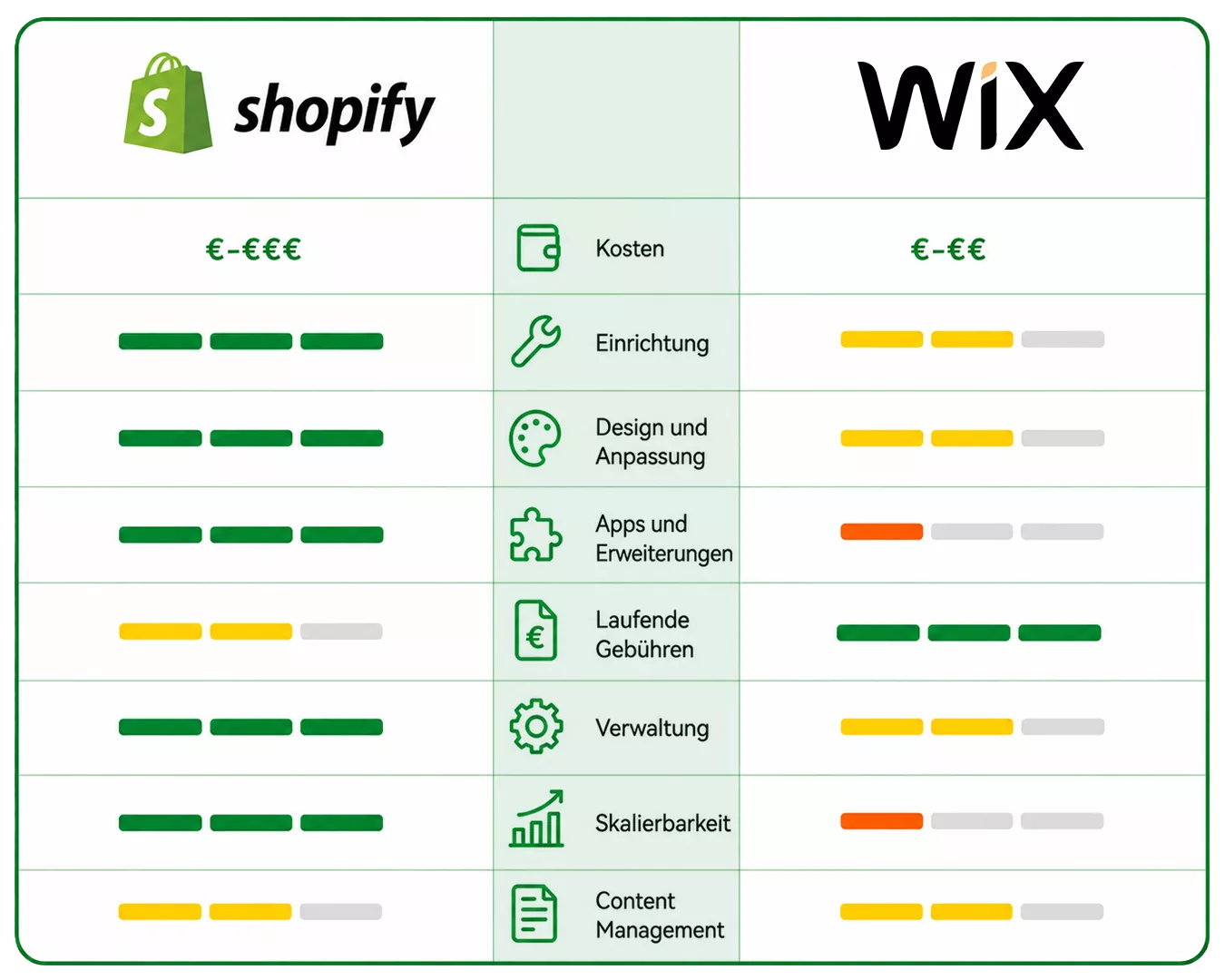
Are you wondering whether Wix or Shopify is the better choice for your store? Both platforms enable you to sell online, but they follow fundamentally different approaches. We compare both systems from practical experience and show you what really matters in the decision. For an overview of more systems, check out our shop system comparison.
- • Wix is a website builder with shop functionality. Its strength lies in design and ease of use, less in e-commerce.
- • Shopify is a specialized e-commerce platform. Everything is focused on selling, from product management to checkout.
- • For costs, Wix starts cheaper (from €27), Shopify is around €36 monthly. Total costs depend heavily on your requirements.
- • For stores that want to grow and take e-commerce seriously, Shopify is usually the smarter long-term choice.
Wix and Shopify: Two Different Worlds
Before we dive into details, you should understand that Wix and Shopify pursue different goals. Wix is a website builder that can also do e-commerce. Shopify is an e-commerce platform where you can also build content pages. The difference sounds small but affects every aspect.
Wix targets users who want a beautiful website and want to sell a few products on the side. The drag-and-drop editor is intuitive, the templates are modern, and you can get started without technical knowledge. The shop is just one feature among many.
Shopify was built from the ground up for online retail. Every function, every setting, every app revolves around selling. You notice this in product management, shipping options, and checkout. For pure sellers, this is an advantage; for website projects with a small shop component, it’s sometimes overkill.
Cost Comparison: What Do You Really Pay?
The price question is more complex than a glance at monthly fees. Let’s break it down.
Wix Costs
For e-commerce, you need at least the Business Basic Plan at Wix for about €27 per month. This lets you accept online payments and run a store. Higher plans like Business Unlimited (€38) or Business VIP (€59) offer more storage and additional features.
For transaction fees, Wix works with external payment providers. Depending on the provider, between 1.9 and 2.9 percent per transaction applies. Wix itself doesn’t charge additional platform fees if you use Wix Payments.
Shopify Costs
The Basic Plan from Shopify costs about €36 per month with annual billing. This includes all core e-commerce features, unlimited products, and 24/7 support. The Shopify plan is about €105, the Advanced plan €384 monthly.
For transaction fees with Shopify Payments on the Basic plan, you pay 2.1 percent plus €0.30 per transaction. If you use another payment provider, there’s an additional platform surcharge of 2 percent. This is an important cost factor many overlook.
The advantage with Shopify Payments: Once you activate it, the platform surcharge is completely waived. This also applies to PayPal payments, which then only cost the normal PayPal fee.
Cost Comparison in Practice
| Cost Type | Wix (Business Basic) | Shopify (Basic) |
|---|---|---|
| Monthly base fee | approx. €27 | approx. €36 |
| Hosting | included | included |
| Transaction fee (credit card) | approx. 1.9 to 2.9% | 2.1% + €0.30 |
| Platform surcharge (external payment) | 0% | 2.0% (without Shopify Payments) |
| Product variants | max. 300 | unlimited |
At first glance, Wix seems cheaper. With growing revenue, however, this can shift, especially when you need advanced e-commerce features that cost extra at Wix.
Ease of Use: How Quickly Can You Get Started?
In terms of usability, Wix has a real advantage: The drag-and-drop editor is intuitive and fun. You drag elements where you want them, adjust sizes, and see the result immediately. For design freedom, Wix is hard to beat.
Shopify works with a more structured approach. You choose a theme and customize it within predefined areas. This feels less free but has an advantage: Stores consistently look professional because the framework prevents design mistakes.
For pure store management – creating products, processing orders, tracking inventory – Shopify is clearly superior. The interface is optimized for e-commerce and guides you through every process. With Wix, you often have to click through various menus to accomplish the same tasks.
The best user experience depends on what you actually want to do. For website design, Wix is easier. For store operations, Shopify is more efficient.
E-Commerce Features in Detail
This is where the fundamental difference between both platforms becomes most apparent.
Product Management
Shopify offers unlimited product variants. You can create complex products with different sizes, colors, and options without hitting limits. Inventory management automatically tracks stock across multiple locations.
Wix limits you to maximum 300 product variants. For small stores, this is enough, but if you sell fashion, jewelry, or other products with many variants, you’ll quickly hit this limit. Inventory management is simpler and offers less automation.
Payment Methods
Shopify supports over 100 payment providers worldwide. From credit cards to PayPal to local options like Klarna, instant bank transfer, or Apple Pay – everything is included. Integration works with just a few clicks.
Wix offers about 50 payment providers. The most important ones for the German market are included, but for international sales or special requirements, the selection can be limited.
Multi-Channel Sales
Shopify shines at selling across multiple channels. You can sell directly on Amazon, eBay, Instagram, TikTok, and Facebook, all from one interface. Orders and inventory sync automatically.
Wix also offers integrations for social selling, but the options are more limited. For complex multi-channel strategies, you need additional apps or external solutions.
If you plan to sell on marketplaces like Amazon or eBay alongside your store, Shopify’s native multi-channel support is a real time-saver.
Design and Templates
Wix has over 800 templates, many specifically for various industries and purposes. The editor lets you place every element pixel-perfect. This is both strength and risk: You have maximum freedom but also responsibility for cohesive design.
Shopify offers about 150 themes in the official store, some free. Quality is consistently high because every theme is vetted by Shopify. Customization options are more structured than Wix, leading to more consistent results.
An important difference: With Wix, you can’t change templates after starting without rebuilding the site. With Shopify, theme changes are possible anytime because content and design are separate.
Apps and Extensions
The Shopify App Store offers over 8,000 apps for every conceivable use case. From email marketing to product reviews to advanced shipping options, you’ll find a solution for almost any problem. Integration is seamless.
The Wix App Market has about 500 apps. The most important categories are covered, but the selection is significantly smaller. For standard requirements, this is enough; for special needs, it can get tight.
Store2x recommends: Less is often more. Before deciding, check which apps you really need. Sometimes a platform with fewer but better native features makes more sense than one with a huge app ecosystem.
SEO and Marketing
Both platforms offer solid SEO fundamentals. You can customize meta titles and descriptions, define URLs, and add alt texts for images.
Wix has caught up significantly in recent years and now offers reasonable SEO tools. The integrated SEO assistant guides you through the most important settings. For blogs, Wix is well-suited, which facilitates content marketing.
Shopify scores with clean technical structure. Loading times are usually faster, which is important for both SEO and conversion. For content marketing, Shopify requires a bit more effort because the platform is primarily product-focused.
Support and Help
Shopify offers 24/7 support via chat, email, and phone. Quality is good, wait times usually short. Additionally, there’s an extensive Help Center and the Shopify Community.
Wix has support via chat and email, but not around the clock. Quality is decent, but complex e-commerce questions sometimes lack depth. The knowledge base is extensive and helps with many standard questions.
Legal Requirements in Germany
For the German market, both platforms must be set up GDPR-compliant. Wix hosts data partly in the USA, requiring additional privacy documentation. Shopify now offers European data centers.
Legal notices, terms and conditions, and cancellation policies must be built in yourself with both systems. For Shopify, there are specialized apps like German Market that automate German legal requirements. For Wix, the selection of German legal apps is smaller.
Expert tip: Have your legal texts checked by a lawyer or specialized service provider. Neither Wix nor Shopify takes responsibility for legally compliant setup.
When Is Wix the Better Choice?
Wix makes sense if you:
- Want a beautiful website and the shop is only part of it
- Have a small assortment with few product variants
- Value maximum design freedom more than e-commerce depth
- Have a limited budget and can manage with basic features
- Don’t plan to scale significantly or sell internationally
Wix is a solid choice for freelancers, artists, or small businesses who want to present their work and sell a few products on the side.
When Is Shopify the Better Choice?
Shopify makes sense if you:
- Want to run a real online store, not just a website with shop functionality
- Plan to scale and increase revenue
- Need to manage many products or complex variants
- Want to sell through multiple channels like Amazon, Instagram, or retail
- Have little time for technical maintenance and want to focus on selling
Shopify is the better choice for merchants who see e-commerce as their core business, not a side project.
Switching from Wix to Shopify
Maybe you’re already using Wix and wondering if a switch makes sense. That’s a valid thought when your store grows and you’re hitting the platform’s limits.
Migrating from Wix to Shopify is doable but not a weekend project. Products, customer data, and order history need to be transferred. URLs change, which leads to SEO losses without proper redirects. Design and features need to be rebuilt.
With the right concept, however, you can use the migration as an opportunity. A switch offers you the chance to optimize structures, streamline processes, and start fresh with a clean setup.
We at Store2x specialize in exactly these migrations to Shopify. If you’re considering whether a switch makes sense for you, you can request a free potential analysis.
Conclusion
Wix or Shopify? The answer depends on your focus. If you need a website with shop functionality and design is more important than e-commerce depth, Wix can be the right choice. If you want to run a real online store and scale, Shopify is the platform that grows with your requirements.
 Frequently Asked Questions