Jimdo vs Shopify: Direct Comparison 2026
Jimdo vs Shopify in direct comparison. Costs, e-commerce features, scaling and usability. Find out which system fits your store.

Richard Roth
SEO & GEO Strategist
June 20, 2026
9 min read
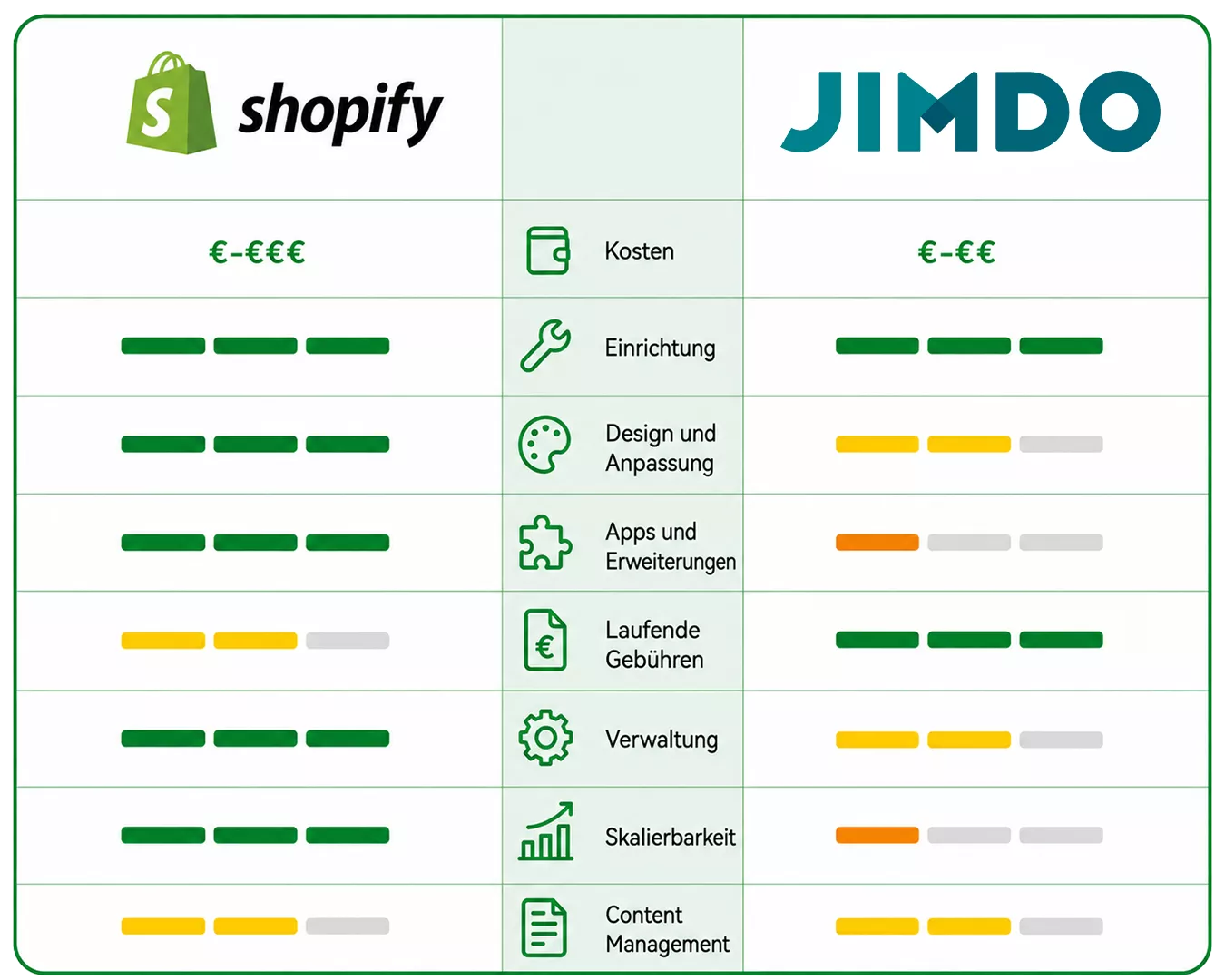
You’re facing a decision: Jimdo or Shopify? Both systems target different audiences. Jimdo is a website builder for a quick start, Shopify a real e-commerce platform for growing stores. We compare both from practical experience and show you what really matters in the decision. For an overview of more systems, check out our shop system comparison.
- • Jimdo is a website builder with a shop function. Ideal for small sites, portfolios, and simple stores with few products.
- • Shopify is a dedicated e-commerce platform. It's built to sell and to grow with your business.
- • On costs, Jimdo is cheaper to start with, but its e-commerce features are heavily limited. Shopify costs more but delivers a complete selling system.
- • As soon as you want to sell seriously, scale, or run multiple channels, Jimdo hits its limits fast. Then Shopify is the more sustainable choice.
Jimdo and Shopify: Website Builder vs. Selling Platform
Before we dive into details, you should understand that Jimdo and Shopify were built for different purposes. Jimdo is a website builder. With Jimdo Dolphin, you create a simple website in minutes, optionally with a small shop. The focus is on simplicity, not on selling.
Shopify is an e-commerce platform from the ground up. Every function, from the product catalog to the checkout to shipping logic, is designed for selling. You don’t start with a website and add a shop to it, you start with a shop that’s meant to sell from day one.
This difference explains almost everything that follows. Jimdo is perfect for getting online quickly. Shopify is built to generate revenue online and to grow that revenue.
What Does Jimdo Cost Compared to Shopify?
At first glance, Jimdo is cheaper. On closer inspection, it depends on what you need.
Jimdo Costs
Jimdo offers several plans, from a free entry tier to e-commerce plans in the range of about €9 to €39 per month. Hosting, SSL, and a simple shop are included. For a small website with few products, this is often enough.
But the low prices come at a cost: limited features. The more you want to sell, the sooner you’ll notice that important e-commerce features are missing or only rudimentary.
Shopify Costs
Shopify works with a clear pricing model. The Basic plan costs about €36 per month with annual billing. This includes hosting, SSL, support, and all core features for selling.
The other plans: The Shopify plan is about €105, the Advanced plan €384 monthly. For transaction fees with Shopify Payments on the Basic plan, you pay 2.1 percent plus €0.30 per transaction.
Cost Comparison in Practice
| Cost Type | Jimdo | Shopify (Basic) |
|---|---|---|
| Monthly cost | approx. €9 to €39 | approx. €36 |
| Hosting | included | included |
| E-commerce features | basic | complete |
| App ecosystem | very limited | over 8,000 apps |
| Scalability | low | high |
Don’t just look at the monthly price. The decisive question is whether the system grows with you. A cheap plan that slows you down after six months costs more in the end than the right platform from the start.
How Easy Are Jimdo and Shopify to Use?
When it comes to simplicity, Jimdo is strong, that’s exactly what it was made for.
With Jimdo, you create a website in a few minutes, often without any prior knowledge. You answer a few questions, choose a design, and get going. For absolute beginners, that’s a real advantage.
Shopify is also beginner-friendly, but with more depth. The dashboard is clearly structured, and you don’t need coding skills. You’ll invest a bit more time but get significantly more options to design and optimize your store.
The difference: Jimdo is faster to launch, Shopify gives you more control. If you just need a simple online presence, Jimdo is enough. If you want to sell and optimize, Shopify’s slightly steeper learning curve pays off.
Which E-Commerce Features Do Jimdo and Shopify Offer?
This is where the biggest difference between the two platforms lies.
Jimdo offers a simple shop: You can list products, create variants, and accept payments. For a small catalog, this works. But features like extensive discount logic, subscription models, professional inventory management, or deep shipping integrations are barely there or missing entirely.
Shopify delivers a full-featured e-commerce system. Unlimited products, flexible variants, professional inventory management, discount codes, gift cards, abandoned-cart recovery, and an optimized checkout that’s demonstrably tuned for conversion. Everything you need to sell seriously is included out of the box.
Store2x recommends: If your store is more than just a side project and you plan to sell regularly, you need e-commerce features that grow with you. That’s exactly where Shopify comes in, while Jimdo is more suited for a simple online business card with a shop function.
Which Payment Providers and Apps Are Available?
Payment providers and extensions show how different the two ecosystems are.
Jimdo supports common payment methods like PayPal and credit card, but the selection is limited. For most small shops, this is enough. However, if you need special payment methods or local providers, it can get tight.
Shopify offers Shopify Payments plus over 100 additional payment providers. On top of that comes the App Store with over 8,000 apps for marketing, shipping, accounting, reviews, and nearly every other use case. This ecosystem is one of Shopify’s biggest advantages: You can extend your store exactly as your business demands.
How Good Are Jimdo and Shopify at SEO?
Both platforms offer basic SEO features. You can customize meta titles, descriptions, and alt texts.
Jimdo covers the basics and is enough for a simple website. But with growing stores that have many products and categories, you hit limits, for example with structured data, flexible URL control, or international setups.
Shopify offers more SEO depth: clean URL structures, automatic sitemaps, fast loading times via a global CDN, and a large selection of SEO apps. Especially if organic traffic is an important channel for you, Shopify has the edge here.
How Well Do Jimdo and Shopify Scale?
This is the decisive question if you think long-term.
Jimdo is optimized for small projects. As long as your shop stays manageable, everything runs smoothly. But as soon as you want more products, more orders, or more sales channels, you lack the necessary depth. Jimdo doesn’t grow with you, it sets limits relatively early.
Shopify is built for growth. From the first sale to several million in revenue with Shopify Plus, the platform covers every stage. You can sell internationally, connect multiple channels like Instagram and TikTok, and extend your setup anytime without having to switch systems.
When Is Jimdo the Better Choice?
Jimdo makes sense if you:
- Need a simple website with a small shop function
- Sell only a few products and don’t plan to grow
- Have a minimal budget and want to be online fast
- Have no special requirements for features or integrations
- Run the shop more as a side project than as your main business
Jimdo is a good starting point if simplicity matters more to you than feature scope.
When Is Shopify the Better Choice?
Shopify makes sense if you:
- Want to sell seriously and build revenue
- Plan to grow your store
- Offer more than just a handful of products
- Want to serve multiple channels or international markets
- Need a system that grows with you instead of slowing you down
Shopify is the platform when your store is your business and not just your online business card.
Switching from Jimdo to Shopify
Maybe you started with Jimdo and now notice your store is hitting limits. This is a common scenario. Jimdo is ideal for getting started but quickly too tight for professional e-commerce.
Migrating from Jimdo to Shopify is very doable because Jimdo shops are usually manageable. Products, images, and content are transferred, a conversion-optimized Shopify theme replaces the old design, and with a clean redirect map your rankings stay intact. In many cases, the new store is live in around two weeks.
We at Store2x specialize in exactly these migrations to Shopify. If you’re considering whether a switch makes sense for you, you can request a free potential analysis.
Conclusion
Jimdo or Shopify? The answer depends on your ambition. If you need a simple website with a small shop function and don’t plan major growth, Jimdo is a cheap and quick way to start. As soon as you want to sell seriously, scale, or serve multiple channels, Shopify is the more sustainable choice because the platform grows with your business.
 Frequently Asked Questions