Plentymarkets vs Shopify: Direct Comparison 2026
Plentymarkets vs Shopify in direct comparison. Costs, complexity, multichannel and ERP. Find out which system fits your store.

Richard Roth
SEO & GEO Strategist
June 20, 2026
9 min read
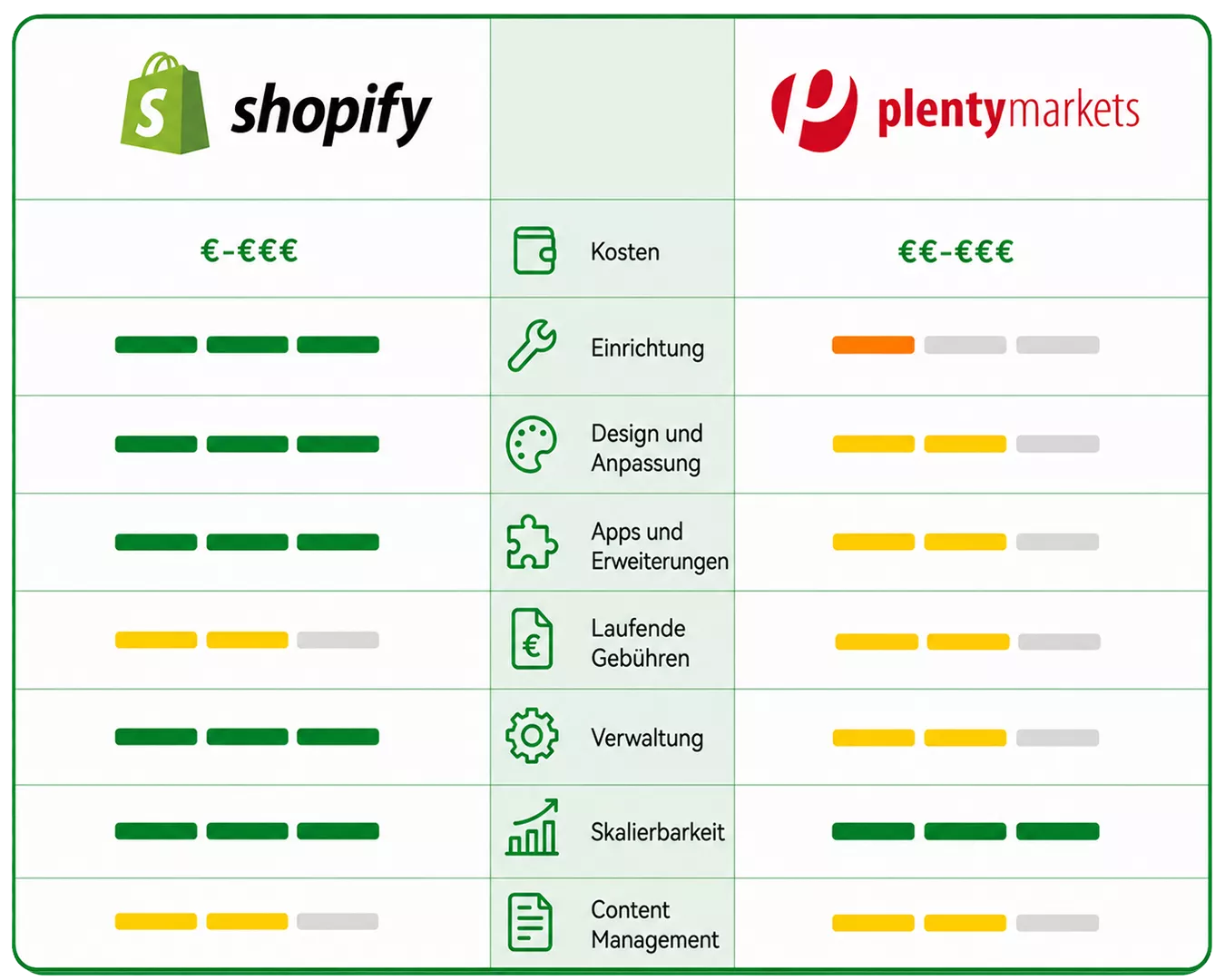
You’re facing a decision: Plentymarkets or Shopify? Both systems target growing merchants but follow opposing philosophies. Plentymarkets is an all-in-one solution with ERP and multichannel, Shopify a focused selling platform. We compare both from practical experience and show you what really matters in the decision. For an overview of more systems, check out our shop system comparison.
- • Plentymarkets is an all-in-one system: shop, warehouse management, and multichannel in one platform. Powerful, but complex and with a steep learning curve.
- • Shopify is a focused e-commerce platform. It does one thing excellently, selling, and complements everything else through specialized apps.
- • For pure shop operators, Plentymarkets is often oversized. You pay for and maintain features you don't even need.
- • Shopify scores with intuitive usability, fast performance, and predictable costs. You solve multichannel through the App Store instead of a monolithic system.
Shopify and Plentymarkets: Focus vs. All-in-One
Before we dive into details, you should understand that Shopify and Plentymarkets follow fundamentally different approaches. Plentymarkets is an all-in-one system: shop, warehouse management (ERP), inventory, shipping, and marketplace connections in a single platform. Everything from one source, but complex.
Shopify follows the best-of-breed approach. The platform focuses on selling and does that excellently. Everything else, from warehouse management to marketplace connections, you add through specialized apps from the App Store. This way you build exactly the setup you need.
This difference shapes everything that follows. Plentymarkets gives you everything in one system but demands onboarding and maintenance. Shopify keeps the core lean and leaves you the choice of what to extend it with. The question is: Do you need a complete system or a focused platform with flexible extensions?
Cost Comparison: What Do You Really Pay?
The cost structure differs significantly because both systems cover different things.
Plentymarkets Costs
Plentymarkets works with a usage-based model. Costs consist of a base fee, booked features, marketplace connections, and partly revenue-dependent components. This makes calculation more complex and often more expensive than expected for pure shop operators.
On top of that comes the maintenance effort: An all-in-one system needs to be configured, maintained, and understood. Many merchants therefore work with Plentymarkets partners, which causes additional costs.
Shopify Costs
Shopify works with a clear pricing model. The Basic plan costs about €36 per month with annual billing. This includes hosting, SSL, support, and all core features.
The other plans: The Shopify plan is about €105, the Advanced plan €384 monthly. For transaction fees with Shopify Payments on the Basic plan, you pay 2.1 percent plus €0.30 per transaction. Apps for ERP or multichannel are added as needed, but you only pay for what you actually use.
Cost Comparison in Practice
| Cost Type | Plentymarkets | Shopify (Basic) |
|---|---|---|
| Base costs | usage-based | approx. €36/month |
| Hosting | included (cloud) | included |
| Feature scope | all-in-one included | core plus apps as needed |
| Maintenance effort | high | low |
| Typical onboarding | several weeks | a few days |
Ask yourself honestly how many of the all-in-one features you really use. If you primarily run a shop and don’t need a complex ERP, with Plentymarkets you pay for features that sit idle.
How Complex Are Plentymarkets and Shopify to Use?
This is where one of the biggest everyday differences lies.
Plentymarkets is powerful but complex. The interface offers an enormous number of features, which means a steep learning curve. It often takes weeks until you master the system productively, and updates occasionally bring breaking changes that have to be maintained.
Shopify is deliberately kept simple. The dashboard is clearly structured, new employees are onboarded quickly, and you don’t need coding skills to be productive. This simplicity isn’t a lack of depth but a design decision: complexity moves into apps, the core stays usable.
Store2x recommends: If your team spends a lot of time understanding the system instead of selling, that’s a warning sign. A focused platform like Shopify frees up that time for growth.
How Good Are Plentymarkets and Shopify at Multichannel?
Multichannel is one of Plentymarkets’ core strengths, but Shopify keeps up well.
Plentymarkets is strong in the marketplace business. Connections to Amazon, eBay, and other channels are deeply integrated, including inventory and price control across all channels. For merchants who primarily sell via marketplaces, that’s a real argument.
Shopify solves multichannel through specialized apps and native sales channels. Amazon, eBay, Instagram, TikTok, and others can be connected, often with first-class apps optimized exactly for each channel. You build your multichannel setup modularly instead of maintaining it in a monolithic system.
The difference: Plentymarkets brings multichannel built-in, Shopify leaves you the choice of the best tools per channel. Both work, the path there is just different.
Warehouse Management and ERP
This is where Plentymarkets shows its original strength.
Plentymarkets is at its core an ERP with a shop function. Inventory management, order processing, purchasing, and accounting are deeply integrated. For merchants with complex logistics and high order volume across many channels, this integration can be valuable.
Shopify deliberately separates selling and warehouse management. For ERP requirements, you connect specialized solutions, from lean inventory tools to full-featured ERP systems. The advantage: You choose exactly the ERP that fits your business instead of committing to an integrated system.
Which approach is better depends on you. If ERP is the core of your business, Plentymarkets plays to its strength. If the shop is at the center, Shopify’s lean, extensible approach is often more practical.
SEO and Performance
Both platforms offer solid SEO fundamentals. Meta titles, descriptions, and URL structure can be customized.
Shopify has a clear advantage in performance. The global CDN infrastructure ensures fast loading times worldwide, and the storefront is tuned for speed out of the box. Fast loading times directly affect rankings and conversion.
With Plentymarkets, frontend performance depends more on configuration and template and is more often cited as a weak point in practice. With optimization, good values are achievable, but this requires effort and know-how.
Apps and Extensibility
The Shopify App Store is huge. Over 8,000 apps for every conceivable use case, from marketing automation to ERP connection to advanced shipping options. Installation is simple, most apps work immediately.
Plentymarkets has its own plugins and interfaces, often tailored to the DACH market and the marketplace business. The selection is more focused but smaller. For deep customizations, you usually need technical know-how or a Plentymarkets partner.
When Is Plentymarkets the Better Choice?
Plentymarkets makes sense if you:
- Want an integrated ERP with shop and multichannel from one source
- Primarily sell via marketplaces like Amazon and eBay
- Run an inventory- and process-intensive business with high volume
- Have the resources for onboarding, maintenance, and partners
- Prefer the all-in-one idea over a modular setup
Plentymarkets plays to its strengths when ERP and multichannel form the core of your business.
When Is Shopify the Better Choice?
Shopify makes sense if you:
- Want to focus on selling and put the shop at the center
- Prioritize intuitive usability and fast onboarding
- Want predictable costs instead of usage-based complexity
- Need a fast, conversion-strong storefront
- Prefer to build your setup modularly via apps rather than in a complete system
Shopify is the choice if you want to reduce complexity and focus on growth.
Switching from Plentymarkets to Shopify
Maybe you’re already using Plentymarkets and notice the system is oversized or too complex for your shop. This is a common scenario, especially for merchants who primarily run a shop and don’t need a full-featured ERP.
Migrating from Plentymarkets to Shopify is doable but requires careful planning because the Plentymarkets data model is deeply nested. Products, variants, customers, and order history are transferred cleanly, marketplace connections are re-established via Shopify apps, and with a seamless redirect map your rankings stay intact.
With the right concept, you use the migration as an opportunity: away from complexity, toward a focused, fast setup. We at Store2x specialize in exactly these migrations to Shopify. If you’re considering whether a switch makes sense for you, you can request a free potential analysis.
Conclusion
Plentymarkets or Shopify? The answer depends on your focus. If you need an integrated ERP with deep multichannel and have the resources for a complex system, Plentymarkets can be the right platform. If you want to focus on selling, reduce complexity, and scale quickly with predictable costs, Shopify is usually the better choice.
 Frequently Asked Questions