JTL vs Shopify: Direct Comparison 2026
JTL vs Shopify in direct comparison. Costs, hosting, ERP connection and scaling. Find out which system fits your store.

Richard Roth
SEO & GEO Strategist
June 20, 2026
9 min read
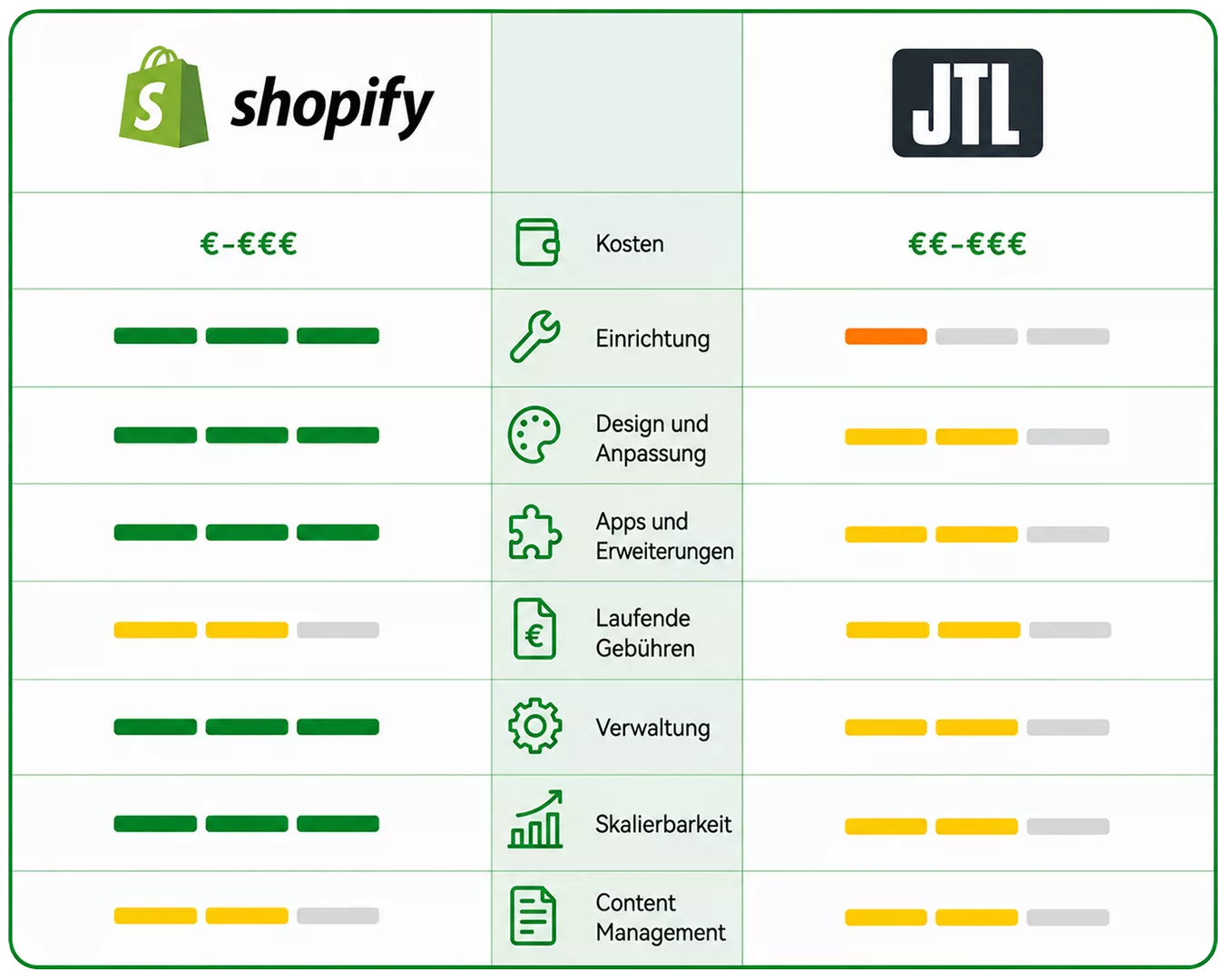
You’re facing a decision: JTL or Shopify? Both systems are common in German-speaking e-commerce but follow fundamentally different approaches. JTL is self-hosted and tightly integrated with JTL-Wawi, Shopify is a cloud-based all-in-one solution. We compare both from practical experience and show you what really matters in the decision. For an overview of more systems, check out our shop system comparison.
- • JTL-Shop is a self-hosted shop system that works closely with JTL-Wawi (warehouse management). The license is free, but you need your own hosting.
- • Shopify is a cloud-based SaaS platform. Hosting, updates, and security are included, and you can start immediately.
- • JTL's big strength is its deep warehouse management integration. If you work intensively with JTL-Wawi, that's a real argument.
- • The good news: JTL-Wawi can also be connected to Shopify. You can move to the cloud without giving up your warehouse management.
Shopify and JTL: Cloud vs. Self-Hosted With Warehouse Management
Before we dive into details, you should understand that Shopify and JTL follow fundamentally different approaches. Shopify is a fully hosted SaaS solution. You sign up, choose a theme, and can start selling. You don’t have to worry about servers, updates, or security.
JTL is a self-hosted ecosystem. JTL-Shop is the storefront, but the heart of it is JTL-Wawi, a free warehouse management system that many merchants in the DACH region use for inventory, shipping, and accounting. Shop and Wawi are tightly integrated, which makes JTL strong for inventory-intensive businesses.
In Germany, JTL has a loyal base among merchants who have built their processes around the Wawi. Shopify, on the other hand, dominates among brands that value a modern, maintenance-free platform. Both approaches have their merits, the question is just: What fits your business?
Cost Comparison: What Do You Really Pay?
At first glance, JTL seems cheaper because the shop is free. On closer inspection, the picture gets more complex.
JTL Costs
The JTL-Shop and JTL-Wawi are free at their core. That sounds unbeatable, but the total costs arise elsewhere: You need your own hosting (about €30 to €300 monthly depending on traffic), often paid plugins, and in most cases an agency for setup, updates, and maintenance.
On top of that, many merchants pay for service packs or worker licenses of JTL-Wawi once multiple workstations or advanced features are used. The free license is the entry point, not the whole picture.
Shopify Costs
Shopify works with a clear pricing model. The Basic plan costs about €36 per month with annual billing. This includes hosting, SSL, support, and all core features.
The other plans: The Shopify plan is about €105, the Advanced plan €384 monthly. For transaction fees with Shopify Payments on the Basic plan, you pay 2.1 percent plus €0.30 per transaction.
Cost Comparison in Practice
| Cost Type | JTL | Shopify (Basic) |
|---|---|---|
| Shop system license | free | approx. €36/month |
| Hosting | €30 to €300 | included |
| Updates & maintenance | agency or internal | included |
| Typical setup costs | €5,000 to €20,000 | under €5,000 |
| Warehouse management | JTL-Wawi included | via app/connector |
The free JTL license hides the running costs. Always factor in hosting, maintenance, and agency effort. Only then do you get a fair comparison with Shopify’s predictable monthly costs.
Hosting and Operations
This is where one of the biggest differences between both platforms lies.
Shopify is fully hosted. You don’t have to worry about anything. Updates are automatically applied, security is Shopify’s responsibility, and infrastructure scales automatically with your traffic. This is a real plus for teams that want to focus on selling.
JTL requires your own hosting. You’re responsible for servers, performance, backups, and security yourself, or you delegate it to a hosting partner. Updates to the shop software and the Wawi must be actively applied and tested, as they can be technically complex.
The advantage of self-hosted: You have full control over your infrastructure. The disadvantage: This control means responsibility and ongoing effort. With Shopify, this effort disappears entirely.
How Important Is the JTL-Wawi Connection?
This is the core of the decision, because warehouse management is JTL’s real strength.
JTL-Wawi controls inventory, shipping, invoices, purchasing, and often the entire logistics. Many merchants have built their processes around it over years. In JTL-Shop, this connection is native, inventory and orders sync automatically.
The decisive message: You don’t have to give up the Wawi when you switch to Shopify. Via a connector, JTL-Wawi can also be connected to Shopify. Inventory, orders, and items keep syncing while you benefit from the modern, fast Shopify storefront up front.
Store2x recommends: If JTL-Wawi is the backbone of your logistics, don’t give it up. During a migration, we connect it to Shopify so you get the best of both worlds: proven warehouse management in the back, modern selling platform in the front.
Flexibility, Themes, and Maintenance
When it comes to customization, the different philosophies show.
JTL gives you far-reaching control over the storefront through NOVA templates and custom code. You can intervene deeply but usually need developer know-how for that. The theme architecture is considered more technical and less modern than Shopify’s.
Shopify offers modern, fast themes that are customizable without programming. Through Liquid and Custom Apps, you go deep if you want. For most requirements, though, the theme editor and the App Store with over 8,000 apps cover everything.
The trade-off: JTL gives you maximum control but demands technical resources. Shopify takes complexity off your hands and delivers a more modern frontend without you having to worry about the technology behind it.
Internationalization and Sales Channels
For international sales and multi-channel, Shopify has clear strengths.
Shopify Markets makes it easy to sell in different countries with local currencies, languages, and payment methods. Integration with Amazon, eBay, Instagram, and TikTok works with just a few clicks. For brands that want to scale internationally, this is a real advantage.
JTL can do multi-channel too, mainly through the Wawi, which supports connections to Amazon and eBay. International storefronts, however, are more configuration-intensive, and the focus traditionally lies on the DACH market. If you want to quickly expand into many countries, Shopify is the more direct path.
SEO and Performance
Both platforms offer solid SEO fundamentals. Meta titles, descriptions, and URL structure can be customized.
Shopify has an advantage in performance. The global CDN infrastructure ensures fast loading times worldwide without you having to worry about caching or server optimization. Fast loading times directly affect rankings and conversion.
With JTL, performance depends on your hosting and configuration. With a well-optimized server, you achieve good values, but this requires know-how and ongoing maintenance. This is where Shopify’s hosted infrastructure pays off.
When Is JTL the Better Choice?
JTL makes sense if you:
- Use JTL-Wawi intensively and have built your processes around it
- Need full control over hosting and infrastructure
- Run an inventory-intensive business with complex logistics
- Have technical resources or an agency for operations and maintenance
- See the tight integration of shop and warehouse management as central
JTL plays to its strengths when warehouse management and logistics are at the center of your business.
When Is Shopify the Better Choice?
Shopify makes sense if you:
- Want a maintenance-free platform without server worries
- Prioritize a modern, fast storefront and high conversion
- Want to sell internationally and serve multiple channels
- Prefer predictable monthly costs over fluctuating maintenance costs
- Want to keep JTL-Wawi but modernize the frontend
Shopify takes technical complexity off your hands without you having to give up warehouse management.
Switching from JTL to Shopify
Maybe you’re already using JTL and wondering if a switch to Shopify makes sense. This is a common scenario, especially when maintenance effort and hosting worries increase.
Migrating from JTL to Shopify is doable but requires careful planning. Products, variants, customers, and order history are transferred, JTL-specific fields are mapped cleanly, and JTL-Wawi is reconnected via a connector. With a seamless redirect map, your rankings stay intact.
With the right concept, you use the migration as an opportunity: away from server maintenance, toward a modern platform, without giving up your proven warehouse management. We at Store2x specialize in exactly these migrations to Shopify. If you’re considering whether a switch makes sense for you, you can request a free potential analysis.
Conclusion
JTL or Shopify? The answer depends on your focus. If JTL-Wawi is the backbone of your logistics and you need full control over your infrastructure, JTL has its merits. If you want a maintenance-free, modern, and quickly scaling platform, Shopify is usually the better choice, especially since you can keep using JTL-Wawi there too.
 Frequently Asked Questions