The 7 Best E-Commerce Platforms Compared
Find out which e-commerce platform fits your business. Compare Shopify, Shopware, WooCommerce, Magento, Wix, BigCommerce, and Squarespace in detail.

Richard Roth
SEO & GEO Strategist
June 10, 2025
12 min read
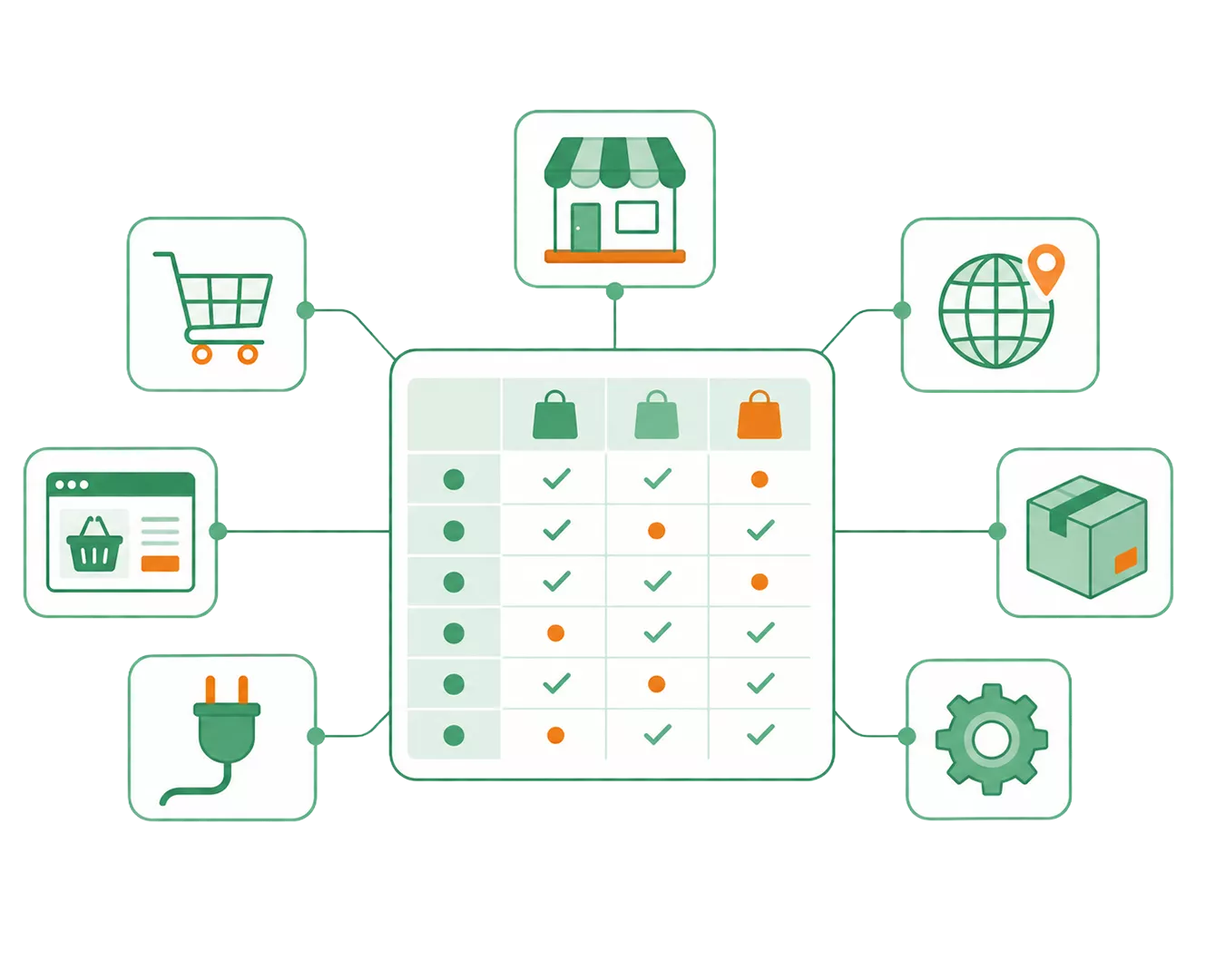
Find out which e-commerce platform fits your business. Choosing the right system determines how quickly you can launch, how well you’ll scale, and how much effort daily maintenance requires. Compare Shopify, Shopware, WooCommerce and four other platforms in detail.
- • Shopify excels with fast setup, strong app ecosystem, and excellent scalability for D2C brands
- • WooCommerce dominates with around 21% market share in Germany, but requires more technical know-how
- • Shopware is the DACH champion with native GDPR compliance and strong B2B features
- • For beginners, Shopify and Wix are particularly suitable; for enterprise projects, Magento or BigCommerce
Which E-Commerce Platform Is Right for You?
Choosing the right e-commerce platform is one of the most important decisions for your online success. A system that fits today can become a bottleneck tomorrow. That’s why it’s worth taking a close look at the strengths and weaknesses of each platform. The wrong decision will cost you time, money, and nerves later.
Especially if you’re planning big and want to reach the next level, a solid and clean structure is essential. Sustainable scaling only works when your shop runs smoothly and planned measures work harmoniously with the rest of your store.
In this comparison, we examine seven established e-commerce platforms and categorize them by their core strengths. Whether you’re just starting out, looking to scale, or need an enterprise setup: Here you’ll find the right solution for your requirements.
1. Shopify
Shopify is consistently rated as the top choice for beginners in current 2025/2026 tests and is considered an all-rounder among shop systems. The platform scores with extremely fast setup. Within a few hours, you can launch your first online store and start selling.
What makes Shopify special: The all-in-one solution takes technical complexity off your hands. Hosting, security, updates, and performance are in Shopify’s hands. You focus on your product and marketing while the platform runs in the background.
Shopify’s app ecosystem is impressive. Over 8,000 apps extend your shop with features like multi-channel sales, dropshipping, subscription models, or advanced analytics. Integration with Instagram, TikTok, Amazon, and Google Shopping works seamlessly, opening new sales channels.
Shopify’s checkout, known as Shop Pay, is among the highest-converting on the market. One-click payment reduces cart abandonment and increases your revenue. For shops with high traffic, this is a real competitive advantage over other systems.
| Strengths | Consider |
|---|---|
| Fastest launch of all systems | Transaction fees with external payment providers |
| Excellent checkout (Shop Pay) | German legal texts require additional apps |
| Strong scalability up to enterprise | Monthly costs increase with features |
| Excellent app ecosystem with 8,000+ apps | Less control over code than open-source |
| Multi-channel natively integrated | Some B2B features only in expensive plans |
Who is Shopify suitable for? D2C brands, dropshipping businesses, startups, and companies that want to scale quickly. The platform grows with you, from first sales to millions in revenue. If you run a shop that’s hitting its limits, a migration from WooCommerce to Shopify could be the next logical step.
Expert Tip: Shopify is particularly well-suited if you want to sell multi-channel. The native integrations with social media platforms and marketplaces are often superior to other systems. Test different channels and scale where it works.
2. Shopware
Shopware is considered the DACH champion and the strongest specialized shop system for the German market. With around 14% market share in Germany, it’s one of the leading platforms in the DACH region and enjoys great trust among German merchants.
Shopware’s biggest advantage: It’s developed in Germany. GDPR, GoBD, and German payment providers are integrated from the ground up. You save yourself configuring legal text apps and local payment providers. Legal compliance is basically built-in.
Shopware 6 uses an API-first approach and enables headless commerce. For companies that need maximum flexibility in frontend design, this is a strong argument. You can connect any frontend while still using the powerful Shopware backend.
Shopware’s B2B features are among the best on the market. Customer group pricing, individual catalogs, quote processes, and complex discount logic are natively available. For companies with business customer sales, this is a decisive advantage over pure B2C systems.
However, Shopware is not a system for quick starts. Setup is more complex, and you need either technical know-how or an agency. Development and plugin costs can quickly add up, especially with individual requirements.
If you’re currently using Shopware and planning scalability or international expansion, a migration from Shopware to Shopify might be interesting. The lower operating costs and Shopify’s international ecosystem open new possibilities.
3. WooCommerce
WooCommerce achieves around 21% market share in Germany and is the most widely used e-commerce plugin. As a WordPress extension, it benefits from the huge WordPress community and thousands of available plugins for every conceivable use case.
WooCommerce’s strength lies in its flexibility. You have full control over code, design, and hosting. For content-heavy websites with shop functionality, WooCommerce is often the obvious choice. Blogs, magazines, and information portals with integrated shops often rely on this solution.
- Free entry (plugin itself is free)
- Maximum customizability through open-source basis
- Huge plugin ecosystem with thousands of extensions
- SEO advantages through WordPress basis and established tools
- Full control over hosting and data
The downside: More responsibility lies with you. Hosting, security updates, performance optimization, and legal adjustments must be managed yourself or handed over to service providers. With growing traffic, WooCommerce can become maintenance-intensive. Server configuration, caching, and database optimization require technical know-how.
Maintenance costs are often underestimated. Plugin updates can lead to conflicts, security vulnerabilities must be closed promptly, and performance optimization requires continuous attention. Factor these hidden costs into your calculation.
Many of our customers started with WooCommerce. That’s perfectly fine for the beginning, as WooCommerce enables a quick and cheap start. With growing requirements, it often lacks the capabilities to build clean foundations for scaling.
Store2x recommends: If your WooCommerce shop is hitting limits and you need more automation or performance, it’s worth looking at a WooCommerce to Shopify migration. With the right concept, your SEO visibility remains intact.
4. Magento / Adobe Commerce
Magento, now known as Adobe Commerce, is the enterprise solution among shop systems. For large companies with complex requirements, multiple storefronts, and international markets, Magento remains a solid choice. The platform serves some of the world’s largest online stores.
The platform offers maximum customization options. Every function can be individually developed. B2B features, multi-store setups, complex product configurations, and international currency and tax logic are Magento’s strengths. If you have very specific requirements that no other system fulfills, Magento is often the answer.
The downside: Magento is expensive and resource-intensive. You need a dedicated developer team or a specialized agency for setup, maintenance, and development. License costs for Adobe Commerce are in the five-figure range per year. Hosting, development, and support come on top. For SMEs, this is usually not an option.
- Maximum flexibility for complex requirements
- Multi-store and multi-language native
- Strong B2B features for wholesale
- High investment costs and ongoing expenses
- Long development cycles for changes
In the mass market, Magento is declining compared to SaaS solutions like Shopify. Cloud and SaaS alternatives offer similar features with less effort. The trend is moving away from heavy on-premise solutions.
If you want to move away from Magento, we support you with a migration from Magento to Shopify. The switch saves development costs in the long run and enables faster iterations.
5. Wix
Wix is primarily a website builder that offers an integrated shop function. For beginners with a low budget and simple requirements, Wix can be a good starting point. The platform targets users without technical background.
Wix’s strength: The low barrier to entry. You build your shop via drag-and-drop. Technical knowledge is not required. The price-performance ratio is attractive for small projects, and you can go online within hours.
- Intuitive operation without prior knowledge required
- Affordable entry from about $27 per month
- Hosting, SSL, and domain included
- Solid design templates for various industries
- No technical maintenance necessary
For ambitious e-commerce projects, Wix quickly reaches its limits. Scalability is limited, advanced features are missing, and Germany-specific requirements (legal texts, payment) require workarounds. With a growing product catalog or increasing traffic, you’ll feel the limitations.
Customization options are restricted. You’re bound to the templates and features that Wix offers. Individual developments are hardly possible. For a test balloon or side project, that might suffice; for your main business, probably not.
If you started with Wix and now want to grow, a migration from Wix to Shopify is often the most sensible next step. You keep your customer relationships and get a system that scales with you.
6. BigCommerce
BigCommerce positions itself as a SaaS solution for mid-market and B2B e-commerce. The platform offers many features out of the box that you’d need plugins for with other systems. This reduces complexity and dependence on third-party apps.
BigCommerce is particularly strong in multi-channel sales and international expansion. Native integrations with Amazon, eBay, and Google Shopping are mature. For companies with complex B2B requirements like customer group pricing, quote workflows, or individual catalogs, BigCommerce is worth considering.
The platform supports headless commerce and enables connection of any frontend. For companies seeking maximum flexibility in customer experience without sacrificing a robust backend, this is a strong argument.
In Germany, BigCommerce is less common than Shopify or Shopware. The community is smaller, and German-language resources are limited. Support and documentation are primarily in English. For purely German projects, there are often better alternatives with a more local focus.
Good to know: BigCommerce charges no transaction fees, regardless of payment provider. At high revenue, this can be a financial advantage over Shopify. Calculate at what revenue the switch might pay off.
7. Squarespace
Squarespace is the design champion among website builders. For creatives, photographers, artists, and design-oriented brands, Squarespace offers the most visually appealing templates. The platform focuses on aesthetics and user-friendliness.
The shop function is solid but not the platform’s focus. For small product catalogs and brands where aesthetics are paramount, Squarespace can work. Portfolios with integrated shops, limited editions, or digital products are typical use cases.
Squarespace templates are professionally designed and mobile-optimized. Without design skills, you achieve a high-quality appearance. For brands that need to convince visually, this is an argument.
The limits become visible with growing requirements: Limited e-commerce features, no native connection to German payment providers, restricted customization options, and limited integrations with third-party tools. For scalable e-commerce businesses, Squarespace is not the first choice.
E-Commerce Platforms in Direct Comparison
| System | Ideal for | Cost (monthly) | Technical Know-how |
|---|---|---|---|
| Shopify | D2C, Dropshipping, Scaling | from $36 | Low |
| Shopware | B2B, DACH focus, Enterprise | from $0 (Community) | High |
| WooCommerce | Content + Shop, WordPress users | from $0 + Hosting | Medium to High |
| Magento | Enterprise, Multi-Store | from $22,000/year | Very high |
| Wix | Beginners, small shops | from $27 | Very low |
| BigCommerce | B2B, Multi-Channel | from $29 | Medium |
| Squarespace | Design focus, Creatives | from $27 | Low |
What Matters When Choosing an E-Commerce Platform
Every e-commerce platform has its place. The question is: Which one fits your current and future requirements? The right answer depends on your business model, budget, and growth plans.
If you want to start quickly and scale without worrying about technology, Shopify is the logical choice. The platform takes operational complexity off your hands and lets you focus on growth. You pay a monthly fee and get a working system.
If you need maximum control and flexibility, open-source solutions like WooCommerce or Shopware are interesting. You pay for this freedom with higher maintenance effort and need technical resources. For companies with their own IT team, this can make sense.
And if you already have a working shop system that’s hitting its limits? Then an honest look at migration options is worthwhile. Every migration allows you to rethink structures and set up leaner processes. With the right concept, risk becomes opportunity.
Conclusion
The right e-commerce platform depends on your growth goal. For most D2C brands and growth-oriented shops, Shopify offers the best overall package of simplicity, scalability, and ecosystem. Honestly assess your requirements and make an informed decision.
 Frequently Asked Questions