Shopware vs Shopify: Direct Comparison 2026
Shopware vs Shopify in direct comparison. Costs, B2B features, hosting, flexibility. Find out which system fits your store.

Richard Roth
SEO & GEO Strategist
June 12, 2026
10 min read
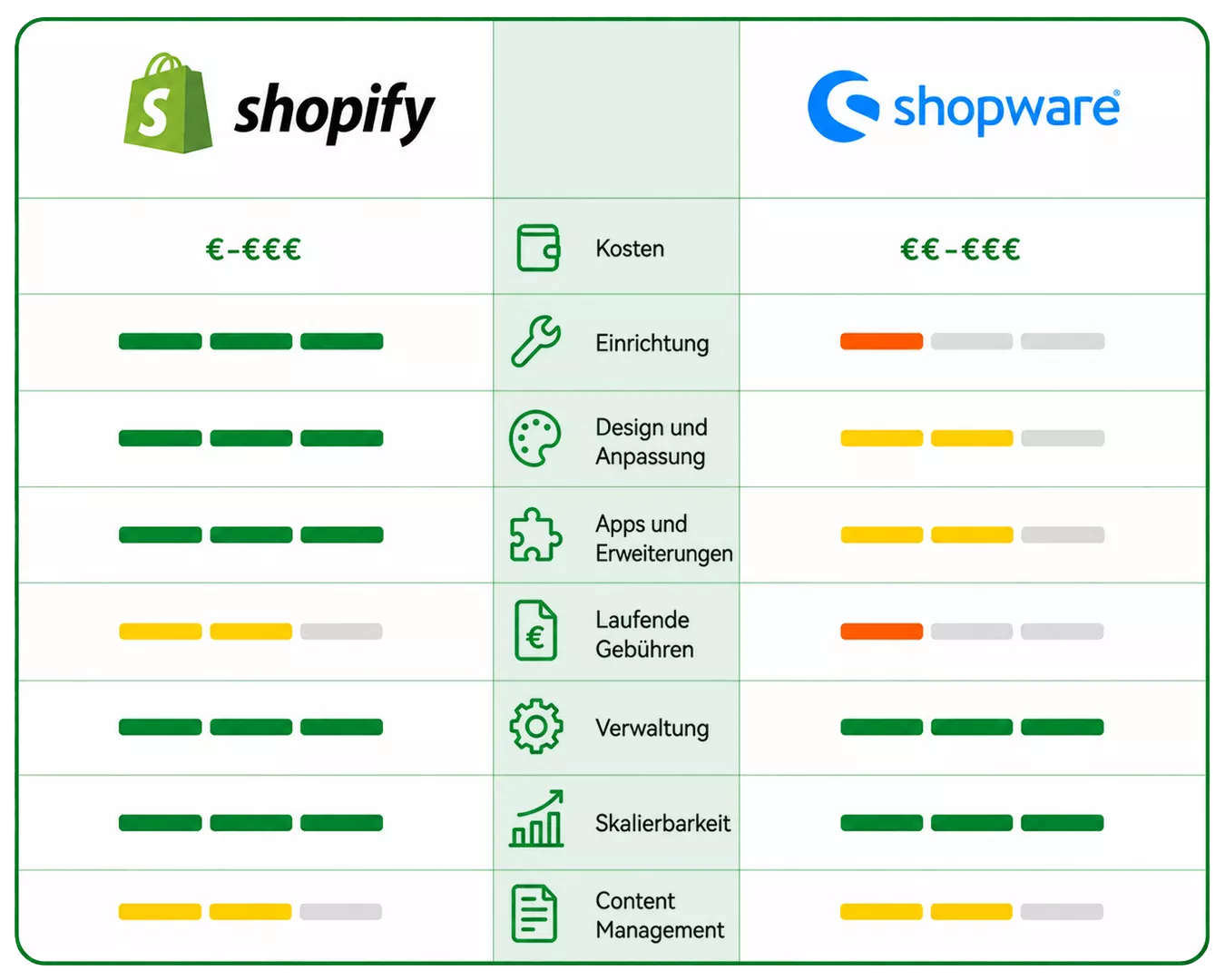
You’re facing a decision: Shopware or Shopify? Both systems have their place in e-commerce, but they follow fundamentally different philosophies. We compare both platforms from practical experience and show you what really matters in the decision. For an overview of more systems, check out our shop system comparison.
- • Shopify is a cloud-based SaaS platform. Hosting, updates, and security are included. You pay monthly and can start immediately.
- • Shopware 6 is an API-first platform with open-source core. You have full control over code and hosting but also carry more responsibility.
- • For entry costs, Shopify leads (from €36 monthly). The Shopware Community Edition is free but requires your own hosting and often agency support.
- • For B2B shops and complex requirements, Shopware is often more flexible. For fast D2C scaling, Shopify is usually more efficient.
Shopify and Shopware: Two Different Philosophies
Before we dive into details, you should understand that Shopify and Shopware follow fundamentally different approaches. Shopify is a fully hosted SaaS solution. You sign up, choose a theme, and can start selling. You don’t have to worry about servers, updates, or security.
Shopware 6 is an API-first platform with open-source core. You can self-host it or use it as PaaS. The big advantage: You have access to the complete source code and can customize every aspect. The disadvantage: This flexibility requires technical know-how or an agency.
In Germany, Shopware traditionally has a strong position in the mid-market and B2B sector. Shopify dominates among D2C brands and international merchants. Both systems have their merits – the question is just: What fits your business?
Cost Comparison: What Do You Really Pay?
The cost question is more complex with Shopware than Shopify because different models exist. Let’s break it down.
Shopify Costs
Shopify works with a clear pricing model. The Basic plan costs about €36 per month with annual billing. This includes hosting, SSL, support, and all core features.
The other plans: The Shopify plan is about €105, the Advanced plan €384 monthly. For enterprise, there’s Shopify Plus starting at about €2,300 per month.
For transaction fees with Shopify Payments on the Basic plan, you pay 2.1 percent plus €0.30 per transaction. If you use another payment provider, there’s an additional platform surcharge of 2 percent.
Shopware Costs
Shopware has a tiered licensing model. The Community Edition is free, but only for shops with up to one million euros in annual revenue.
The commercial plans: Rise costs about €600 per month, Evolve from €2,400, and Beyond (Enterprise) from €6,500 monthly. These prices are GMV-dependent and can increase.
The important difference: Shopware doesn’t charge transaction fees. You only pay your payment provider’s fees. At high revenue levels, this can make a significant difference.
What licensing costs don’t show: With Shopware Self-Hosted, hosting costs are added (€50 to €500 monthly depending on traffic) and usually also agency costs for setup and maintenance.
Cost Comparison in Practice
| Cost Type | Shopify (Basic) | Shopware (Community) |
|---|---|---|
| Monthly license | approx. €36 | €0 |
| Hosting | included | €50 to €200 |
| Transaction fee | 2.1% + €0.30 | payment provider only |
| Typical setup costs | under €5,000 | €10,000 to €50,000 |
| Maintenance/Support | included | Agency or internal |
For total budgets under €30,000, Shopify is almost always cheaper. For complex B2B projects with high revenue, Shopware can be more economical long-term because no transaction fees apply.
Hosting and Operations
This is where one of the biggest differences between both platforms lies.
Shopify is fully hosted. You don’t have to worry about anything. Updates are automatically applied, security is Shopify’s responsibility, and infrastructure scales automatically with your traffic. This is a real plus for teams that want to focus on selling.
Shopware offers various options: You can work self-hosted on your own servers, use a PaaS solution, or book managed hosting with a partner. Each option has pros and cons regarding control, costs, and effort.
The advantage of self-hosted: You have full control over your data and can run servers in your country. For companies with strict compliance requirements, this is often decisive.
Flexibility and Customization
If maximum customization is your main criterion, Shopware has the edge.
Shopware 6 is designed API-first. This means: Every function is accessible via interfaces. You can customize the complete source code, develop your own plugins, and deeply integrate the system into your existing IT landscape. ERP, PIM, CRM – everything can be connected.
Shopify also offers extensive customization options, but within a defined framework. The App Store with over 8,000 apps covers most requirements. For deeper interventions, there are Custom Apps and the Headless option with Hydrogen. But you can’t change the core itself.
This is the classic trade-off: Flexibility vs. simplicity. Shopware gives you full control, but you need the know-how to use it. Shopify takes decisions off your hands but also limits your options.
B2B Features
This is where a clear difference between both platforms shows.
Shopware grew up in the German mid-market and has correspondingly strong B2B features. Customer groups with individual prices, complex discount tiers, B2B customer portals, self-service ordering – all this is natively built into the platform, especially in higher editions.
Shopify offers B2B features in Shopify Plus. You can create B2B customer accounts, maintain customer-specific price lists, and run separate storefronts. For many B2B requirements, this is enough. But if you need very complex pricing logic or deep ERP integration, it can get tight.
Store2x recommends: If B2B makes up more than 50 percent of your revenue and you have complex customer structures, take a closer look at Shopware. For B2B as a supplement to D2C business, Shopify Plus is often sufficient.
Internationalization and Multi-Channel
For international sales, Shopify has clear strengths.
Shopify Markets makes it easy to sell in different countries with local currencies, languages, and payment methods. Integration with Amazon, eBay, Instagram, and TikTok works with just a few clicks. For D2C brands that want to scale internationally, this is a real advantage.
Shopware can do internationalization too, but it requires more configuration. Multi-store setups are possible but more complex. The focus traditionally lies on the DACH market, even though this has changed with Shopware 6.
If your main market is Germany, Austria, and Switzerland and you sell little internationally, this isn’t a disadvantage. But if you want to quickly expand into ten countries, Shopify is the faster path.
Apps and Extensions
The Shopify App Store is huge. Over 8,000 apps for every conceivable use case, from marketing automation to product reviews to advanced shipping options. Installation is simple, most apps work immediately.
The Shopware Store is smaller but more focused. Many plugins are tailored to German requirements, such as interfaces to German ERPs or legal adjustments. Quality is good, selection sometimes limited for special requirements.
An important difference: With Shopware, you can develop your own plugins that are deeply integrated into the system. With Shopify, you’re limited to what the App API allows.
SEO and Performance
Both platforms offer solid SEO fundamentals. Meta titles, descriptions, URL structure – all can be customized.
Shopify has an advantage in performance. The global CDN infrastructure ensures fast loading times worldwide. You don’t have to worry about caching or server optimization.
With Shopware, performance depends on your hosting. With a well-configured server and caching, you achieve excellent values. But this requires know-how or a partner who takes care of it.
Support and Community
Shopify offers 24/7 support via chat, email, and phone. Quality is good, even if complex technical questions sometimes lack depth. For enterprise customers, there are dedicated account managers.
Shopware has support through partners and agencies. Shopware AG itself offers support for commercial editions. In practice, however, most shops work with an agency that handles first-level support.
The Shopware community in Germany is active and helpful. There are regular meetups, conferences, and a vibrant developer scene. If you have technical challenges, you’ll usually find help quickly.
Legal Requirements in Germany
For the German market, both platforms have solutions, but with different effort levels.
Shopify hosts on global infrastructure. For GDPR compliance, you need additional apps like German Market or appropriate configuration. This works but requires attention.
Shopware can be run on German servers. For companies with strict privacy or compliance requirements, this is a clear advantage. Legal notices, terms, and legal texts can be maintained directly in the system.
Expert tip: If data sovereignty is critical for you, such as with sensitive customer data or regulated industries, take a closer look at Shopware Self-Hosted.
When Is Shopify the Better Choice?
Shopify makes sense if you:
- Want to start quickly without worrying about technology and hosting
- Run a D2C business and focus on scaling
- Want to sell internationally and serve multiple channels
- Have a limited budget and prefer predictable monthly costs
- Don’t have your own tech team and want minimal agency dependency
Shopify takes technical complexity off your hands. It costs flexibility but saves time and stress.
When Is Shopware the Better Choice?
Shopware makes sense if you:
- Need maximum control over code, data, and hosting
- Have a complex B2B business with individual prices and processes
- Need deep integration into ERP, PIM, or CRM
- Value data sovereignty and hosting in Germany
- Have budget for agency support and ongoing maintenance
Shopware gives you full control. But that also requires the resources to use that control.
Switching from Shopware to Shopify
Maybe you’re already using Shopware and wondering if a switch to Shopify makes sense. This is a common scenario, especially when maintenance effort increases or Shopware 5 has reached end-of-life.
Migrating from Shopware to Shopify is doable but requires careful planning. Products, categories, and customer data need to be transferred. URL structures change, which leads to SEO losses without proper redirects. Plugins must be replaced by Shopify apps.
With the right concept, you can use the migration as an opportunity. A system change offers the possibility to simplify processes, reduce technical debt, and start fresh with a clean setup.
We at Store2x specialize in exactly these migrations to Shopify. If you’re considering whether a switch makes sense for you, you can request a free potential analysis.
Conclusion
Shopware or Shopify? The answer depends on your focus. If you want to quickly scale a D2C business and value technical simplicity, Shopify is usually the better choice. If you need maximum control, have complex B2B requirements, or hosting in Germany is important, Shopware can be the right platform.
 Frequently Asked Questions