PrestaShop vs Shopify: Direct Comparison 2026
Shopify vs PrestaShop in direct comparison. Open source vs SaaS, costs, features. Find out which platform fits your store.

Richard Roth
SEO & GEO Strategist
June 12, 2026
10 min read
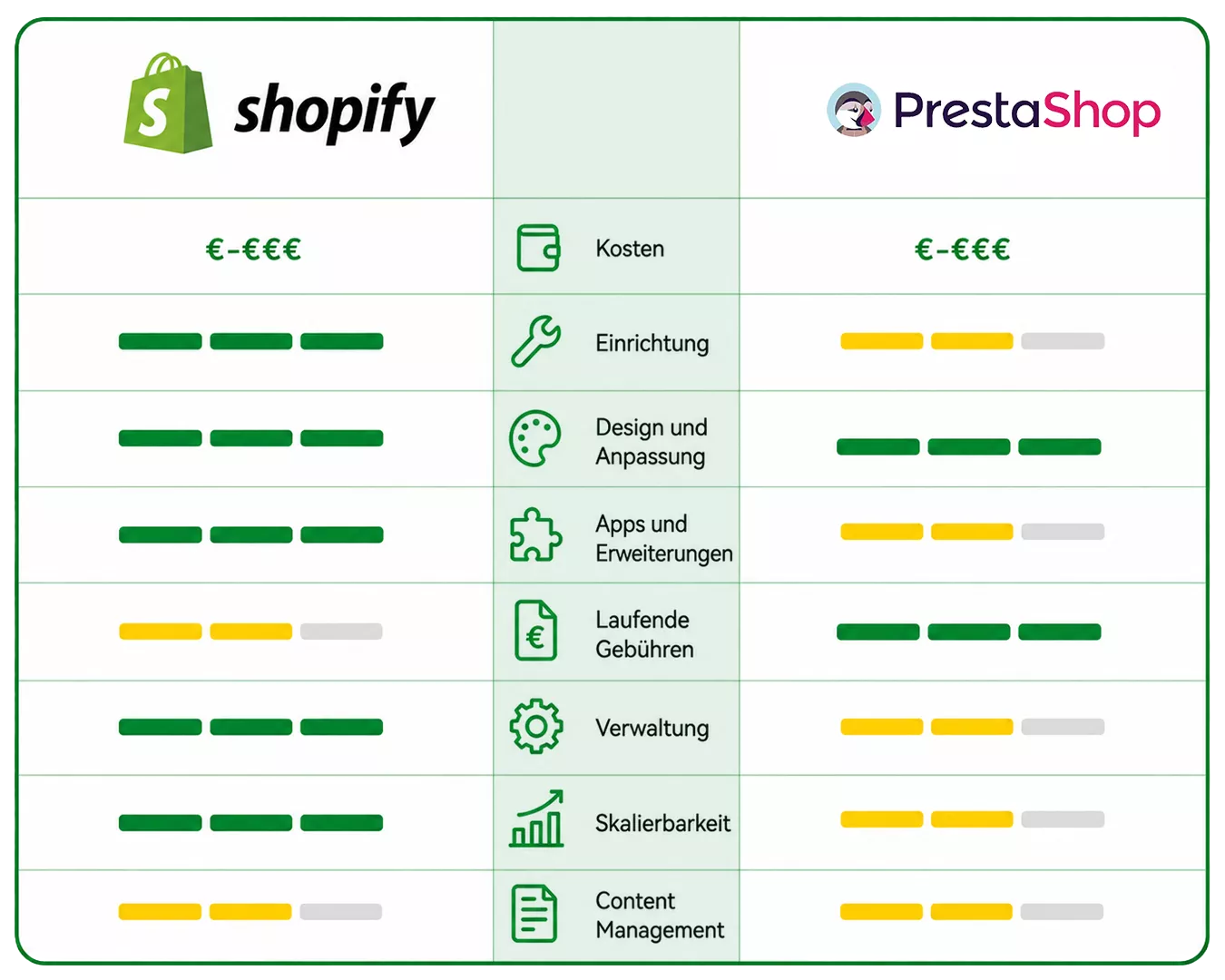
Are you wondering whether PrestaShop or Shopify is the better choice for your store? Both platforms have their merits, but they follow fundamentally different approaches. We compare both systems from practical experience and show you what really matters in the decision. For an overview of more systems, check out our shop system comparison.
- • PrestaShop is an open-source solution. The software is free, but you need your own hosting and bear responsibility for technology and maintenance.
- • Shopify is a SaaS platform with monthly fee. Hosting, updates, and security are included. You can start immediately.
- • For total costs, PrestaShop isn't automatically cheaper. Hosting, modules, and agency costs can add up.
- • For stores with custom requirements and technical know-how, PrestaShop offers more flexibility. For quick start without tech effort, Shopify is more efficient.
PrestaShop and Shopify: Two Different Worlds
The most important difference between PrestaShop and Shopify isn’t a single feature but the architecture model.
PrestaShop is open source. You download the software for free and install it on your own server. You have full access to the PHP source code and can customize every aspect. In return, you bear responsibility for hosting, updates, security, and performance.
Shopify is a complete SaaS solution. You sign up, pay monthly, and can get started. Shopify handles hosting, updates, and security. You don’t have access to core code, but customizations are possible through themes, apps, and APIs.
PrestaShop originally comes from France and has a strong presence in Europe. Shopify dominates worldwide, especially among D2C brands. Both systems have their strengths – the question is just: What fits your business better?
Cost Comparison: What Do You Really Pay?
The cost question with PrestaShop is more complex than it first appears.
PrestaShop Costs
The software itself is free. This sounds tempting, but total costs come together differently.
What you need: Hosting costs between €20 and €200 monthly depending on traffic. Add paid modules for features that are included on other platforms. Many essential features like advanced SEO, certain payment methods, or marketing tools cost extra.
The biggest cost factor is often development and maintenance. If you don’t have technical knowledge, you need an agency for setup, customizations, and ongoing updates. This can quickly cost several thousand euros annually.
The advantage: PrestaShop charges no transaction fees. You only pay your payment provider’s fees.
Shopify Costs
Shopify works with clear monthly fees. The Basic plan costs about €36 per month with annual billing. The Shopify plan is €105, the Advanced plan €384 monthly.
For transaction fees with Shopify Payments on the Basic plan, you pay 2.1 percent plus €0.30 per transaction. With other payment providers, there’s an additional platform surcharge of 2 percent.
Apps cost extra, but many core features are already included. Total costs are more predictable than with PrestaShop.
Cost Comparison in Practice
| Cost Type | PrestaShop | Shopify (Basic) |
|---|---|---|
| Software license | €0 | approx. €36/month |
| Hosting | €20 to €200/month | included |
| Transaction fee | payment provider only | 2.1% + €0.30 |
| Typical setup costs | €5,000 to €30,000 | under €5,000 |
| Maintenance/Updates | Self-responsibility or agency | included |
The free PrestaShop software often becomes more expensive than expected when you add up hosting, modules, and agency costs. For smaller stores, Shopify is usually more economical.
Ease of Use: How Quickly Can You Get Started?
There’s a clear difference between both platforms here.
Shopify is optimized for user-friendliness. The interface is intuitive, products can be created via drag-and-drop, and you don’t need programming skills. From signup to first sale can take just a few hours.
PrestaShop requires more technical understanding. You need to install the software, configure a server, and work with PHP-based architecture. The backend is functional but less intuitive than Shopify. For setup, you need either know-how or an agency.
This isn’t a quality judgment but a trade-off: PrestaShop gives you more control, Shopify takes more work off your hands. What fits better depends on your resources.
Flexibility and Customization
If maximum customization is your main criterion, PrestaShop has the edge.
You have full access to the PHP source code. Every function, every process, every integration can be customized. The module system is powerful, and over 10,000 free and paid add-ons extend functionality. For complex requirements like special B2B logic or deep ERP integration, this is a real advantage.
Shopify also offers extensive customization options, but within defined limits. The App Store with over 8,000 apps covers most requirements. For deeper interventions, there are Custom Apps and the Headless option. But you can’t change the core itself.
The classic trade-off: Flexibility vs. simplicity. PrestaShop gives you full control but demands the know-how to use it.
Internationalization and Multilingualism
PrestaShop was designed multilingual from the start. Over 70 languages are directly available, country-specific tax rules and currencies can be configured in detail. For European shops focusing on various EU countries, this is practical.
Shopify has caught up with Shopify Markets. You can sell in different countries with local currencies, languages, and payment methods. Tax and customs calculation is integrated. For international expansion, Shopify is now well-positioned.
The difference: PrestaShop gives you more control over details, Shopify automates much of it. Both approaches work, depending on how much you want to configure yourself.
Modules and Apps
Both platforms have large ecosystems for extensions.
The PrestaShop Addons Marketplace offers over 10,000 modules. Many are free, others paid. Quality varies, and you must check yourself whether modules are compatible with your version. Updates can cause conflicts.
The Shopify App Store has over 8,000 apps. Installation is easier, most apps work immediately. Shopify vets apps before inclusion, making quality more consistent.
An important difference: With PrestaShop, you can develop your own modules deeply integrated into the system. With Shopify, you’re limited to what the App API allows.
SEO and Performance
PrestaShop offers very granular SEO control. URL structure, meta tags, canonical tags – everything can be fine-tuned. For SEO professionals who want to control every aspect, this is attractive.
Shopify has solid SEO fundamentals, but less detail control. The most important features are there, but some customizations require apps or aren’t possible at all.
For performance, it depends on hosting. Shopify is fast on global CDN infrastructure. PrestaShop can be equally fast with good hosting, but you have to handle caching and optimization yourself.
Hosting and Operations
The biggest operational difference lies in hosting.
With PrestaShop, you’re responsible for server, security, and updates. This means: configuring servers, keeping PHP versions current, applying security patches, creating backups. If you can’t do this yourself, you need a managed hosting provider or an agency.
Shopify takes this completely off your hands. Hosting, SSL, updates, security – everything is included. Infrastructure scales automatically. You don’t have to worry about anything.
The advantage of PrestaShop: You can run servers in Germany and have full data control. For companies with strict compliance requirements, this can be decisive.
Store2x recommends: Don’t underestimate maintenance effort with PrestaShop. Updates can break modules, security gaps require quick response. If you don’t have a tech team, Shopify is often the less stressful choice.
Support and Community
Shopify offers 24/7 support via chat, email, and phone. Quality is good, even if complex technical questions sometimes lack depth.
PrestaShop as an open-source project has no official support for the free version. You rely on community, forums, and paid support. There are paid support packages, but most shops work with agencies.
The PrestaShop community is active, especially in France and Southern Europe. In Germany, Shopify is now more strongly represented.
Legal Requirements in Germany
Both platforms require adjustments for the German market.
With PrestaShop, there are modules for German legal requirements. Legal notices, terms and conditions, cancellation policy, GDPR compliance – all can be set up. Since you control the server yourself, you can easily host data in Germany.
Shopify offers apps like German Market that cover German legal requirements. Data resides on Shopify servers, which is legally fine but may be an issue for some companies.
Expert tip: Have your legal texts checked by a lawyer or specialized service provider regardless of system. Neither PrestaShop modules nor Shopify apps replace legal advice.
When Is PrestaShop the Better Choice?
PrestaShop makes sense if you:
- Need full control over code, hosting, and data
- Have technical know-how or work with an agency
- Have complex requirements that standard SaaS doesn’t cover
- Want to save transaction fees at high revenue
- Value independence from a SaaS platform
PrestaShop gives you maximum freedom. But this freedom also requires resources to use it.
When Is Shopify the Better Choice?
Shopify makes sense if you:
- Want to start quickly without worrying about technology
- Prefer predictable costs and want no surprises
- Don’t have your own tech team and want to minimize agency dependency
- Are focused on scaling and growth
- Value the support of a large platform
Shopify takes technical complexity off your hands. It costs flexibility but saves time and stress.
Switching from PrestaShop to Shopify
Maybe you’re already using PrestaShop and wondering if a switch makes sense. That’s a valid thought, especially when maintenance effort increases or you want to focus on selling rather than technology.
Migrating from PrestaShop to Shopify is doable. Products, categories, and customer data can be transferred. URL structures change, requiring proper redirects. Modules must be replaced by Shopify apps.
With the right concept, you can use the migration as an opportunity. A platform change offers the possibility to reduce technical debt and start fresh with a clean setup.
We at Store2x specialize in exactly these migrations to Shopify. If you’re considering whether a switch makes sense for you, you can request a free potential analysis.
Conclusion
PrestaShop or Shopify? The answer depends on your resources. If you have technical know-how and want maximum control, PrestaShop can be the right choice. If you want to focus on selling and outsource technology, Shopify is usually the more efficient path.
 Frequently Asked Questions