Shopify vs Magento: Comparison for Growing Stores 2026
Shopify or Magento? We compare costs, scalability, and effort. Find out which system fits your store.

Richard Roth
SEO & GEO Strategist
June 12, 2026
9 min read
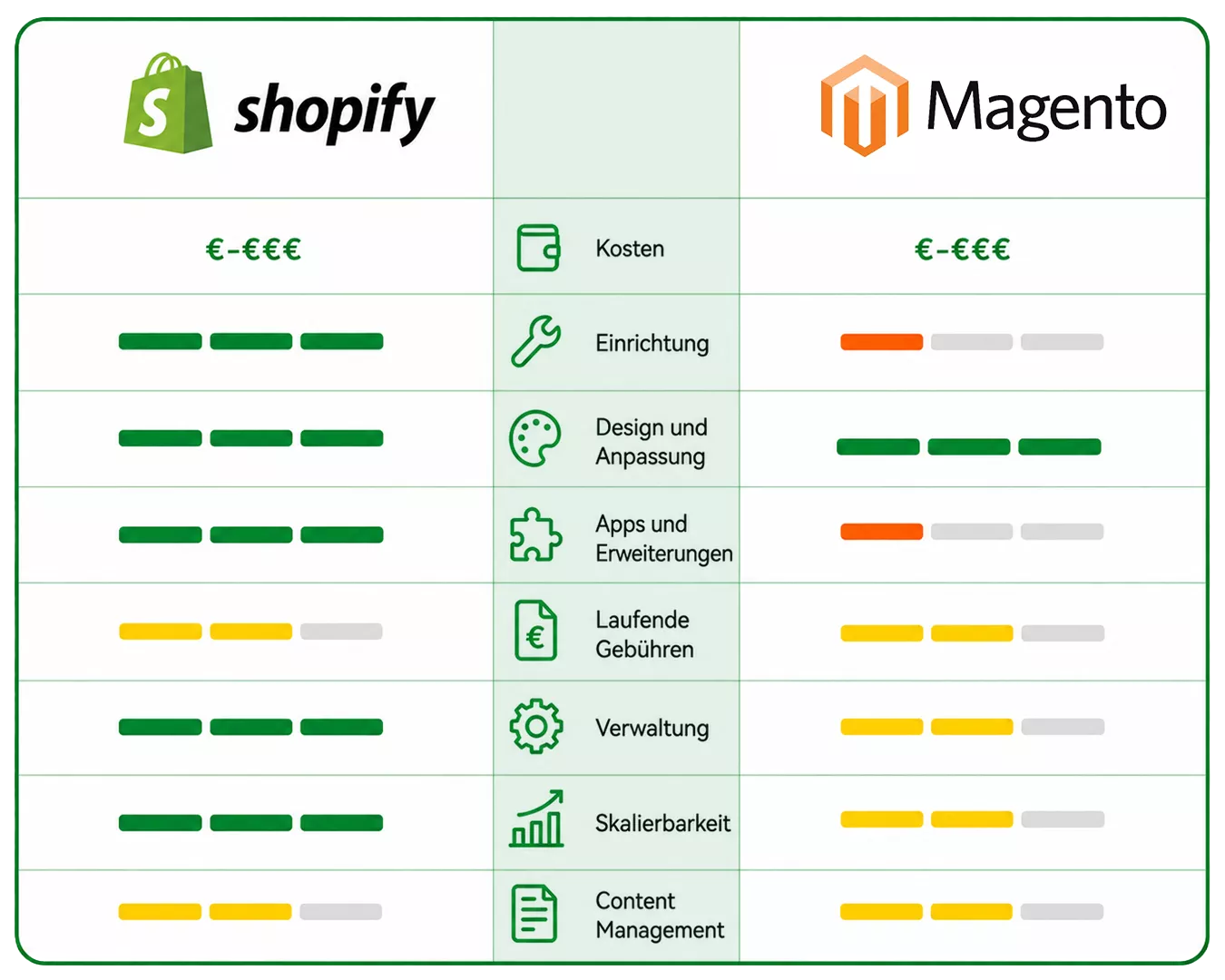
Are you running a successful online store and slowly hitting the limits of your system? Then you’ve probably heard of Magento. Or you’re already using Magento and wondering if the effort is still justified. Both systems play in a different league than website builders. But they couldn’t be more different. For an overview of more systems, check out our shop system comparison.
- • Magento offers maximum flexibility but requires your own development team and high ongoing costs.
- • Shopify scales from small to Enterprise and takes technology, hosting, and security off your hands.
- • The Total Cost of Ownership is often 50 to 70 percent higher with Magento than Shopify.
- • A migration from Magento to Shopify is technically demanding but pays off for most merchants.
Two Systems, Two Philosophies
Magento and Shopify follow fundamentally different approaches. Magento is an open-source platform that you host yourself and fully control. This sounds like freedom at first. In practice, however, it means: You’re responsible for everything. Servers, updates, security patches, performance optimization. This requires either an internal development team or an agency on retainer.
Shopify is a SaaS solution. You rent the infrastructure and get updates, security, and hosting included. This limits you in some places, but it also takes a lot of work off your hands. For most merchants, this is exactly the decisive advantage.
Cost Comparison: Getting Concrete
The costs differ considerably between the two systems. And not just in the obvious license fees.
Magento: Hidden Costs Add Up
Magento Open Source is free. That sounds tempting. But license costs are only a fraction of what you actually pay. For a performant store, you need powerful hosting that quickly reaches €500 to €5,000 monthly. Add developer costs for customizations, updates, and bug fixes.
Adobe Commerce, the Enterprise version of Magento, starts with five-figure annual fees. Exact prices depend on revenue and are negotiated individually. Over three years, you quickly reach €150,000 to €500,000 in total costs with Magento. With larger setups, even more.
Shopify: Predictable Costs
With Shopify, you pay a fixed monthly fee. The Basic plan starts at €36, for growing stores the Shopify plan at €105 per month makes sense. For large merchants, there’s Shopify Plus starting at about €2,300 monthly.
The big difference: Hosting, SSL, updates, and security are included. You don’t need a DevOps team. Over three years, total costs with Shopify are usually between €50,000 and €150,000. That’s often 50 to 70 percent less than comparable Magento setups.
Total Cost of Ownership (TCO) is more important for shop systems than the pure license price. A “free” system can end up being significantly more expensive than a SaaS solution with monthly fees.
Cost Comparison in Practice
| Cost Type | Magento Open Source | Shopify (Plus) |
|---|---|---|
| Software license | €0 | €36 to €2,300+/month |
| Hosting | €500 to €5,000/month | included |
| Transaction fee | payment provider only | 2.1% + €0.30 (Basic) |
| Typical setup costs | €50,000 to €200,000 | €5,000 to €50,000 |
| Maintenance/year | €20,000 to €100,000 | included |
Scalability: Who Keeps Up When You Grow?
Both systems can run large stores. But the path there is very different.
Magento: Scaling Is Manual Work
Magento can theoretically handle any traffic. In practice, however, you have to actively ensure this. Set up load balancers, optimize caching, tune database queries. During traffic spikes like Black Friday, you need someone watching the servers at night. This is doable but ties up resources.
Shopify: Scaling Is Built-In
Shopify hosts all stores on a global infrastructure. During traffic spikes, the platform scales automatically. You don’t have to worry about anything. On Black Friday 2023, Shopify processed sales worth over $9 billion worldwide without notable outages.
For you as a merchant, this means: You can focus on marketing and products instead of managing infrastructure.
Flexibility and Customization
Magento traditionally has the edge here. But the lead is shrinking.
Magento: Maximum Control
With Magento, you have access to the complete source code. You can customize every function, change every database table, build every integration yourself. For very specific requirements, this is a real advantage. For most stores, however, it’s overkill.
The disadvantage: Every customization must be checked and possibly redeveloped during updates. This makes Magento projects often slow and expensive to maintain.
Shopify: Flexible Within the System
Shopify gives you less control over core functions. In return, you get a huge app store with over 8,000 extensions. Most requirements can be covered without custom development.
For individual customizations, Shopify offers the Storefront API and Shopify Functions. You can customize checkout processes, discount logic, and more. With Shopify Plus come additional options like Script Editor and Checkout Extensibility.
Store2x recommends: Before making a decision, check which customizations you really need. Often supposedly indispensable custom features can be replaced by standard apps.
B2B Features Compared
For B2B merchants, both platforms are interesting. But the implementation differs significantly.
Magento B2B
Adobe Commerce includes native B2B features: company accounts, quote requests, customer-specific price lists, approval workflows. This is comprehensive but also complex to set up. The features are deeply integrated into the system, making customizations elaborate.
Shopify B2B
Shopify Plus has offered native B2B features since 2022. You can handle B2B and D2C sales through the same store, with separate price lists and payment terms. Setup is significantly easier than with Magento. For very complex B2B scenarios, however, Shopify may hit limits.
Performance and Loading Times
A slow store costs revenue. This isn’t an exaggeration. Google has proven that every second of additional loading time reduces conversion rate by about 7 percent.
Magento: Performance Is Your Job
Magento can be fast. But you have to actively ensure it. Set up Varnish cache, Redis for sessions, connect CDN, optimize images, clean up code. Without optimization, Magento stores are often sluggish, especially with large catalogs.
Shopify: Performance Is Standard
Shopify stores load in under 2 seconds on average. The platform uses a global CDN and optimizes automatically. You don’t have to worry about server configuration. This is one of the underrated advantages of SaaS.
Security and Updates
Security vulnerabilities in your store can be expensive. Not just through data loss, but also through GDPR fines and reputation damage.
Magento: You’re Responsible
With Magento, you must apply security patches yourself. Adobe regularly releases updates, but installation is on you. Miss a critical update, and your store is vulnerable. Plus: Every custom extension can introduce new security vulnerabilities.
Shopify: Security Included
Shopify is PCI-DSS Level 1 certified. Security updates are applied automatically. You don’t have to do anything. The risk lies with Shopify, not with you.
Expert tip: In a migration from Magento to Shopify, often 80 percent of ongoing maintenance costs disappear. This alone justifies the switch for many merchants.
Migration from Magento to Shopify
A migration isn’t a weekend project. But it’s doable and the right step for many Magento merchants.
What Comes Along?
Product data, categories, customers, and order history can be migrated. With complex product variants and custom attributes, care is needed. The data structure in Shopify is different from Magento; some adjustments are necessary.
What Needs Rethinking?
Custom extensions have no direct equivalent in Shopify. You need to check which features you can replace with apps and which you’ll have redeveloped. This is the most elaborate part of the migration.
Protecting SEO During Migration
URL structures differ between Magento and Shopify. Without proper 301 redirects, you lose rankings. This is technically solvable but must be planned from the start. We’ve accompanied many Magento to Shopify migrations and know what matters.
When Is Magento the Better Choice?
Magento makes sense if you:
- Have an internal development team with Magento experience
- Your requirements are so specific that no standard solution fits
- You’re already deeply invested in the Adobe ecosystem
- Budget for ongoing development and maintenance isn’t a limiting factor
When Is Shopify the Better Choice?
Shopify makes sense if you:
- Want to focus on products and marketing, not technology
- Predictable costs are more important than maximum control
- You want to scale quickly without building infrastructure
- Your team has no developers for store maintenance
The reality is: For the vast majority of merchants, Shopify is the better choice today. Magento only makes sense in very specific enterprise scenarios, and even there Shopify Plus is catching up strongly.
Conclusion
Magento and Shopify serve different needs. Magento offers maximum control but demands corresponding resources. Shopify takes technology off your hands and lets you move faster. For growing merchants who don’t want to invest in a development team, Shopify is almost always the smarter decision.
Are you considering switching from Magento to Shopify? We at Store2x specialize in exactly these migrations to Shopify. In a free initial consultation, we’ll help you make the right decision for your business.
 Frequently Asked Questions